


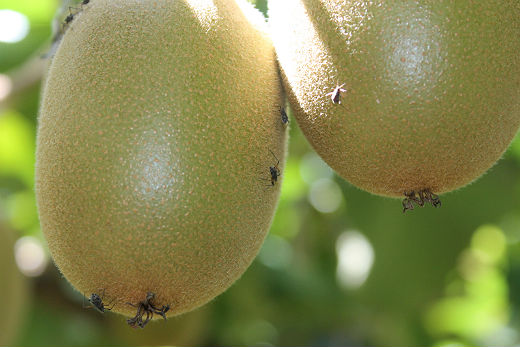
The giant willow aphids which rapidly invaded an Omokoroa kiwifruit orchard in early-February have just as quickly disappeared, but property owner Neil Brough believes they will be back.
Photo: file.
'Within days their numbers decreased significantly and now they are hard to find – but they will be back next season,” says Neil, who found the giant willow aphid, a new insect to New Zealand, climbing over vines, fruit and structures in his orchard on February 10.
Concerned the insect, which excretes honeydew, might cause problems with sooty mould on fruit, Neil contacted Zespri and Kiwifruit Vine Health which have sent staff to visit his orchard.
Since SunLive's February 13 story of Neil's initial discovery of the aphids, the orchardist says he's heard from other kiwifruit growers who've also found the pest.
'It appears it is now very widespread. It is yet another insect we have to control. We did spray it with an organic product, which was all we can use so close to harvest, but I don't think it did much good.”
The rapid disappearance of the insects didn't completely surprise Neil, who'd read up on their life cycle, which involves them returning to their host trees – usually willows or poplars, in autumn where they prepare to over-winter.
The Ministry for Primary Industries, which first became aware of the insect in New Zealand in December last year, says kiwifruit is not currently known to be a host to this species, and the aphid feeding on the vines is not thought to pose a threat to the kiwifruit industry.
'These aphids may be present on vines and vine structures, but this would most likely be transient as they move to other host plants,” an MPI spokesperson told SunLive.
'As its name would suggest, it is associated with willows [and occasionally poplar]. Sooty mould appearing on kiwifruit, due to honeydew contamination from the aphid feeding on adjacent shelterbelts, could potentially occur.”
Neil and his staff first became aware of the insects when they noticed the trunks and stems on the willow shelter turning black with mould. Sooty molds are caused by Ascomycete fungi, which grow on the sugary honeydew secreted by insects such as aphids, scales, and cicada.
Sooty mould on kiwifruit makes it unacceptable for export; and Neil is now watching the gold fruit in his orchard for any signs of the fungus developing.
By the time the Ministry for Primary Industries became aware of the new insect pest giant willow aphids late last year, it was too widespread throughout the country to make eradication feasible, says an MPI spokesperson.
The aphid is now present in Northland, Auckland, Bay of Plenty, Gisborne, Wairoa, Wairarapa, Taranaki, and the Tasman District in the South Island.

0 comments
Leave a Comment
You must be logged in to make a comment.