


Technological advances in infra-red imaging have revolutionised the way we see our world.
During the last 40 years, infra-red imaging has progressed breast health screening from black and white mammography (x-rays), to highly sensitive heat detection called thermography.
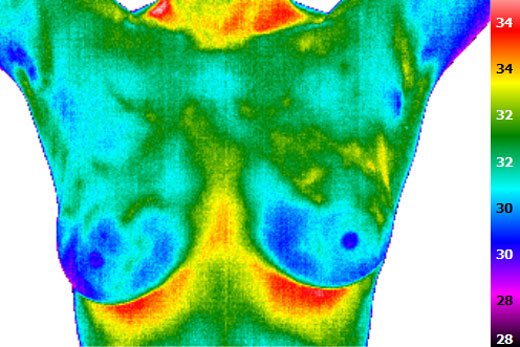
The yellow area in this thermography image shows heat on the left, due to inflammation that was constantly present. This woman also had a lot of pain and discomfort on a daily basis.
Many women prefer the method because it doesn't involve any contact with or radiation to the breasts. It's also the earliest indicator of an unhealthy breast that could precede breast cancer.
Although it is not yet accepted by most radiologists trained in mammography, modern computerised thermography is gaining ground, especially as limitations and risks associated with mammographic screening are increasingly being raised internationally.
Dr Mike Godfrey introduced infra-red thermography to New Zealand in 2002. His clinic is based in Tauranga with trained technicians travelling to different cities now having provided the service to more than 4000 women.
Thermographic examinations involve sitting topless in front of the infra-red camera in an air conditioned room for about 20 minutes. A female technician takes a series of images, before and after a 10-minute period of cooling. Because the breast tissue cools significantly, a ratio of temperature change is established. Areas of heat that don't cool are thermally abnormal. The images are analysed by a trained doctor, who will provide a report with recommendations.
Many people haven't heard about thermography; or unfortunately, have been misinformed. Thermography doesn't detect cancer, neither does mammography. Both reveal abnormalities that indicate the need for further investigation. Thermography is unique in it also provides a picture of the blood vessel pattern, which is specific to each woman – and like a mole map, can be monitored to detect any changes. Unhealthy breasts show heat from inflammation or new blood vessel growth preceding a tumour. An abnormal thermogram allows a woman to make changes in her lifestyle and support her body to create healthy breast function.
Because the breasts in two-thirds of women under 50 have enough density to obscure the existence of any breast cancer (as both cancer and background appear white on x-ray), thermography provides an effective solution for women of all ages.
Thermography has FDA approval as an adjunctive investigation for breast cancer. Mammovision developed by InfraMedic in Germany is EU-certified as a class 1 medical thermography device (CE 0483), and is also registered in New Zealand.

0 comments
Leave a Comment
You must be logged in to make a comment.