


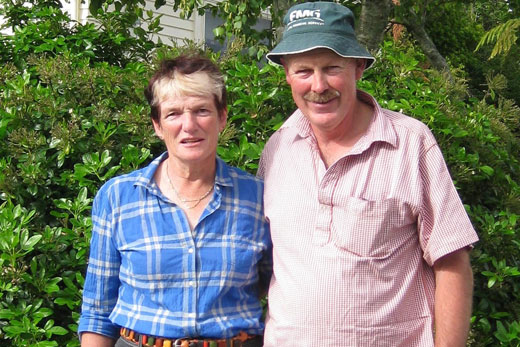
Nineteen years ago effluent from the newly-constructed dairy shed on Sherwood Farm at Kaharoa could, quite legally, be discharged into a stream.
However, owners Heather and Lachlan McKenzie had no intention of doing so.
'Not only wasn't it right for the environment, it would have also meant sending a valuable resource off downstream – and I don't like anything leaving this property without providing a return,” says Lachlan, who jokingly attributes that financial prudence to his Scottish ancestry.
Heather and Lachlan McKenzie believe doing the right thing by the environment makes sound business sense.
At a time when dairy shed effluent was more widely considered a nuisance to be disposed of as quickly and as easily as possible, Lachlan was among a small group of farmers who understood its nutrient value.
Lachlan built effluent holding ponds and today it is spread through a travelling irrigator with a prototype 'irrosafe” device to shut off the pump if the irrigator stops moving. That technology was trialled and developed on-farm with Lachlan's help.
Doing the right thing by the environment is an essential part of the McKenzie farming philosophy. 'We are the first part of a food production business, which provides high quality food to the world. We must do so in the most efficient way possible, and with regard to our natural resources.”
Complex
Farming, says Lachlan, is part of a highly complex biological system which needs to be managed carefully – and when that's done right, it can enhance the natural environment at the same time as enabling an increase in food production.
Sherwood Farm is an example of that. When Heather and Lachlan brought the 390 ha property its free-draining Kaharoa pumice soils had very low organic content and fertility.
'I would dig post holes and find hardly a worm. Now there are several in every spade full.”
The brown-top pastures had runoff problems with significant risk of soil erosion.
Through a carefully considered fertiliser programme, which includes almost fortnightly applications of small amount of Lachlan's 'witches' brew” – fertiliser, and now chicken manure – to no more than one-third of the grazed area at a time, organic content of soils has increased from about two per cent to 10-12 per cent.
'In the last 10 years, clover growth has gone from virtually none to good large-leafed plants being a reasonable percentage of the now rye grass dominant mixed pastures. This has improved water-holding capacity and fertility while reducing runoff and nutrient leaching. '
Sediment traps or detention dams in main ephemeral waterways have been installed to reduce soil loss to water ways.
Fragile
Acutely aware of how fragile the soils are, the McKenzies have changed the land use of the former sheep and beef property to suit its contour, which ranges from rolling to steep incised gullies. Today, 220 ha is farmed, 120 ha is in native bush, and 50 ha of the steeper areas are in forestry. A further 50 ha of mainly grazing land is leased.
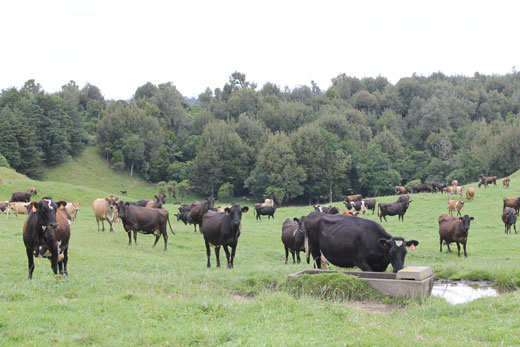
Sherwood Farm's contour ranges from rolling to steep incised gullies.
Although there's less land in pasture, average dry matter production has gone from approximately 6 t/ha to 12 t/ha.
Two years after purchase, Lachlan, with the help of two others, built the dairy which today milks 650 cows once-a-day.
Last season, despite the summer dry, those cows produced 203,000 kg/ms and the figure for the more climatically favourable 2012 season was 230,000 kg/ms.
The transition to once-a-day milking should be complete this season. It's a move Lachlan believes will reduce stress all round, on animals, staff and infrastructure.
The dairy herd has not been drenched for worms nor treated for lice for decades.
Vision
'Last year the farm got a certificate from Fonterra for being in the top 25 per cent for somatic cell count and that is from a once-a-day milking herd,” says Lachlan.
'Antibiotics are used, but if an animal has more than two treatments then it is culled. Last season, 89 per cent cows got in calf in six weeks with an overall empty rate of 3.4 per cent.”
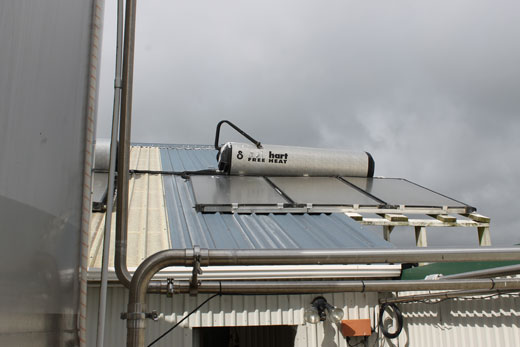
Solar panels on the dairy roof boost the heat of wash-down water.
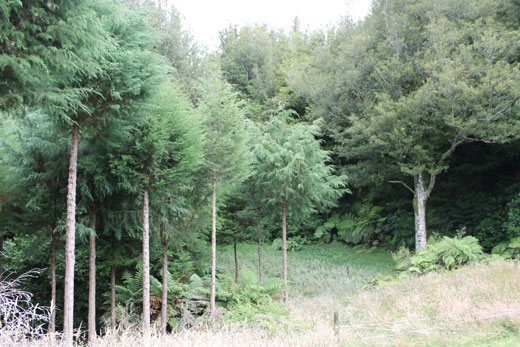
On the more marginal areas of Sherwood Farm, 50 ha of pine and Cupressus lusitanica have been planted.

0 comments
Leave a Comment
You must be logged in to make a comment.