


Retiring some former grazing land at Pukekauri Farms has increased dry matter production on the remaining pasture by two tonne per hectare.
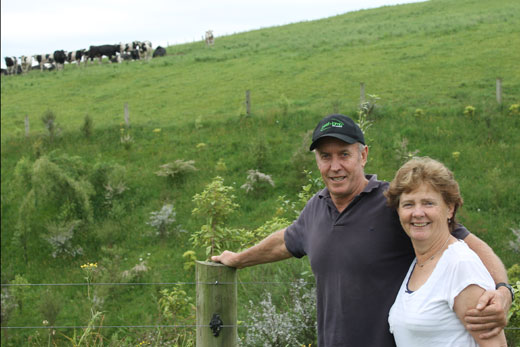
Rick Burke and Jan Loney.
While it may seem counter-intuitive, Rick Burke says fencing out and protecting marginal parts of the 350 ha property in Lund Rd near Katikati has improved the overall performance of the farm and added another $40,000 per 100 ha to the bottom line each year.
'The areas we have retired were among the hardest to manage. They grew the most weeds, were erosion prone and needed more fertiliser. By taking them out of grazing we've removed those costs and both the farm and the environment has benefitted.
'We are now getting better production, increased fertility, better rotational grazing systems and not wasting fertiliser.”
Rick's advice to farmers is not to underestimate the other benefits gained from planting trees and shrubs and protecting sensitive areas. 'It adds value to a farm in terms of the vista and the capital value. Bird life also increases. We now have tui, fantail and pigeon around the house and flocks of kaka.”
Pukekauri certainly has a very attractive vista, with well maintained, healthy pasture and stock, lots of trees and native shrubs, all set against the backdrop of the Kaimai Ranges with extensive views to the coast.
Plantings
Today 110 ha of the farm is in covenanted mature native bush, wetlands and riparian planting and 28 ha is in plantation pines, redwoods and Cyprus lucitanica. The balance is 212 effective grazing land with shelter trees in exposed paddocks.
Rick admits he didn't always see the value of retiring marginal grazing land and planting riparian areas, but the late Derry Seddon, changed his views.
'My father-in-law Derry has played an important role and worked closely with us on the farm Land and Environment Plan. Unfortunately, Derry passed away September 2012. He made an enormous contribution over 17 years to our current environmental achievements.”
Pukekauri is made up of 250 ha owned by the Seddon Family Trust, a 50 ha joint venture between the Seddon Family Trust and Rick Burke, plus a further 50ha owned by Rick. The accumulated properties are farmed by Rick and partner Jan Loney as one unit to provide an economic and sustainable block.
The improved performance of Pukekauri pasture is also due in no small part of smart grazing management and a carefully considered fertiliser regime.
'One of the real positive things we have done is engage Brian Thomas from Nutrilink to advise us on our fertiliser policy and nutrient management programme. He has given us real confidence in our fertiliser spending and his experience has been invaluable in discussing a whole range of farm policies. Our base fertiliser is RPR which we have used for 18 years,” says Rick.
Suffolk sheep
The farm carried 420 ewes last year but this is to be reduced to 250 high performance ewes with the aim of developing an eczema resistant Suffolk sheep flock.
Each season 100 kg bull calves are grazed for one winter to target weights of 500kg-550 kg for processing. Light, 12 month old bulls are carried through spring and early summer, then sold on to two-year bull finishers. The farm carries around 220 bulls, including 20 jersey bulls, in total.
Dairy grazers arrive as weaner heifers then return to their dairy farms in calf. The farm also grazes rising one year heifers from May to May and winters rising two year old dairy heifers and cows. In total the farm carries 414 rising one and two-year-old heifers and mixed aged cows.
The land in Lund Rd is easy and gently rolling to steep and three main streams run through it. Since 1995 and with the encouragement and advice from Laurie Donald, formerly of Environment Bay of Plenty, these water ways have been progressively fenced out and planted in natives.
Protecting and planting streams has reduced flooding and erosion. 'The farm's soil is predominantly Waihi Ash. Erosion has been a problem in extreme weather events in the past. Riparian and wetland protection has had a huge impact on reducing silt runoff and damage to farm infrastructure.”
However, planting takes time, money and attention. Weeds in the early stages can be an issue and pest plants and animals also have to be kept under control.
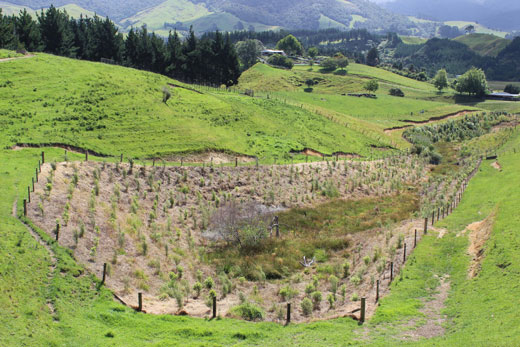
Fencing out and planting erosion-prone or difficult areas continues at Pukekauri Farms.
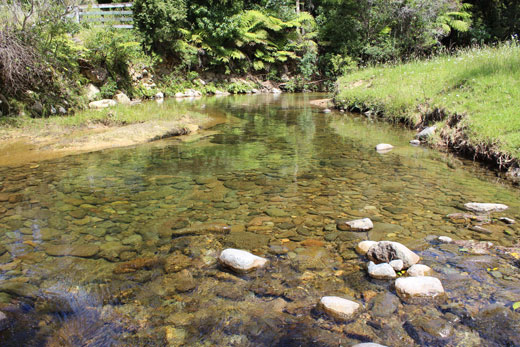
Three main streams run through Pukekauri Farms and since 1995 they have been progressively fenced out and planted.

0 comments
Leave a Comment
You must be logged in to make a comment.