


Physical evidence of wide-scale Maori activity is being unearthed at the Summerset By The Sea retirement development in Katikati as an archaeological dig of the site progresses this week.
As part of development conditions, a Waihi Beach archaeologist has been searching the site during the last two weeks to record and document any signs of archaeological or pre-historic occupation or land-use.
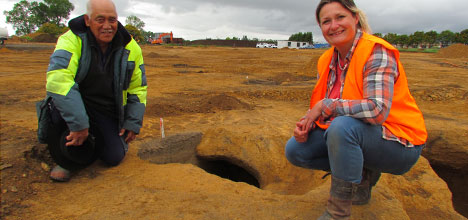
Mishmish Heritage managing director and archaeologist Brigid Gallagher and Katikati kaumatua Paeahi Wanakore at Summerset's archaeological dig.
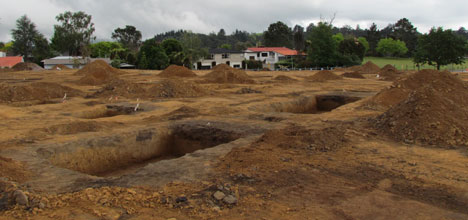
Mishmish Heritage managing director and archaeologist Brigid Gallagher and her colleagues have found many archaeological features, some potentially 500 years old, relating to food-cultivating activity by Maori – undertaken on a large scale at multiple points in time.
'What we're finding is a lot of features pertaining to gardening, storage of kumara, perhaps potatoes.
'It's kind of a similar scenario to what we see around the Bay of Plenty in that you've got a settlement previously found around the coastal edge; step back and you've got features relating to gardening and cultivation,” says Brigid.
'It's really nice to see in Katikati, because this area – although there's been odd archaeological sites pinpointed – is demonstrating in a very visual inconclusive way there was lots going on here, which no-one in this area generally accepts or considers when thinking about development of the landscape.”
Summerset By The Sea site and contracts manager Carsten Nopper says this shows Summerset as part of a different picture, about private developers.
'Archaeology has the big unknown of what is actually in the ground and you only find out when you open it up.
'Nevertheless, from the word go, it was Summerset's intention to work and comply within the requirements of the Historic Places Trust; and we are committed to continue this path.”
Katikati kaumatua Paeahi Wanakore, who was at the site's foreshore archaeological clearance about five years ago, is happy with the findings.
'Europeans have been saying we didn't live here – we're saying to them we did live here because old people told us we did live here,” says Pae.
'But nothing was written, it was all handed down by mouth – and this is evidence. This is what it is – physical evidence.”
Pae says it would not have just been ancestors of his own iwi who enjoyed this coastline site.
'Maori were very transient people, they moved round the coast where the food was – the last 100 years I would say would have probably been this iwi here now. But before that – well it could have been anybody.”
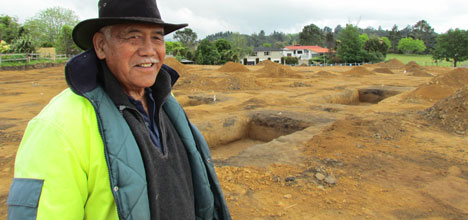
Katikati kaumatua Paeahi Wanakore at Summerset's archaeological dig.
Brigid says as part of Summerset's development an archaeological assessment of the land is required.
'[It's] searching what is the potential there'll be archaeological remains still remaining here; then we conduct investigations or record the archaeology prior to any building taking place.”
The development's foreshore area was cleared (by an archaeologist) about five years ago.
'They encountered two, interpreted settlement or housing living areas – ranging through to the early historic period,” say Brigid.
'It looked like Maori living here but it was after European arrival, because the artefacts, such as pottery and glass and these sorts of things, only came when Europeans arrived.”
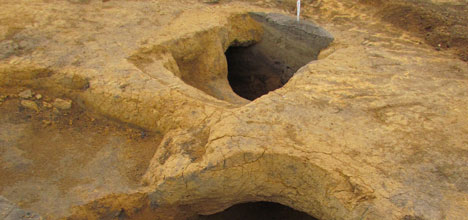
But this time, Brigid says her team has uncovered strong physical evidence, by way of food storage pits, shell middens and rua (underground kumara storage pits), that a long period of settlement by Maori happened at this area.
'What we have is this long period of settlement across this landscape – we haven't got any returns on the dates yet – but it could anywhere from 500 years ago, with occupation coming and going across the landscape, up until the present day.
'This is the last chance to record these findings – because once the land is developed, it is gone.”
Brigid says the block has nine archaeological sites previously recorded, with only one in the first development area.
'The rua have a very small entrance; then it balloons out into an underground cavern; in here you see the first stage of refrigeration, creating a space cool and dark, supporting long-term storage of root vegetables.”
Brigid says, crucially, the site work involves checking samples from the pits, 'seeing if we can get dateable evidence, whether it be from charcoal or use shell features – so if we can get dates about these clusters of features, it's then whether we can say things about differences in time period of when they [Maori] went and came back.
'They could have been one year between movement or 50 or 100 years – if we could determine that – that would be very interesting.”
Carsen says Summerset By The Sea is still on target for delivery dates for its main building; with building commencing soon.
The Historic Places Act 1993 defines an archaeological site as a place associated with pre-1900 human activity, including shipwrecks, where there may be evidence relating to the history of New Zealand that can be investigated using archaeological methods.

2 comments
500 year old sites!!!
Posted on 06-11-2013 17:57 | By Ross01
Maori or Maoriori?
Maori not Moriori, Ross01
Posted on 07-11-2013 11:15 | By Peter Dey
The only Polynesians who lived in New Zealand were Maori. There was no other race of people living in New Zealand before Maori arrived. People who think that Moriori lived here before Maori arrived are ignorant. They should read some up to date history.
Leave a Comment
You must be logged in to make a comment.