


Divers are scouring Pilot Bay waters for any further sightings of the unwanted aquatic pest Mediterranean fanworm.
Last week a team of divers from Bay of Plenty Regional Council, University of Waikato and National Institute of Water and Atmospheric Research started searching Pilot Bay for the pest known to attach itself to boats.
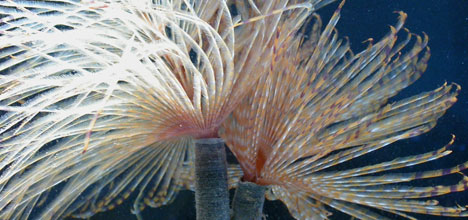
Mediterranean fanworm (Sabella spallanzanii) in Lyttleton Harbour. Photo: G.Read.
The search was initiated after a single specimen of the invasive marine animal was located on a rock near Pilot Bay boat ramp by a University of Waikato diver on September 13.
Council's Natural Resource Operations general manager, Warwick Murray, says about one quarter of the search area has been covered so far and no further fanworms have been located.
'The dive survey will give the council a clearer picture of the scale of the problem and the management options,” says Warwick.
'So far we only know of one individual. By thoroughly searching Pilot Bay and other high risk areas, we'll find out how numerous and widespread they might be.”
Divers are methodically searching the highest risk areas of the Tauranga Harbour and visually checking Pilot Bay from the shoreline to the channel edge, including mooring blocks, hulls of moored vessels, and the reef out to the Tangaroa statue at Stoney Point.
High risk sites in the marinas, wharves and port area of the south-eastern end of the harbour are also being checked.
Warwick says the 5cm long fanworm discovered in Pilot Bay is likely to have spread from the infested hull of a visiting vessel.
'We need boat owners to be vigilant by keeping their anti-fouling paint in good order, and ensuring their hull is clean before they travel to a new region.”
The tube-dwelling Mediterranean fanworm grows up to 40cm in length and is always anchored to a hard surface, and topped with a single spiral fan or radiole. It grows in clumps, forming dense mats that take light and nutrients from native plants.
According to the Ministry of Primary Industries fanworm, although not yet recorded to have had significant impacts on fisheries or aquaculture, have potential to become a nuisance to recreational and commercial fishers through the clogging of dredges and fouling of other fishing gear.
Along with Auckland Harbour, Mediterranean fanworm is also found in Lyttleton and Whangarei Harbours, and was discovered on two barges in Coromandel Harbour earlier this year.
The initial dive survey is expected be completed this month, subject to favourable weather conditions and water clarity.
For more on the Mediterranean fanworm, visit www.mpi.govt.nz or read the factsheet.

0 comments
Leave a Comment
You must be logged in to make a comment.