


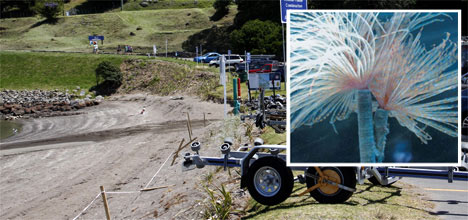
Authorities are investigating an unwanted aquatic pest discovered by a University of Waikato diver in Pilot Bay.
In an email sent out to Tauranga Harbour recreation users yesterday, Bay of Plenty Regional Council says a single specimen of the Mediterranean fanworm was located on a rock near Pilot Bay boat ramp on September 13.
The Mediterranean Fanworm has been discovered in Pilot Bay.
According to council this is the first time the species has been detected in the Bay of Plenty. It is also present in Lyttleton, Whangarei and Auckland Harbours and is sufficiently well established for the Ministry of Primary Industries to determine it cannot now be eradicated from New Zealand waters.
Council's Tauranga Harbour programme coordinator Bruce Gardner says MPI has confirmed the specimen is a fanworm.
The fanworm takes the shape of a tube which is always anchored to a hard surface, and topped with a single spiral fan or radiole. It grow in clumps, forming dense mats that take light and nutrients from native plants.
According to MPI fanworm, although not yet recorded to have had significant impacts on fisheries or aquaculture, have potential to become a nuisance to recreational and commercial fishers through the clogging of dredges and fouling of other fishing gear.
'Last year's extensive MPI survey of Tauranga Harbour found no evidence of Mediterranean fanworm. This is a recent find and we hope a very limited incursion,” says Bruce.
'We will do everything possible to establish the extent of the incursion, prevent any further incursion and manage whatever spread of the pest has taken place.”
Warwick Murray, General Manager Natural Resource Operations, says its extremely disappointing that this unwanted organism has appeared in Bay of Plenty waters.
'It's most likely the organism was brought here on the hull of a boat. Boat owners must remember to regularly clean their boat hull, keep their anti-fouling paint in good order, and ensure the hull is clean before they travel to a new region.”
MPI and the University of Waikato they are developing a delimiting survey for the harbour to take place next week, in an effort to reduce its risk.
Mediterranean Fanworm species typically found in estuaries or sheltered sites at depths of anywhere between one to 30 metres.
The tube is tough and flexible and often muddy in appearance. It can often have other organisms growing on the surface. They can grow up to 40cm tall and the fans are white, banded with brown and orange, and the central stem is orange.
As part of steps taken to prevent the spreading of the aquatic pest, messages about the overwhelming importance of clean and pest-free boat hulls will distributed, says Bruce.

1 comment
Wake up
Posted on 26-09-2013 13:18 | By Poseidon
Wake up Mr Murray its more than likely the fan worm arrived on or in a ship or hadn't you noticed the ships arriving here from all points of the compass. Most unlikely the worm arrived on a boat. Now you know its here what are you going to do about it??
Leave a Comment
You must be logged in to make a comment.