


A kiwifruit grower has labelled the chemical, hydrogen cyanamide, better known by brand names like Hi-Cane, Breaker and Cyan as the ‘P of the industry'.
At a meeting, named Hui on Hi-Cane, in Te Puna last night, August 6, about 50 people scrutinised use of the chemical and health problems they believed it was creating. The crowd included spraying contractors, growers, concerned members of the public and a film crew from the 20/20 television programme.
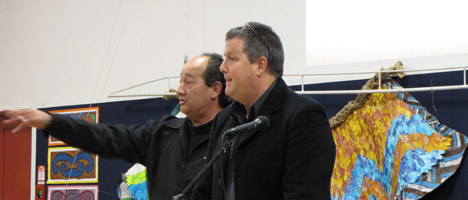
Tommy Kapai Wilson taking questions from the audience for Environment Bay of Plenty's Mike Cauldwell.
The meeting was called after increasing concerns about unexplained health issues in the community and the poisoning a few days ago of Te Puna resident and author Tommy ‘Kapai' Wilson, who also facilitated the meeting.
Following a presentation that informed the audience with some facts about hydrogen cyanamide, Te Puna health organisation, Pirirakau Hauora, told how it has a huge spike each year in asthma attacks in the months following hydrogen cyanamide application.
One Te Puna woman said her two sons, aged 21 and 23, are both undergoing treatment for unrelated cancers and that while visiting them in Waikato Hospital she met two other families from the Western Bay of Plenty, who each had two of their children undergoing treatment for unrelated cancers.
'None of these families had any history of cancers,” she said.
'Although I can't say for sure that Hicane caused them, I can't be sure that it didn't.”
While representatives of the Hauora conceded other factors could impact their asthma figures; given the high use of sprays in the area they were inclined to believe they might be playing a part.
A former committee member from the Te Puna School said a principal at the school had kept records for five years of spikes in difficult behaviour by pupils.
'There were always difficulties in controlling children in the months following Hicane application.”
John Godwin of Healing World in Tauranga told the meeting he sees a high number of cases of what he believes to be poisoning by orchard sprays in his business.
Organic kiwifruit grower Ross Hart described hydrogen cyanamide as the ‘P' of the industry.
'The vines and the orchardist become dependent on it.” But Ross was quick to remind the meeting that the growers are not breaking the law by using hydrogen cyanamide. 'However, 45 per cent of orchard owners are absentee owners and it is possible many don't know what is going on at their orchards.”
Mike Cauldwell from Environment Bay of Plenty explained that even if an orchardist was absent from his orchard; under the doctrine of vicarious liability he would still be liable for the actions of his contractors.
Facilitator Tommy Wilson wound up the meeting by calling for recommendations to take the issue further.
In addition to the call for another compliance officer and a study on health effects in the area, the meeting also asked that the regional council take complaints about spray drift more seriously. They are calling for orchardists and spraying contractors to be more pro-active in advising neighbours before they begin spraying.

0 comments
Leave a Comment
You must be logged in to make a comment.