


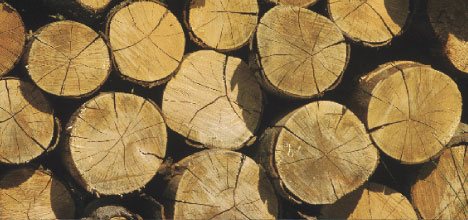
Timber may again be the economic and employment life blood of Kawerau, if an analysis of wood processing opportunities
in the town proves positive.
The town's economic development group called ISKawerau has commissioned Rotorua Crown Research Institute Scion to prepare a report on the future prospects for the industry this month.
The analysis will look at the benefits of wood processing in Kawerau, where delivered log costs are expected to be lower than many New Zealand locations, and if energy costs can be reduced by the use of geothermal heat.
It will also assess the impact of clustering complementary technologies compared to stand-alone operations.
Kawerau was established in 1953 as a mill town for the then new Tasman pulp and paper mill. Today the mill is owned by Norske Skog which earlier this year announced the redundancy of 100 staff and the closure of one of its paper machines.
In addition to investment metrics, such as return on capital employed and other economic indicators, the study will measure the effect increased wood processing will have on both employment within the district and the gross domestic product of the local economy.
'This is an important study for Kawerau and the Eastern Bay of Plenty because it will provide quantifiable information to support investment propositions for industrial development in the district,” says Su Cammell, project manager of the Industrial Symbiosis project. 'The recent release of the WoodScape study, which was developed to evaluate potential opportunities for investment in traditional and emerging wood processing opportunities, has been the catalyst for this analysis.”
The initial WoodScape study looked at five wood supply regions to understand the different wood processing options in these regions; and took a financial modelling and market review approach in assessing the potential of a range of traditional and emerging technologies. This base data will be layered with Kawerau specific information to provide comparisons between Kawerau and other operational centres and regions.
Dr Michael Jack, Scion's science leader for clean technologies and co-author of the original WoodScape Study, described the Kawerau project as a practical extension to the initial work. 'The Woodscape model is a valuable tool for investors because they can use it to identify investment and employment opportunities that are region or site specific.”
The New Zealand Government's growth strategy targets a rise in exports from 30 to 40 per cent of GDP by 2025. In today's terms this means an increase of $20billion. Enabling growth in the wood processing industry will play a substantial role in meeting these targets. The WoodScape results show that the Central North Island has, by far, the biggest forest resource of any region in New Zealand, and due to its ability to support large scale wood processing facilities, has the potential to make a significant contribution.
ISKawerau's aim to reduce unemployment in the district to below the national average, through increased investment in the sector, is something Mayor Malcolm Campbell welcomes.
'Kawerau's Potential is largely untapped. This study will highlight our resources and infrastructure and our ability to service industrial growth.
'Higher levels of employment due to increased development will have a positive impact on both Kawerau and the wider Eastern Bay.”
Toi EDA, the Eastern Bay of Plenty's Economic Development Agency, supports the analysis.
'This is an important step in the development of the wood processing industry,” says chairperson Tony De Farias. 'The study will provide potential investors in the wood processing space with clear information on the benefits of establishing their operation in this region.”

0 comments
Leave a Comment
You must be logged in to make a comment.