


Few would make the link between animal blood and plastics but a team of researchers at the University of Waikato, led by chemical engineer Johan Verbeek, have – and with great success.
'Blood is high in protein and protein is a naturally occurring polymer which can be used to create plastic,” says Johan.
Plastic is formed from a polymer which is a molecule of repeating structural units. Proteins that are essential for life, such as blood, are also polymers – and could therefore potentially be turned into a plastic.
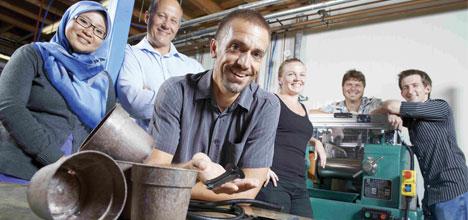
Waikato University chemical engineer Dr Johan Verbeek and Aduro Biopolymers CEO Darren Harpur with Novatein products made from blood meal.
It took about six years of research and development to successfully and consistently produce plastic from blood meal and other additives. Now that process is about to become a commercial reality, and has some big business backing both here and in Australia.
The university has established a company called Aduro Biopolymers to market Novatein –the trademarked product Johan and the team have developed – and to find investors to help commercialise it. Aduro Biopolymers CEO Darren Harpur says Wallace Corporation Limited has taken up a 45 per cent stake in the company, with the balance being owned by WaikatoLink, the University of Waikato's technology transfer organisation.
Australia
Meat & Livestock Australia – a producer-owned firm involved in marketing, research and development services for cattle, sheep and goat farmers – has also formed a partnership with Aduro Biopolymers; and a Novatein product for the Australian market is currently being developed. Plans are in place to establish a manufacturing facility in Australia and have a product ready for market by 2016 or 2017. Darren will not say what the product is but – under the agreement Aduro – will have the right to market it in countries other than Australia.
And the intellectual property rights to Novatein will remain with Aduro Biopolymers. Eventually those responsible for its discovery and development will receive a share of any profits made from Novatein. Johan says Novatein is a way of adding value to what is currently a by-product of abattoirs, to create biodegradable plastics in a sustainable manner. Products made from Novatein rapidly absorb water and break down in the environment or compost situations relatively quickly. The rate of breakdown can be controlled by altering the Novatein formulation.
Novatein is essentially blood meal processed into granules, (similar to those made from petro-chemicals), and is suitable for using in conventional plastic manufacturing plants to produce a range of plastics products.
'The blood meal raw material is a by-product of animal rendering and very similar to the dry blood and bone fertiliser used by home gardeners,” says Darren.
'We understand researchers overseas have also been working on similar products but because of the potential risk of transmitting BSE (mad cow disease), the processes they have to go through are more complicated than in New Zealand where the disease doesn't exist,” says Darren.
Bioplastic
In its dry state, the raw material poses no more risk to those working with it than for anyone applying fertiliser to their garden.
Novatein can be re-formulated, modified and optimised to suit a particular product's attributes. Pots, pegs and weed matting have different characteristics and properties, so a bioplastic formulation would be different for each one. Researchers have also modified the colour of blood meal so the resulting bioplastic has a translucent honey-coloured appearance.
While it will not be used to make products such as plastic cutlery or packaging for foods, Novatein is ideal for plant pots, trays, clips for horticulture, weed mat pegs and temporary plastic capping on building sites where the biodegradable nature of the plastic is an advantage. It can also be used in conjunction with conventional plastics to reduce the content of that non-renewable resource.
One example of its potential use would be to make pots for plants such as tomatoes which could then be planted in the ground, or larger pots, without removing the original container, which would break down in the soil.
Darren says finding manufacturers keen to use the product was a challenge, as plastic made from blood does not have immediate appeal. That hurdle is being over-come, especially with the interest from Australia. What does appeal is that Novatein can be produced more cheaply than bioplastics made from plant material; and its price is competitive with plastics made from petrochemicals.
Cost effective
Bioplastic products are generally expensive because their production tends to involve energy intensive and complex science, which means significant investment is required in research and development and manufacturing facilities.
'The manufacturing process for Novatein is quite simple. This means the capital costs required to commence manufacture will be relatively low and should enable the cost effective production of Novatein,” says Darren. Before going out into the market place to sell the product, Aduro had to establish if Novatein granules would work in conventional plastic extrusion machines; and if they could produce a variety of shapes. 'We asked plastics manufacturers if we could conduct some trials on their machines, and those proved successful.” Aduro won't manufacture plastic products but instead sell Novatein to manufacturers – and the list of possibilities for its use is growing all the time.
Darren says it's been exciting to be involved in the project which began as ‘blue skies' research with no definite commercial outcome in mind. The results, he says, prove both the value of such research, and the challenges of making money from it. To find out more go to: www.adurobiopolymers.com

0 comments
Leave a Comment
You must be logged in to make a comment.