


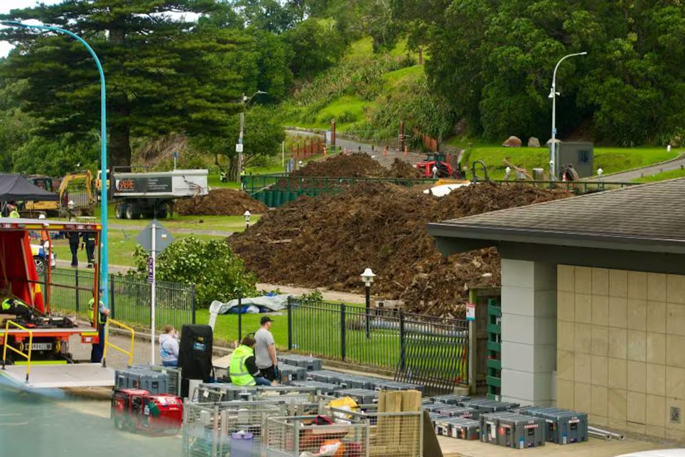
An external review commissioned by Tauranga City Council into its own actions before the Mauao tragedy may find there was nothing it could have done to change what happened, Mayor Mahé Drysdale says.
Six people died after a section of Mauao hillside collapsed, sending a landslide into two council-owned establishments, Mount Maunganui Beachside Holiday Park and Mount Hot Pools, about 9.30am on January 22.
The landslide followed a record 24 hours of rain and earlier slips on the mountain.
The council has faced scrutiny over why the facilities were not evacuated, as well as other aspects of its role in the management of the iwi-owned maunga, which had a documented risk of slips.
In an emergency meeting on Monday, the council voted to appoint an external person to lead an organisational review of the council’s systems, processes and decision-making leading up to the landslide.
Drysdale was authorised to appoint the reviewer and approve the terms of reference.
The external option was chosen over a rapid internal review by a senior council staff member, or doing nothing – effectively leaving any probe to the Crown and/or its agencies.
Councillors spoke of the need for a transparent process that delivered quick answers while addressing its inherent conflict of interest as the operator of the campground.
“The last thing we want is to see another event of this magnitude that could have been prevented,” Drysdale said.
“That’s not to say that there is going to be anything, it may be that this is a natural disaster and there wasn’t any action that we could have taken in those moments to change things.”
 Tauranga Mayor Mahé Drysdale in Monday morning's emergency council meeting to discuss how the review of the Mauao incident would be approached. Photo / Jo Jones
The council also voted to “strongly support” an independent Crown inquiry and any other investigation by Crown agencies into the tragedy.
Council chief executive Marty Grenfell was instructed to provide all requested information to the reviewer and any other inquiries.
The meeting, the first of the year, heard the councillors had already been discussing draft terms for the review in what Drysdale described to Local Democracy Reporting as their regular informal “catch-ups” to “give staff direction”.
Matua-Ōtūmoetai ward councillor Glen Crowther expressed the most reluctance about the council diving straight into an external review, and was the sole vote against that part of the resolution.
He said he believed the tragedy was the “single most important” issue that had ever been before the council, and the process it took was important.
Crowther said he was not opposed to an external review, but said the timing could be improved by having staff pull together the facts first, which he said was already happening.
 Tauranga City councillors Kevin Schuler, Glen Crowther and Hautapu Baker at Monday morning's emergency council meeting. Photo / Jo Jones
He was also concerned that a “premature judgement” could put staff at risk.
He referenced comments by former Christchurch Mayor Lianne Dalziel about the need for one joined-up, full and independent inquiry into the Mauao landslide that could effect change – not multiple inquiries.
Crowther said the council’s conflict of interest meant its review could not be called independent, unlike a Crown-ordered inquiry.
Pāpāmoa ward councillor Steve Morris said the council could not afford to wait for other inquiries, given its responsibility to the almost 170,000 residents of Tauranga.
“Natural disasters don’t give us the courtesy of time.”
 Tauranga City councillors Rick Curach, Steve Morris and Marten Rozeboom at Monday morning's emergency council meeting. Photo / Jo Jones
He said an external review was essential to avoid conflict of interest, and a “rapid internal review wouldn’t carry the same public confidence”.
“We need facts laid out so we can start giving closure to the families.”
Te Awanui ward councillor Hēmi Rolleston supported an external review, adding, “we’ve got to move with haste, but we’ve got to move with care”.
He said there was no script for an event like this, and transparency was vital.
“It does need to be external … we need to make sure we can have confidence in the findings.”
Te Papa ward councillor Rod Taylor said things could be missed in an internal review.
“When you work inside an organisation, you often don’t see the wood for the trees …”
Deputy mayor and Mauao/Mount Maunganui ward councillor Jen Scoular said it was important that the council took action and learned from anything the review highlighted to prevent a recurrence.
 Tauranga deputy mayor and Mauao/Mount Maunganui Ward councillor Jen Scoular.
She said that, as a governor and community member, she wanted to know the facts and the timeline.
“It’s important that the external reviewer sets this out so we can start looking at why it happened.”
The report could feed into other reviews that would follow, she said.
Drysdale said he wanted someone external appointed who the council could have trust and confidence in.
The report would “absolutely be made public”.
“We’ve tragically lost six lives, and that elevates this to a different level … I want to be absolutely certain that we understand it fully.
“It’s not about rushing it … but it is very important that we get this information as quickly as possible.”
The review was about establishing the facts, understanding what happened and whether the “actions of Tauranga City Council were appropriate in the circumstances”.
The council wanted to ensure that if there was anything it could do differently, it learned that as quickly as possible to protect residents’ and visitors’ lives.
Ayla Yeoman is a Local Democracy Reporting journalist based in Tauranga. She holds a Bachelor of Arts majoring in communications, politics and international relations from the University of Auckland, and has been a journalist since 2022.
LDR is local body journalism co-funded by RNZ and NZ On Air.

5 comments
It is already in progress,
Posted on 03-02-2026 17:07 | By nerak
'butt covering'. 'The council wanted to ensure that if there was anything it could do differently,' There most certainly is, KEEP YOUR HANDS OFF!
Tragedy
Posted on 04-02-2026 09:41 | By Yadick
At the end of the day tragedies happen and sometimes you cannot always foresee Mother Nature and sometimes you can.
However, as tragic and sad as this disaster is there was a Civil Defence phone alert, people heroically telling others to leave, and visually there was landslides leading up to the deadly one and flows of water where there was once perfectly dry land. Why would you be waiting to be formally told to evacuate.
Self evacuation, as some did, would surely have been logical.
The only blame in this sad tragedy is the untamable Mother Nature and from that lessons can be learned.
Safety is everyones responsibility.
The Master
Posted on 04-02-2026 13:06 | By Ian Stevenson
Yes a tragedy.
I am sure TCC would like, in fact very much like to conduct its own internal review, that would be TCC deciding if TCC was right or wrong. We all know what that answer would be. Like that never happened before.
I would suggest that as 6 people have died as a result of the slip, on TCC land, at a TCC run business activity, with all the media, Police, Fire, Government attention to it... then the ability of TCC to do the usual "white-wash" and "fudgy-doo" and a planned/schemed choreographed blame diversion shenanigans is not going to get past the rest of New Zealand so easily. Especially the families impacted.
It has to be independent, seen to be and pushed fully, warts and all. That is the only way TCC could get held to account here.
Completely Preventable Tragedy
Posted on 04-02-2026 22:26 | By MaddieLuna
Incredible that Drysdale, ahead of an external inquiry, would say "..it may be that this is a natural disaster and there wasn't any action that we could have taken in those moments to change things."
Are you for real??! Firstly, stop speaking.
But also, how about, instead of a Council person sent to assess the situation just driving around in a golf buggy, actually calling for an evacuation first up?
How about that action, Drysdale?!
Cannot WAIT for the findings!
Do what you do best until they come out - absolutely nothing.
How was the external investigator selected?
Posted on 06-02-2026 14:30 | By morepork
Step back.
A tragedy occurs, instigated by Nature, but not entirely without warning.
The Council own the property where it occurs.
They therefore decide (quite properly...) that THEY should not investigate.
But we have no transparency on how they selected an investigator.
For us, it looks like they got a "consultant", paid the "consultant" a considerable amount of money. and expected to be cleared, with the verdict along the lines of: "Regrettable act of Nature. No culpability".
How is that any different from bribing an investigator to get them off the hook?
This needs to have an investigator who everybody has confidence in and will be seen to be thorough and fair.
The investigation should be set up and managed as a project with an experienced project manager, finally providing a public report of the events which happened, and the timeline, along with pertinent comment.
Leave a Comment
You must be logged in to make a comment.