


As they walk through a small paddock at Kereta on the Thames Coast, Ray Russek and Colleen Flavell are acutely aware they tread where their ancestors did.
'This is where the homestead was, and over there is the old telegraph exchange,” says Ray.
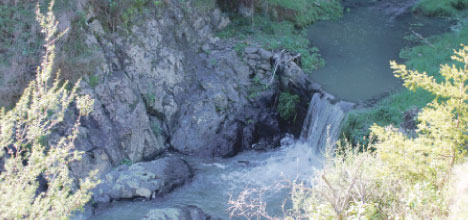
Ted Russek constructed a hydro scheme on the stream on the farm in the 1930s to supply electricity to his home.
'That oak tree was here when they arrived, but it was much smaller,” says Colleen.
They speak of their grandparents Wenzel and Margaret Russek who settled at Kereta 100 years ago in May. Among their nine children was Paul, Colleen and Ray's father. Today Ray and wife Eileen, and their son Neville and his family still live on and farm the land that Paul Russek eventually bought.
Their close relations, the Wenzlick family, own the original homestead site. Though the house is now long gone, so it was fitting both families, together with other descendants of pioneers in the district, should come together on May 19 this year to mark the centenary. As part of the celebrations a memorial stone was installed in honour of the pioneering Jamieson, Russek and Wenzlick families.
Ancestors
However, the story of the two families really begins in June 1863 when their Bohemian ancestors arrived in New Zealand from their villages in the Austro-Hungarian Empire, now the western part of the Czech Republic.
They were lured to this country by the New Zealand Government's promise of 40 acres of free land for an adult, and 20 acres for each child; along with glowing accounts of a land of milk and honey from fellow countryman Martin Krippner, who had emigrated earlier.
Margaret and Anton Russek were among the 84 Bohemians who took up the offer, travelling by train from Staab to Prague, to Hamburg, then by sea to Gravesend in England where they boarded the War Spirit for the 106-day journey to New Zealand. None had seen the ocean before, let alone travelled on it.
Puhoi
'There was only one death on the voyage. Lawrence Turnwald was killed when timber on the deck came loose and crushed him,” says Colleen. 'The other families looked after his wife and five young children, who otherwise might not have survived after they arrived at Puhoi.”
From Auckland, the settlers travelled north by cutter to Puhoi; and late on a winter's evening, were rowed in canoes up river by local Maori.
'It must have been disheartening and frightening, especially for the women because they couldn't speak English, or Maori, and all they could see was bush,” says Colleen. The only accommodation was two small nikau whare, one for the men and one for the women.
Next morning, the settlers found very little of their promised land was flat – and all was covered in native bush.
Without the funds to return home, they were forced to stay and - supported by their strong principles of faith God and the Catholic Church and always helping their neighbour - the settlers survived and eventually prospered.
The first years were hard, as the pioneers broke in land to raise crops and graze livestock. 'They made money out of kauri shingles, which they sold in Auckland and timber for housing,” says Ray.
Local Maori kept the newcomers alive with regular deliveries of much-needed fresh food. Fifty years later, Margaret and Anton's son Wenzel and his wife Margaret were keen to move south - and on the recommendation of their eldest son George - bought what was known as the Halfway House at Kereta from Ted Jamieson.
Two day journey
'George had been staying with an aunt, Annie Wenzlick, who lived on the Thames Coast and although his father was keen to buy land in the Waikato, he convinced him the Jamieson property was better,” says Ray. The Halfway House served as a coach stop for travellers on the two-day journey between Thames and Coromandel and came with 300 acres of land, much of it still in native bush. The Russek family continued to run the accommodation house and stables for horses while they cleared bush and bought more land. They were virtually self-sufficient, growing vegetables, raising livestock, milking cows, fishing and hunting. 'The women made butter, which was stamped with the name Otakeo Butter after the stream on the farm, and sold it in Thames,” says Ray. The family also made money from shearing, helping build and maintain the roads, and by working in the bush. Margaret and Wenzel operated a telegraph exchange from a small building alongside their original home. 'The telephone wires were threaded through the bush, often tacked on to trees. My grandparents received and sent telegrams from the exchange too.” When Paul was 18, he bought 824 acres of bush from the Crown, adjoining the Halfway, and began to clear the bush and farm the land.
Oldsmobile
He married Eileen Klaus and in 1930 bought one acre from his mother and built a new family home. Ray, Colleen and their younger brother Barrie were born on the farm. 'We went to school at Tapu and used to catch the Roads Services Bus, which went from Coromandel to Thames each day. Later, Arthur Young who had two daughters also going to school, took us in his Oldsmobile. He'd taken out the back seat and put in two bench seats and could take 16 kids to school,” says Ray.
Cattle and sheep, in mobs from several neighbouring farms, were herded down the road to sale yards at Tapu – and not always without mishap. 'The animals were pretty wild and some took to the sea and kept swimming. Another time some broke out of the holding paddock and headed for the hills,” says Ray. 'Neighbours worked together helping with farm jobs, which required more labour.”
Hydro station
In the late 1930s, Ted Russek, Paul's youngest brother, who owned the original homestead, was tired of living without electricity so built a dam in the stream, cobbling together a power house using machinery from the gold mines to drive a generator.
'Uncle Ted was a clever man. He diverted water from the dam to drive a 12 foot water wheel which powered a generator.” Ted could stop and start the water wheel by winding or unwinding a trip wire, next to his house, to open or shut off the water supply.
'Ted would wait till everyone was in bed, and he was in his pyjamas then he'd go outside to unwind the wire and race back inside to bed before the power failed.” The dam Ted built and the remains of the power house are still in existence.
Ray says fish was an important part of the family's diet but when it came to catching them – speed was the essence. 'They used to row out and drop a stick of gelignite over the side, wait for the explosion to stun the fish and then scoop them up.”
Tapu Store
When Paul Russek became ill, the family moved to Tapu where Paul and Eileen bought and ran the Tapu Store. Ray left Thames High School as soon as he was able and returned to Kereta to farm the land, which he eventually bought from his parents.
It was at Thames High School that Colleen met Eileen Beagley, who from the time she was 13, was a frequent visitor to the Russek farm. However, it wasn't until many years later, and Eileen had completed her training as medical laboratory technician, that Ray realised she would be the perfect farmer's wife.
The couple raised two sons and a daughter on the farm, and now oldest son Neville leases the sheep and beef property from his parents –who continue to live in the house Paul built.
'It's not easy land to farm and if we didn't have a run-off elsewhere to finish our animals we probably wouldn't still be here,” says Ray.
This summer's drought is the worst he has ever experienced – and getting the animals and pasture through it was not easy. 'Thank goodness the weather remained mild after the rain so the grass could grow,” says Ray.
Ray and Colleen have fond memories of growing up at Kereta. And today the property is still enjoyed by members of both the Russek and Wenzlick families – never more so than when 140 family and friends attended the centennial picnic in May.

0 comments
Leave a Comment
You must be logged in to make a comment.