


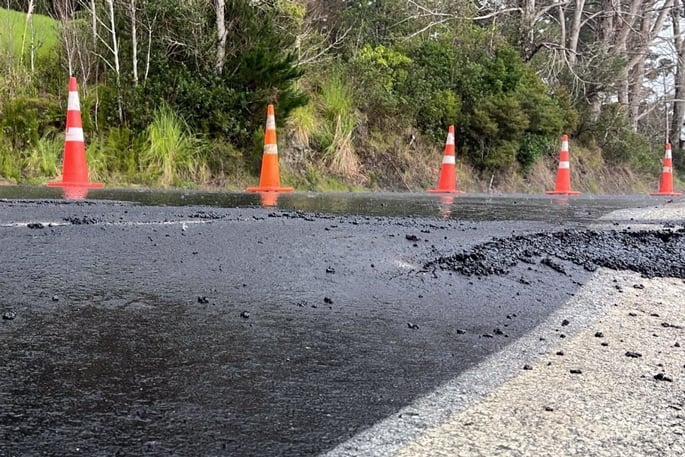
“Unusually high” costs for gravel roads on Coromandel have the council looking at sealing the priciest patches.
Maintaining a 200m piece of Port Jackson Rd, for example, has cost $100,589 since 2017.
Thames-Coromandel District councillors quizzed staff about “the high cost per kilometre for the unsealed network” during a recent workshop, according to a council report.
The issue is also flagged in the council’s 2027-2030 funding application to NZ Transport Agency, which staff recommended that councillors approve at Tuesday’s meeting.
The draft application includes works scheduled over the three years and worth $74.42 million, 24.4% higher than the approved amount in 2024-2027. NZTA’s contribution rate is 51%, meaning the agency would cover about $37.95 million, with the council picking up the rest.
The district faces “an unusually high cost to maintain” unsealed roads, a council report read, referring to the “high rainfall, mountainous terrain, remote road access, aggregate haulage costs and significant seasonal visitor demand” as significant factors.
Of the highest-cost 100m sections of road, 34 are being considered for further assessment. They represent 3.4km altogether and have cost $799,653 since 2017.
And staff have proposed a targeted investment strategy of finding: ”the highest-cost kilometres, compare their forecast life-cycle cost as unsealed versus sealed, and progressively seal the sections where avoided grading, pothole repairs, remetalling and storm reinstatement justify the capital investment”.

A 300m section of the 309 Rd, near Coromandel Town, features on the council’s to-fix list. Photo / Waikato Times
An increased rate of annual resurfacing was also proposed, rising from 5% to 8% to shift the network from “a progressively ageing position toward a sustainable renewal cycle”.
If councillors sign off on the funding application, an “evidence-led” programme can be submitted to NZTA and the council will still be able to refine minor details, staff said.
“[The staff-recommended option] represents the current evidence-based assessment of network need. A reduction in this funding level may require reductions in planned outputs, deferral of renewals or changes to levels of service,” the report read.
Another option presented by staff highlighted the possibility of cost increases due to a new contractor in year two. If adopted, the total amount would hit $82.34 million.
Because of the potential for increased cost, the report outlined it was prudent to make NZTA aware of the situation, while noting a potential scale “cannot be reliably determined until the procurement process is completed”.

The Kirikiri Stream Bridge has had some attention recently. Photo / Christel Yardley, Waikato Times
If approved, the council’s funding application must be lodged with NZTA by December 11.
Local Democracy Reporting previously reported the price for a Kirikiri Stream Bridge replacement and nearby works went from $12 million in 2016 to $65 million in 2026.
The agency said it was now “refining the scope”.
LDR is local body journalism co-funded by RNZ and NZ On Air.


0 comments
Leave a Comment
You must be logged in to make a comment.