


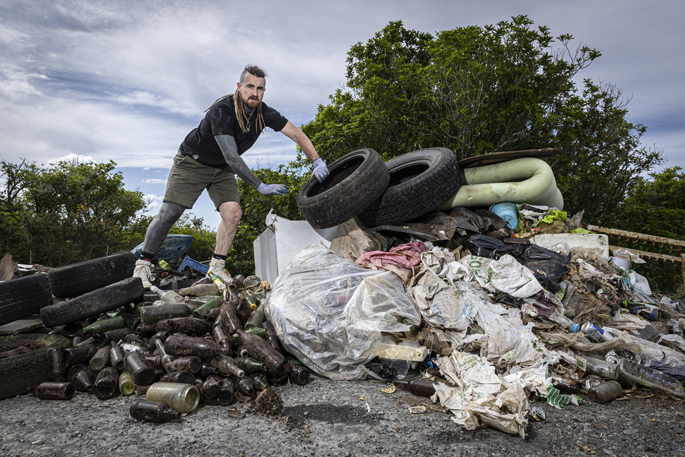
Dead cats in bags, stolen vehicle parts and bottles dating back to the 1950s are among nearly four tonnes of rubbish Brando Yelavich has dragged from the Coromandel bush.
But after two months of cleaning up other people’s mess, the 32-year-old says he’s now being left with the bill, as Thames-Coromandel District Council raises safety concerns and refuses to continue waiving his dumping fees.
“Literally every single spot that I have looked at that you can stop on the side of the road, there is rubbish down in the bush,” Yelavich told Local Democracy Reporting.
“I just didn’t think it was even remotely that bad.”
After Yelavich ramped up his operation, the council stopped waiving the dumping fees after two months, citing “health and safety” issues.
“Now I’m moving trailer loads of it, they’re like ‘oh it’s a health and safety hazard because we don’t want to associate with helping you in case you get hurt’.”
“I’m literally just asking you not to charge me $800, $900 to dump some rubbish that I pulled out of the bush because I want to do a good thing for the country and inspire other people to do the same.”
Yelavich is known for traversing New Zealand’s coastline on foot in 600 days at just 19 years of age and has amassed hundreds of thousands of followers on social media.
He wants to work with the Thames council in recruiting and paying local volunteers to clean across the district.

Finding peculiar items is the norm for Brando Yelavich. Photo / Christel Yardley, Waikato Times
He is frustrated with the council using red tape to protect itself in not supporting him, adding he knew it wouldn’t do anything because of the bank’s steepness and a “classic out of sight, out of mind” thinking.
“I don’t hate the council and I don’t hate the people in the council. I just want my voice heard and I want support with what I’m doing because there is not many people saying that what I’m doing is wrong.”
The council said it admired Yelavich’s efforts but need confidence volunteers were “operating safely” given they may be collecting “potentially dangerous or hazardous waste” such as old metal, glass and asbestos.
The council added the waived fees were a “goodwill gesture” rather than a formal arrangement, calling it unfair and unsustainable if Yelavich plans to expand.
“There are several reasons why we couldn’t partner with Brando in the way he wanted, but we are happy to keep talking with him,” the council said.
“Social media is a great way for people to share information and connect, but Facebook isn’t known for solving issues and we can’t make decisions involving public money on the basis of online appeals.”
Response from the local community has been overwhelmingly positive, Yelavich said.
People have supported him in various ways, from stopping on the side of the road and helping, to donations and in-person congratulations.
“I went to the market the other day and ... maybe 13 or 14 people in the 40 minutes I was there came up and said ‘I’ve seen your content, well done’ ... the feedback is phenomenal.”
Yelavich’s efforts have also caught the eye of environmental charity Keep New Zealand Beautiful.

The bush is full of rubbish but the council says it can’t support Brando Yelavich’s operation. Photo / Christel Yardley, Waikato Times
The charity’s national support manager Wayne Gazley called the work magnificent, adding there’s “probably another 20 or 30 like him” across New Zealand.
“It’s sad that they have to do it in the first place because litter doesn’t grow like a noxious weed, it gets thrown there by some noxious weed,” Gazley said.
“I’m hoping he will join the KZNB banner because what he’s doing and the way he presents his videos is a little bit different to a lot of other people out there.”
Yelavich credits his wife’s fulltime career as a radiographer with giving him the freedom to do what he does.
“I’m a dad, I’m a husband ... we could not survive as a family if she wasn’t doing that.”
Yelavich is building Project Guardian, an organisation looking to professionalise the work he does and a place people can donate to help his cause.
LDR is local body journalism co-funded by RNZ and NZ On Air.


0 comments
Leave a Comment
You must be logged in to make a comment.