


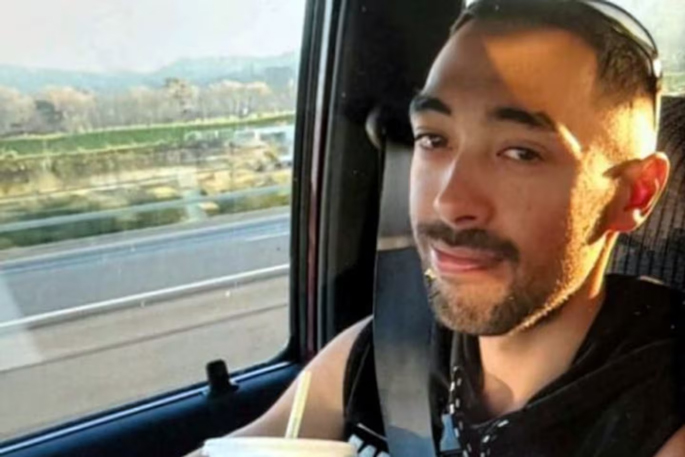

Warning: This story deals with details of a violent death and may be distressing.
Police may never have found Harley Shrimpton’s body had it not been for his killer Piripi Tukaokao leading them to his grave.
But a High Court judge has told the 24-year-old that did not “diminish the seriousness” of what he did.
Tukaokao was found guilty of aggravated robbery, kidnapping and murder after a jury trial in the High Court at Rotorua earlier this year.
The gang member had admitted shooting Shrimpton, but claimed the death was an accident.
The jury rejected that explanation, and today he and 21-year-old co-defendant Tuara Heke, who was found guilty of assisting in moving the body and aggravated robbery, were in the High Court for sentencing.
Justice Simon Mount outlined the facts of the case, which began with an aggravated robbery early on November 3, 2023, by both men, to obtain a cellphone from one of Shrimpton’s friends.
This was used by Tukaokao to lure Shrimpton to a meeting at Tauranga’s Sulphur Point, in attempts to have a drug debt repaid.
When Shrimpton realised he’d been tricked, he told those he was in the car with to “go, go, go”.
However, Tukaokao caught up with him in the Mount Maunganui McDonald’s carpark.
Shrimpton got into Tukaokao’s car under duress, and was taken to a shed on a remote rural property where he was killed by a single shot to the chest.
At sentencing, Justice Mount noted the person who supplied Tukaokao with the gun, Terrence Hayes, died by suspected suicide in December 2023 after learning what Tukaokao had done and leaving a note indicating his distress.
“I’m satisfied his death was a further consequence of your offending.”
The judge was provided with four victim impact statements – including two read by the prosecutor, and one read by Shrimpton’s younger sister.
All described Shrimpton as gentle, kind, with a big heart who looked out for the people he loved.
Shrimpton’s grandfather said he had to watch his family “fall apart”, and the devastation hadn’t ended with the murder.
Shrimpton’s mother had health issues and had “loved her son with every part of her being”; she died about two months after Shrimpton’s death.
“She somehow found the strength to make it through his funeral, but after that she simply wasn’t the same,” Shrimpton’s grandfather said.
“It is my belief that she died with a broken heart.”
Shrimpton’s sister was in the early days of postpartum when her brother’s body was found.
“I was supposed to be enjoying those precious first days with my newborn, but instead I was faced with a devastating reality that my brother was gone,” she said, adding that in the space of three months she lost her brother and her mum.
Planned and callous, or unsophisticated and reckless?
The Crown argued there should be a minimum period of imprisonment (MPI) of at least 17 years for Tukaokao, because of factors in section 104 of the Sentencing Act.
Crown prosecutor Caitlin Bourke submitted that there had been planning and premeditation, and a high level of callousness.
However, Justice Mount told Bourke he was not persuaded the murder had been planned.
He found Tukaokao had obtained the shotgun and sent threatening messages “with the intention of intimidating Mr Shrimpton into paying his drug debts rather than with the intention of killing him”.
He’d acquired the shotgun a little over 24 hours before the murder, as part of a “dangerous escalation” in threats and intimidation.
“It was not in your interests to kill Mr Shrimpton because your primary goal was to extract money from him,” the judge said.
 The gun used to shoot Harley Shrimpton.
“You did not premeditate the murder, as evidenced by the public way in which you took him away in the car and the location of his death on property closely associated with you.”
The judge considered it had been a reckless killing, with the conduct after “largely an unsophisticated attempt to conceal evidence which does not tell in favour of a callous or highly brutal murder”.
However, he recognised another section 104 factor – that the murder happened in the course of another serious offence, the kidnapping.
This meant he was required to impose an MPI of 17 years, unless it would be manifestly unjust.
“You presented the loaded firearm in circumstances that were highly dangerous and deliberately discharged the shotgun at close range with a high degree of recklessness,” Justice Mount said.
“However, as I have found, you did not intend to kill Mr Shrimpton but rather deliberately discharge the shotgun with reckless intent.”
Justice Mount, having considered a case that had similar facts, said that, as was concluded by the court in that case, a 17-year minimum would be unjust.
He said it fell “well outside the type of paradigm that the legislature intended would be caught by the 17-year minimum”.
He adopted a 14-year starting point, but taking into account background factors, considered a two-year reduction was appropriate.
Tukaokao’s background and personal factors included a “tentative diagnosis” of an intellectual disability, likely fetal alcohol spectrum disorder, abuse experienced as a child, early exposure to gang culture and addiction issues.
The judge also took into account his “relatively young age” and that he had shown some “genuine insight” into the impact of his actions.
“You will have to live with the consequences of your actions for the rest of your life and I accept that you have, in your own way, tried to do what you can to put things right,” Justice Mount said.
The key step he’d taken was to lead police to Shrimpton’s body.
“You are at the beginning of a lengthy term of imprisonment, Mr Tukaokao, but you are not without hope,” he said.
“I encourage you to make the most of the opportunities you will have in prison to make yourself a better man and someone your children can be proud of.”
He sentenced Tukaokao to life imprisonment with an MPI of 12 years.
As for Heke, he also had background and personal factors the judge took into account, including an early departure from schooling, intellectual limitations, exposure to trauma, gangs and violence and ongoing addiction issues.
The judge assessed his offending as justifying a starting point of six years’ imprisonment for the aggravated robbery, three years’ imprisonment for accessory after the fact, and two years’ imprisonment for attempting to pervert the course of justice.
Taking into account the totality, the judge set an overall starting point of eight and a half years, with a 5% discount for guilty pleas (for the charges Heke pleaded guilty to on the morning of trial), 10% for youth and background factors and 5% for addiction.
He imposed an end sentence of six years and 10 months’ imprisonment, cumulative to an existing drug-related sentence of 28 months imposed in January.
This meant a total sentence of nine years and two months.
Justice Mount acknowledged the police work in the “painstaking” investigation, and the “enormous amount of work” to reconstruct the movements and assemble evidence for the trial.
In a statement to NZME, Detective Sergeant Joseph Meehan said today’s sentencing outcome was the direct result of some “exceptional work by a dedicated team of investigators” and the convictions ensured the defendants had been held accountable for their actions.
“As evidenced by the support here today, Harley was a much-loved whānau member,” he said.
“The past few years have been incredibly difficult for Harley’s family and I want to acknowledge how they have conducted themselves with dignity throughout this process.
“I hope this result brings them a sense of closure and contributes to their healing process.”
Hannah Bartlett is a Tauranga-based Open Justice reporter at NZME. She previously covered court and local government for the Nelson Mail, and before that was a radio reporter at Newstalk ZB.
Join the NZ Herald’s Open Justice team for Case by Case, a video and podcast series examining the disputes and decisions making headlines across New Zealand.


0 comments
Leave a Comment
You must be logged in to make a comment.