


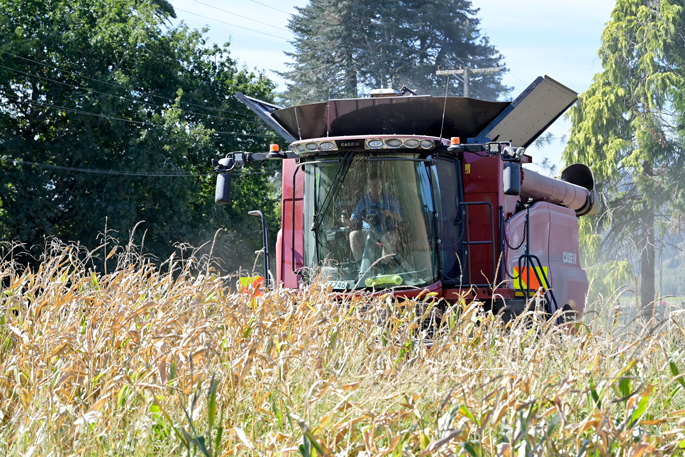
Despite the cost of growing a maize silage crop rising about 30% in the past four years, growers are told they should not be tempted to cut corners, which could result in a reduced yield.
“When you are growing a high-cost, high-input crop, doing the basics right is more important than ever,” Corson Maize national research manager Mike Turner told a Foundation for Arable Research (Far) maize winter workshop.
From 2021-2022 to 2025-2026, his analysis showed total maize silage costs, from spray out to covering the silage stack, rose from $4026 per hectare to $5143/ha.
Fertiliser/lime and seed-related inputs both recorded the biggest increase, at about 41%.
“When costs are going up, you need to protect that investment and yield at harvest.”
Turner said base fertiliser increased from $450/ha in 2022 modelling to $850/ha now. “In comparison, the cost of a soil test is very cheap. So, if you are getting your fertiliser spend wrong, either too much or too little, it can have a big impact on costs.”
Basics right
When growers get the basics right, a higher yield dilutes their costs, Turner said.
For example, 17 tonne of drymatter/ha maize silage crop equates to 31.9 cents a kg of dry matter. At 25 tonnes/ha this falls to 21.7 cents/kg/DM and at 28 tonnes/ha 19.4 cents/kg/DM.
“Yield spreads cost across more kg of feed. This is the strongest reason for growers to protect crop establishment and the basics. Most costs in a maize silage crop are fixed. So, the only real way to offset that is to get a good yield.”
When choosing a Comparative Relative Maturity (CRM) hybrid for silage, growers need to be aware that while silage yields increase for longer-maturing hybrids, so can risk, especially in environments that can get dry and disease-pressured.
Some growers choose a CRM out of habit, he says. “It is worth asking your seed supplier about what hybrid best suits your system?
“Shorter CRM is not about giving up yield potential; it is about providing a more reliable return and a less risky yield. A crop that finishes cleanly, dries down, stands well and meets the harvest window usually protects margin better than a theoretical top-yield option.”
El Niño
Predictions of a super El Niño weather pattern producing hot, dry conditions later this season mean growers without good moisture-holding soils should shorten their CRM to get their crop well into grain-fill or dry-down phase before it comes under too much pressure. Some hybrids can better cope with dry conditions later in the season.
A lower plant population could also be considered, Turner said.
Far senior maize researcher Rene van Tilburg said growers need to factor soil nitrogen into their input calculations and if they are applying more nitrogen than their crop can take up, they are wasting money. “Maximise your soil N; use it or lose it.”
Growers generally make some allowance for soil N, but often this is anecdotal and what they have always done, rather than based on actual soil test results.
Measure, not guess
Instead, growers should measure nitrogen supply rather than guess it and trust the result.
Growers should use a Mineral N test to determine soil N as well as a Potentially Mineralisable Nitrogen (PMN) test, which indicates how much N may become available during the growing season.
This allows side-dress N applications to be better matched to crop demand and soil N supply, improving profitability, van Tilburg said.
In a Far maize grain production trial at the Corson Research site at Newstead, near Hamilton, large differences in soil N supply between plots in 2024-2025 resulted in side-dress N inputs ranging from just 75 kg to 360 kg SustaiN/ha. Soil testing showed the soil supplied from $599 to $1016 worth of N at a SustaiN price of $1400/tonne.
Despite these large differences in N inputs, grain yields remained remarkably similar, with all treatments producing about 16 tonne/ha of grain.
The result saved $446 to $805/ha if no allowance had been made for soil N, with the lowest SustaiN rate having one of the higher yields though not significantly so, indicating no yield penalty for using the soil N tools.
Cultivation intensity
Growers, particularly on well-structured soils, can also consider their cultivation intensity, saving diesel, machinery and labour costs, van Tilburg said.
“Far work shows no yield penalty moving to strip till or no-till on sites with high-quality soil. However, transitioning to strip-till or no-till has its challenges and may not be practical for many growers, van Tilburg said.
Instead, a pass in a conventional system may be eliminated or cultivation depth reduced and speed increased. “A key point when making any of these changes is to ensure a seed bed that will result in consistent seed depth and good seed to soil contact.”
Far trials show the combination of reduced cultivation intensity and use of Mineral N and PMN testing has the potential to save $300 or more per hectare, he said.

0 comments
Leave a Comment
You must be logged in to make a comment.