


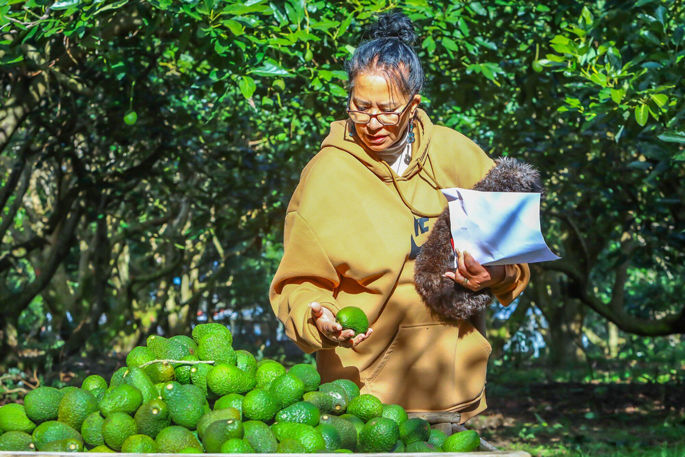
While avocado blocks in Bay of Plenty are commonplace, the location of one is particularly unique.
Opureora Orchard is on the southwestern tip of Matakana Island and occupies 8ha within a 10ha land block known as Opureora 1B7B3.
It is Māori freehold land owned and operated by Opureora 1B7B3 Land Trust, with orchard operations separated into its own business structure and the trustees’ focus on governance.
Trustee Pania Wilson says there are about 800 avocado trees planted in the 8ha site, alongside 10 homes in the papakāinga (intentional communal living on ancestral Māori land – “a nurturing place to return to”).
It also includes an orchard shed which was recently renovated into an accommodation space for use by shareholders and their whānau, as well as orchard workers during picking season, and three bays for storage of orchard vehicles, resources, tools and equipment.
“The space is aptly named ‘Te Whare Manaaki’, a place of welcome, hospitality and community,” Wilson said.
The trust’s immediate history goes back to May 1998, when a hui was called on the island by the Tauranga Moana Māori Trust Board for all registered owners/shareholders in five blocks, including Opureora.
Board members were trustees of the blocks transferred to them by the Māori Trustees’ Office and they wanted to hand responsibilities back to the rightful owners/shareholders.

Shareholders Pania Wilson and Noel Samuels. Photo / Kelly O’Hara
A new land trust was formed to govern Opureora 1B7B3 in January 2000, and in 2004, trustees, with the agreement of the shareholders, entered into a joint venture lease agreement for 18 years to establish an avocado orchard with a well-known orchardist family business from Katikati.
“We were introduced to avocados by the joint venture partner who approached the chair of our land trust at the time,” Wilson said.
Ideal location
“The orchardist had kiwifruit and avocado crops in Katikati but said the climate on Matakana Island is up to three degrees warmer, making an ideal location to grow avocados.”
Across the Island, the main fruits and vegetables grown commercially are avocado, blueberry, corn and kiwifruit.
“Operations/orchard manager Raatu Samuels keeps good relations with our distributor, who provides great, trusted advice and guidance as we’ve been with him since the joint venture 18-year lease agreement ended in 2023, and our land returned lock, stock and barrel – but also $40,000 in deficit,” Wilson said.
“However, the trustees, our orchard team and whānau rolled our sleeves up and, working with a distributor who gets our vision and why we do what we do, we are happy to advise the business is doing okay, despite the challenges, including some of the severest weather events we have ever experienced.”

Avocados grown on Matakana Island. Photo / Kelly O’Hara
The fruit is taken to market using the Matakana Ferry II, a ferry/barge service which operates between Matakana Island and Ōmokoroa.
“This travel accounts for up to 20% of our business costs, but we have no choice if that’s the only way to get product off the Island and into the marketplace,” Wilson said.
“There have been discussions about a collective investment in our own ferry service, and perhaps that will become a reality one day.
“But for now, the focus is on the business and our shareholders/owners.”
The off-season presents a time to clear and refresh the orchard through pruning and weeding.
Raatu Samuels lives on the island and contracts one to two locals for orchard care, but for the current harvest the owners have commissioned professional contractors from the mainland.
Wilson says the land trust does not have shares in any other business on the island.
“However, there is a connection of our shareholders to the other land blocks”, she said, and “that is through whakapapa” (genealogy).
Matakana Island
Matakana is a long, flat island, 20km in length and about 3km wide, forming a sand barrier between Tauranga Harbour and the South Pacific.
It protects the entrance to Tauranga Harbour and stretches from Bowentown to Mount Maunganui.
Matakana Island has two distinct parts – 2023ha of farm and orchard land – including Opureora 1B7B3 land block – on the inner harbour (where most of the population lives) and 4047ha of forest-covered coastal land exposed to the Pacific Ocean.
Combined with nearby Rangiwaea Island, it has a population of more than 300 people.

Michael Tavares working in the avocado orchard on Matakana. Photo / Kelly O’Hara
Wilson said everything from people to product comes over on the barge, while the island hosts its store, post office and health clinic.
There are five marae on Matakana and Rangiwaea islands: Opureora, Kutaroa, Oruarahi/Te Rangihouhiri, Rangiwaea, Oponui, and five hapū (sub-tribes): Ngāi Tuwhiwhia, Ngāti Tauaiti, Ngāi Tamawhariua, Te Whānau a Tauwhao, and Te Ngare. All five belong to Ngāi Te Rangi Iwi.
“Despite our relative isolation and challenges to access necessary health and social services, our whānau are resilient and resourceful,” Wilson said.
“We have te reo Māori experts, environmental warriors, experts in regenerative planting, fishermen, entrepreneurs, carpenters, nurses, lawyers, teachers, accountants, plumbers, drainlayers, farmers and orchardists.”

1 comment
What beautiful fruit!
Posted on 07-09-2026 12:41 | By nerak
Can I buy these locally in Tauranga?
Leave a Comment
You must be logged in to make a comment.