


Councillors have received a new assessment of landslide risks on Mauao, but no decisions have been made about the future of council facilities at its base.
In a Wednesday meeting, Tauranga City councillors heard more information was needed about rockfall risks, which were largely left out of the landslide report.
Councillors discussed the new Quantitative Landslide Risk Assessment (QLRA) report for the mountain in the meeting, which continued Tuesday’s landslide response discussion.
This came after former High Court judge Paul Davison’s review of January’s tragedy found council missed opportunities for years to take action that could have prevented the deaths of six holidaymakers at the Mount Maunganui Beachside Holiday Park.
The council ordered the Tonkin and Taylor assessment after the slip.
The assessment and council staff recommended the council set a risk tolerance threshold to guide decisions about facilities and the area around the base of Mauao.
These include the holiday park, Mount Hot Pools, Pilot Bay Boat Ramp and the Mount Maunganui Lifeguard Service building, all of which remain closed.
The council confirmed on Thursday that the street these are on, Adams Ave, had reopened. It had been closed since July 24 after more earth slipped at the fatal landslide site.
The QLRA found Mauao remained an active landslide environment and landslide and rockfall hazards would continue.
Risk reduction measures would likely be required before affected areas and facilities can be reused.

The site of the fatal landslide on Mauao.
Rockfall report coming
Councillor Glen Crowther questioned why some prior geotechnical reports on Mauao showed the consequences of landslides as lower than those of rockfall.
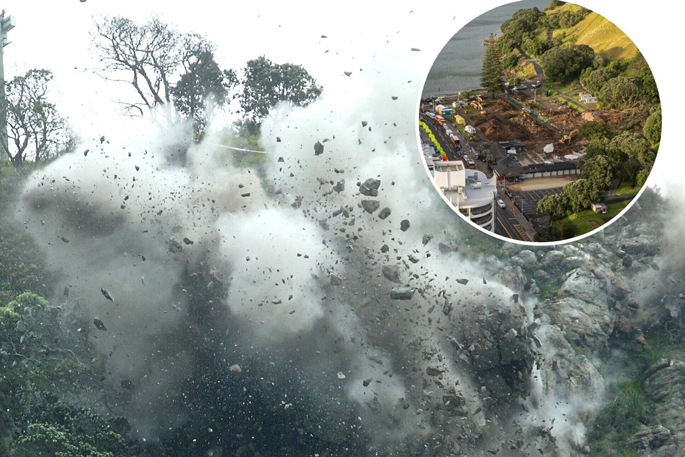
He also noted an approach used by the council to explode boulders to mitigate rockfall dangers in 2003 and 2008.
Crowther asked if the council had been given a false sense of security in previous reports that said rockfall risk was higher than landslide risk.
Tonkin and Taylor senior geotechnical engineer Daniel Ngawhika said risk grew where more people could be affected.
Mayor Mahé Drysdale said he understood the risk of rockfall was higher for individuals, but there was a higher risk a landslide could impact numerous people.
Councillor Hautapu Baker asked why rockfall was not included in the QLRA assessment, considering it was a known risk.
Council chief executive Marty Grenfell said “there wasn’t sufficient information and data”.
The council has commissioned a further study on rockfall and results were expected in about six weeks.
General counsel Phil Kai Fong said seeking this information at the same time as the QLRA would have delayed the process.

Tauranga City Council general counsel Phil Kai Fong (front) and recovery manager Charlie Rahiri.
“Further detailed rockfall modelling is required before the final conclusions can be reached about the extent of risk and mitigation that may be required.”
Slip regression cause unclear
The lack of a Trigger Action Response Plan (Tarp) for the holiday park, despite having been recommended by experts, was one of Davison’s key criticisms.
A Tarp sets out risk reduction measures to be taken when potential landslide triggers or signs occur, such as heavy rainfall.
Tauranga experienced record extreme rainfall totalling nearly 300mm over January 21 and 22, triggering the fatal landslide.
Former University of Canterbury professor Tim Davies said obvious potential triggers, such as heavy rainfall, were not evident in further regression at the slip site in July.

The site of the fatal Mount Maunganui landslide, pictured on August 30, has regressed since January. Photo / Rosalie Liddle Crawford
Councillor Martin Rozeboom asked how they could identify the risk when causes like rainfall are not involved.
Davies said they do not know why it happened.
“It may be that this reactivation only takes place within the head scarp of landslides which have recently occurred.”
Kai Fong said it was difficult or impossible to have Tarps for seismic-triggered failures.
Risk tolerance benchmarked
Councillors adopted the staff-recommended risk tolerance benchmark of a one-in-10,000-year risk of individual death for landslide and rockfall safety.
A council report authorised by recovery manager Charlie Rahiri said this aligned with the Bay of Plenty Regional Policy Statement, a previous council landslide risk tolerance decision and international geotechnical guidance.

Tauranga City Council recovery manager Charlie Rahiri. Photo / Tauranga City Council
The threshold was described in the report as “a balanced and proportionate approach to risk management”.
More and less conservative options were considered but not recommended.
Kai Fong said the benchmark option of one-in-1000-year risk of individual death would likely fall short of community expectations, and the one-in-100,000-year risk would mean much larger mitigation projects and higher costs.
Kai Fong stressed risk reduction did not mean risk elimination.
“Regardless of which threshold is adopted, there will remain a residual level of risk.
“It’s just not possible to remove all landslide and rockfall hazards from an active natural environment such as Mauao.”
He said the threshold is used as a benchmark for assessing the residual risk after considering hazard frequency, exposure and consequence.

Damage to the Mount Maunganui Beachside Holiday Park and nearby hot pools after a slip.
The QLRA said the risk to numerous areas exceeded the benchmark – including the campground, hot pools, boat ramp and nearby pedestrian area, and the Mauao base track.
These would likely need safety measures.
The campground and hot pools were identified as the highest-risk locations because of their proximity to the slopes, high visitor numbers and the vulnerability of people staying for long periods.
Now councillors have adopted the benchmark, the Mauao Recovery Working Group will investigate future land-use options, mitigation measures, stakeholder impacts and costs.
This group would include elected member representatives, technical advisers, recovery office representatives, the Mauao Trust – which owns Mauao on behalf of the three iwi of Tauranga – and iwi representatives.
The QLRA provided conceptual scenarios estimating the cost of stabilising the slope enough to restore full or partial access and use across the holiday park and/or surrounding facilities.
Ayla Yeoman is a Local Democracy Reporting journalist based in Tauranga. She holds a Bachelor of Arts majoring in communications, politics and international relations from the University of Auckland, and has been a journalist since 2022.
LDR is local body journalism co-funded by RNZ and NZ On Air.


2 comments
If the attached….
Posted on 04-09-2026 08:58 | By Shadow1
…photo is a demonstration of making loose boulders safe, you need a new explosives expert. The result should be a split rock that is unable to roll. The dangers of flyrock when too large amounts of explosives are used is well known. I don’t know if we’ve ever experienced falls from existing cliffs.
Have any of our experts looked at dewatering any of the swampy areas that make the worst of the landslides? I’m sure that’s an option. Low cost too.
Shadow1.
More to come
Posted on 04-09-2026 16:49 | By Kancho
Another telling phrase about why rockfall was not included
"Council chief executive Marty Grenfell said “there wasn’t sufficient information and data”.
The council has commissioned a further study on rockfall and results were expected in about six weeks"
And so many more reports and legal ramifications all adding substantial costs for what is in the end systemic management
Issue with a lack of responsibility . A CEO who believes he is best positioned to make changes that where his responsibility to have in place in the first place . Management is what is supposed to happen especially when big bucks are paid for presumed experience.
Leave a Comment
You must be logged in to make a comment.