


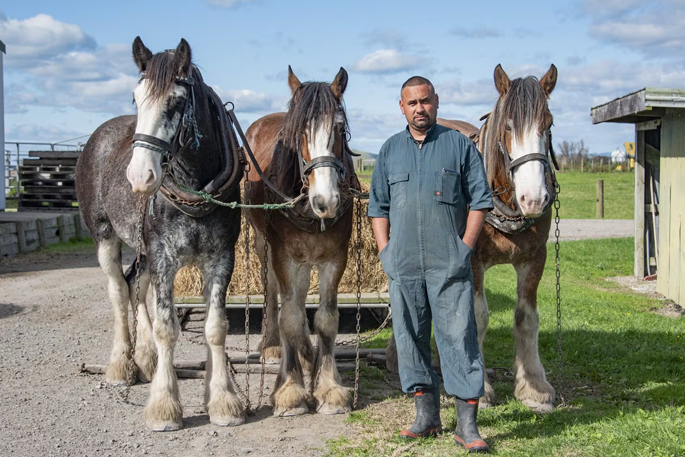
For most farmers, tractors are the machinery of choice.
For Pongakawa contract milker Ross Wilson, it’s a team of powerful Clydesdales.
The thundering draught horses are more than just a nod to the past.
They are an essential part of Wilson’s daily farm life, helping with everything from harrowing paddocks and feeding stock to spreading fertiliser and gathering cows and calves.
It’s a practise that keeps alive a family tradition stretching back generations.
Raised on a Morrinsville drystock farm where his father and grandfather continued working with Clydesdales long after tractors became the norm, Wilson developed a deep respect for the giant horses.
Decades later, he has built up a team of 10 Clydesdales and turned their use into a finely honed farming system that blends old-world craftsmanship with modern agriculture.
“As I had my own family, I started buying and breeding Clydesdales,” says Ross.
“We now have 10 and part of the deal with any farm I work on is space for my horses.”
Horses are the ultimate vintage machines dating back centuries and come in a variety of colours. Each has four cylinders and a 1hp engine which increases by adding more horses.
They run on a fuel mixture of hay, chaff, oats and grazing older pasture, but too many oats can result in unwanted changes in gear and speed.
Ross credits Paul Symes, Vivien Simmons and his father’s friend Derrick Thornton “big time” for their help with learning about behaviour, training and picking a good horse.
“I look for horses with a steady and quiet temperament and a good, responsive mouth. There’s a lot going on with a team of horses and the steering wheel needs to be working.
“I get a feeling of accomplishment from training up a young horse.”
To keep his horses in tip-top condition, Ross rotates between the different models to keep them fit and give them purpose.
“I try to use horses every day for something – whether it’s harrowing, feeding out from a sled or cart, picking up cows and calves, ploughing, discing, fert spreading, seed spreading or gathering up the family and taking them for a ride on Matata beach. We have 10 kids who all ride.”

Ross uses his horses daily for farm work. Photo / Catherine Fry
For comfort, each model has their own equipment consisting of a collar and a properly fitting bridle. Other equipment includes chains, breechings, cart saddles and back bands.
“I have an Amish-style forecart which allows the Clydesdales to pull modern day implements and a little petrol motor runs each implement’s hydraulics and PTO.”
Ross says he has got using the horses for farm work down to a fine art. In the wetter areas on the farm, the horses are a better fit.
“There’s nothing better than driving your horses home after a hard day’s work. It becomes a way of slowing down, time to breathe and be grateful . and it takes me back to my roots.”

Ross Wilson's Clydesdales pull a sled of hay to feed out on the farm. Photo / Catherine Fry

0 comments
Leave a Comment
You must be logged in to make a comment.