


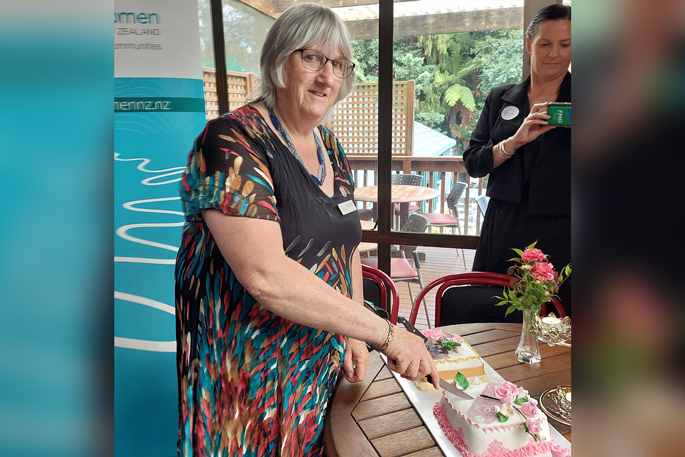
Bay of Plenty-Coromandel Rural Women continues to expand its reach, with regional leader Mary Nowotarski leading a year of celebration, connection and growth.
Nowotarski said the past 12 months have centred on celebrations for Rural Women New Zealand’s 100th anniversary, bringing members together across the region.
The group hosted a cocktail evening in August, followed by a series of 100th birthday lunches held throughout October, and wrapped up festivities with a final lunch in April.
“These events celebrate our history and the role rural women continue to play in supporting their communities,” Nowotarski said.
Rural Women New Zealand began in 1925 as the Women’s Division of the Farmers’ Union and has grown into a nationwide organisation advocating for rural communities.
Alongside the centenary events, Nowotarski focused on creating more opportunities for women to connect socially.
She established a morning tea group and an evening group, giving members a choice of informal catch-ups and organised outings.
“Sometimes it’s dinner, sometimes a visit to a flower farm or even a pamper evening,” she said. “These are so women can just get together for fun and friendship.”
Nowotarski said she planned to expand these initiatives further across the region, responding to growing interest.
The Bay of Plenty-Coromandel region now included more than 100 members across branches such as Colville, Galatea, Oropi, Rerewhakaaitu, Kaharoa, Ngakuru, Te Puke-Rotoehu and Turua.
Nowotarski said membership reflected a changing rural landscape.
“Rural Women are from all sorts of walks in life and don’t have to be farmers to join,” she said. “They just need an interest in rural life, and we have members who live in town as well.”
Nowotarski joined Rural Women New Zealand in the early 2000s while living near Ōtorohanga, quickly becoming involved at branch level. After moving to Rotorua in 2012, she joined the Kaharoa branch and continued to build her leadership role, eventually becoming regional leader.
She said Rural Women New Zealand played a vital role in giving rural women a voice.
“We are a trusted voice on issues that affect rural communities.”
The organisation advocated locally, nationally and internationally, ensuring rural perspectives were heard while also providing leadership opportunities, personal development and global networking connections.
Livestock warning
Meanwhile, Western Bay of Plenty District Council reminded farmers to take care when moving livestock, particularly during the busy winter changeover period.
Transportation director Calum McLean said stock movements were common across the district.
“In some cases, consent may be required depending on how and where the movement is carried out, especially for longer distances or those involving urban roads,” McLean said.
Livestock movement was governed by the council’s Livestock Movements Bylaw 2025, which outlined when consent was required and set safety expectations.
Consent was generally not required when stock were moved directly across a rural road between paddocks, provided the movement was temporary and carefully managed.
However, consent was needed for movements along roads, on urban routes, or where activity may affect traffic safety or road conditions.
McLean said planning was key.
“Our advice is simple – keep safety front of mind and ensure movements protect both livestock and road users.”
He added that movements involving state highways may require additional approvals through Waka Kotahi.

0 comments
Leave a Comment
You must be logged in to make a comment.