


An extra 200 students and a 228-bed central-city university accommodation block are part of plans expected to inject up to $20m into the Tauranga economy.
A local business and a student leader are welcoming the push to bring more students into the city centre and grow the university.
Tauranga City Council last month signed a partnership with the University of Waikato and committed up to $2.4m to boost student numbers, provide more accommodation and fund new programmes.
Local Democracy Reporting can today reveal more details after documents from confidential council meetings were released.
The documents show the council money will help pay for the proposed accommodation block at 219-221 Cameron Rd, where Kale Print used to be.
This would help cater for an extra 200 students over the next four years. The building is a short walk from campus, and is expected to be finished in 2029.

The University of Waikato will receive $2.4 million to go towards its new city centre student accommodation development. Photo / Kelly O'Hara
A council report said the New Zealand Institute of Economic Research had finished an analysis on the economic benefits of tertiary students.
The analysis showed that each additional Tauranga-based tertiary student was estimated to generate about $80,000 to $100,000 per year in wider economic impact.
In addition, students were estimated to contribute $18,000 to $23,000 per year in direct local spending on accommodation, food, transport, retail and everyday services.
An increase of 200 students was expected to deliver about $16m to $20m a year in wider economic benefits alongside $3.6m to $4.6m in direct economic activity.
The council report said the partnership aimed to increase enrolments by about 50 students annually, growing the Tauranga campus from about 1450 students to 1650 by 2029.

University of Waikato’s Tauranga campus welcomes prospective students for Open Day on July 1, 2026. Photo / University of Waikato
University of Waikato Students’ Union executive director in Tauranga, Olivia Boyd, said more students would create a sense of the city being full.

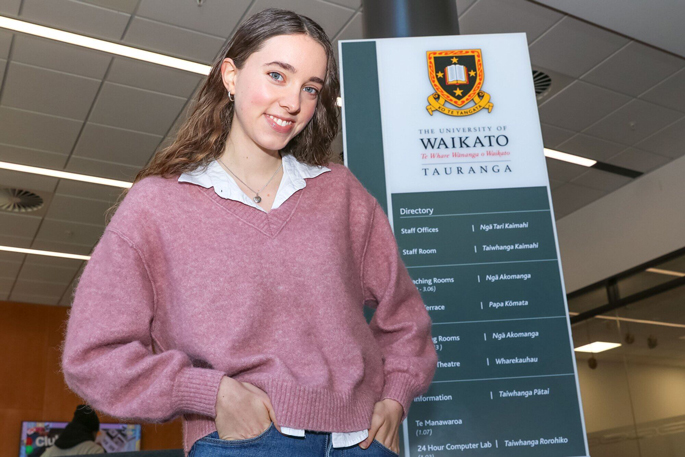
University of Waikato Students’ Union executive director in Tauranga, Olivia Boyd. Photo / Kelly O'Hara
It would also stimulate the local economy and business growth, she said.
“We often walk around and get things from cafes and that sort of thing,” Boyd told Local Democracy Reporting.
“Then as we graduate and we need jobs, it’d be cool to have us all stick around and get jobs around the city.”
Boyd said more students would encourage the rest of the public to create a more active city centre.
“The city has been a bit of a ghost town and been a bit empty in the past few years, but I think we are seeing a bit of change.”
She said students often went into the Mount, especially for the nightlife, and hoped central city businesses would be encouraged to cater to their demographic.
Owner of Grey St’s Banana Blossom Cafe, Amie Hirota, said he supported the plans.

Banana Blossom Cafe owner Amie Hirota. Photo / Kelly O'Hara
He said students regularly came into the cafe. About 7% of their customers were university students and staff.
“The new accommodation will increase student numbers and their spending in the CBD.
“This is a wonderful opportunity for hospitality to cater to students, their budgets and their taste buds.”
A key part of the partnership was the proposed 228-bed student accommodation.
Council documents show the university had encountered funding challenges with the project.
The $2.4m would come from the council’s Elder Housing portfolio sale proceeds. These are sitting at $5.7m and yet to be allocated.
Mayor Mahé Drysdale has spoken about his interest in turning Tauranga into a “24-hour city where there’s always people around.”
He said the accommodation was an example of progress.
Strategy, partnerships and growth general manager Christine Jones said the council transferred ownership of three land titles to the university in 2017 for the city centre campus, including 121, 113 and 101 Durham St.
The Tauranga campus opened in 2019 before facing challenges due to Covid-19, as students studied from home and demand for some programmes changed.
However, deputy vice-chancellor Allister Jones said the university had “ambitious plans” and was in “a strong growth phase”.
Jones said the council partnership showed the city supported the university’s long-term aspirations.

University of Waikato deputy vice-chancellor Alister Jones.
“We are currently experiencing positive momentum, with a 9% increase in student numbers for 2026.
“This growth reinforces the need for more infrastructure to meet the needs of future students.”
The new accommodation site would add to the university’s six three-bedroom flats at Durham Mews and 91 studio rooms in its $20m Selwyn Street Studios building, which opened in 2021.
Ayla Yeoman is a Local Democracy Reporting journalist based in Tauranga. She holds a Bachelor of Arts majoring in communications, politics and international relations from the University of Auckland, and has been a journalist since 2022.
LDR is local body journalism co-funded by RNZ and NZ On Air.


1 comment
students
Posted on 15-07-2026 10:38 | By terminal
I thought uni students were all crying poverty.. how come they are PREDICTED to bring all this income into the claytons city ????? B,S, I think
Leave a Comment
You must be logged in to make a comment.