


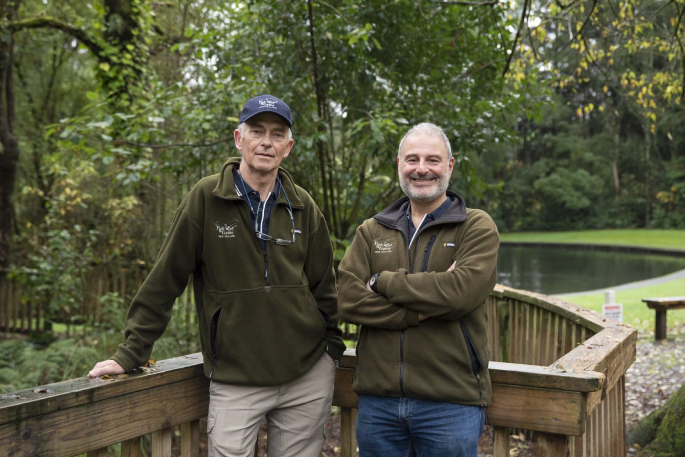
Tucked within 10ha of native bush and exotic plantings in Ngongotahā, Fish & Game New Zealand’s Eastern Region headquarters has been a cornerstone of freshwater management since 1937.
Originally established under the New Zealand Wildlife Service, the site today operates as part of Fish & Game NZ, a public entity created under the Conservation Act 1987. While it reports to the Minister of Conservation, it is not taxpayer-funded, relying largely on revenue from fishing and game bird hunting licences.
One of its key responsibilities is maintaining healthy fish stocks through regulation and restocking. In the Eastern Region, that work centres on breeding trout for release into Rotorua’s lakes – a task that blends science, precision and a strong connection to New Zealand’s angling heritage.
Trout are not native to New Zealand. Brown trout were first introduced in the 1860s, after early pioneers overcame the challenge of transporting temperature-sensitive eggs across equatorial seas. Rainbow trout followed in the 1880s, and both species are now firmly embedded in the country’s freshwater ecosystems.
At Ngongotahā, hatchery manager Mark Sherburn oversees the breeding programme that helps sustain these populations.
“Our hatchery style is a flow-through system,” Mark says. “Fresh spring water from the aquifer under the mountain passes through each tank before flowing into the Ngongotahā Stream and on to Lake Rotorua. It’s ideal for raising trout.”
The hatchery predominantly works with brown and rainbow trout, although hybrid tiger trout – a rarer cross – are also found in the region, particularly in Lake Rotoiti.
Each year, from April through to the end of August, wild broodstock are collected from Lake Tarawera using a fish trap. Carefully selected males and females are brought back to the hatchery, where the breeding process begins.
Females are chosen for their size and strong genetics. When ready, they are anaesthetised and their eggs – or ova – are gently expressed into a container. Males are then stripped of milt, which is added to fertilise the eggs.
“The milt and eggs are swirled in cold water to create a vortex,” Mark explains. “It mimics what happens in the wild. Fertilisation is immediate.”
Once the process is complete, the adult fish are returned unharmed to their home lakes.
Strict biosecurity measures are followed throughout. Broodstock are kept separate from hatchery-raised fish, and all equipment is subject to rigorous cleaning protocols to minimise disease risk.
The fertilised eggs are transferred into incubator trays, where they rest on gauze in cool, flowing spring water. Dim lighting mimics natural river conditions, where eggs would typically be buried beneath gravel.
Within a matter of weeks, tiny black dots – the developing eyes – become visible inside the bright orange ova. Non-viable eggs are removed to protect the health of the rest.
After about a month, the eggs hatch into alevins – small, tadpole-like fish still sustained by their yolk sacs. These are kept in dark troughs until they begin to swim freely and seek food.
“That’s when we know they’re ready to move on,” says Mark.
From there, the young trout are fed a high-protein diet of commercial salmon feed. As they grow, they are moved through progressively larger tanks and ponds, mimicking the transition from sheltered streams to open water.
At around 6 months old, the fish are transferred to outdoor ponds. By the time they reach 1 year, they are ready for release into regional lakes.
While some lakes, such as Lake Rotorua and Lake Tikitapu (Blue Lake), sustain their own trout populations, many others lack suitable spawning habitats. The hatchery plays a vital role in supplementing these fisheries, ensuring ongoing opportunities for recreational anglers.
Beyond fish production, the site also serves an educational and community function.
The hatchery is open to the public on weekdays, and guided tours are available by arrangement. During spring, the popular Children’s Fish-Out Days offer young people the chance to catch their own trout.
“For a small donation, we teach them how to fish and catching a trout is guaranteed,” Mark says. “It’s a great way to get kids off screens and outdoors, and to show them where their food comes from.”
With support from the Rotorua Anglers’ Association, fish are filleted on-site, giving children a tangible connection to the process from water to plate.
As pressures on freshwater ecosystems continue to grow, the role of facilities like the Ngongotahā hatchery is increasingly important. Combining decades of expertise with a deep respect for the environment, the team works quietly behind the scenes to ensure Rotorua’s lakes remain productive and accessible.
For anglers, it means the chance to cast a line into well-stocked waters. For the region, it represents a longstanding commitment to conservation, recreation and community.

0 comments
Leave a Comment
You must be logged in to make a comment.