


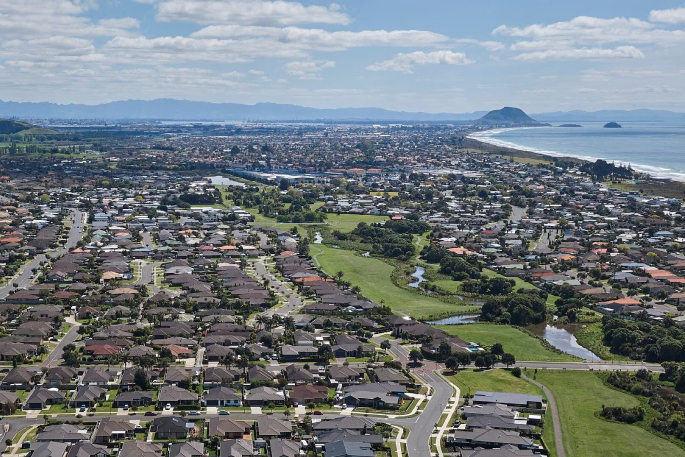
Tauranga has emerged as one of the few bright spots in New Zealand’s increasingly divided housing market, recording modest growth while much of Bay of Plenty experienced declining property values.
The latest QV House Price Index shows residential property values fell 0.4% nationally in the three months to the end of June, with the average New Zealand home now worth $906,443 – almost unchanged from the start of the year but 14.8% below the market peak reached in 2022.
However, Bay of Plenty presented a mixed picture, with Tauranga recording a 0.9% increase in average home values during the quarter, making it the strongest-performing market in the region.
Whakatāne also posted modest growth of 0.4%, while Rotorua (-1.2%), Western Bay of Plenty (-1.6%), Kawerau (-0.8%), Ōpōtiki (-3.2%) and Gisborne (-4.2%) all recorded declines.
QV spokesman Simon Petersen said in a media release that the latest figures highlighted a growing divide between regional housing markets across the country.
“The national average only tells part of the story. Tauranga was the North Island’s only green arrow this quarter, with Whangārei and New Plymouth the only other main centres to avoid average home value declines,” he said.
“By contrast, average home values increased virtually everywhere south of Greymouth, except in Dunedin.”
Petersen said a clear split had emerged between the country’s strongest-performing property markets and those where values were drifting sideways or falling.
While regions such as Canterbury and Southland continued to benefit from strong local economies and relative affordability, other areas remained under pressure from weaker economic conditions and high levels of housing stock.
“Broader political and economic uncertainty is weighing heavily on buyer confidence, while cost-of-living pressures remain a significant challenge for many households,” Petersen said.
“As a result, many prospective purchasers are choosing to sit on the sidelines.”
Despite the subdued conditions, first-home buyers remained active in many markets, taking advantage of elevated stock levels and a wider choice of properties.
Locally, QV-registered valuer Damian Hall said market conditions had become softer towards the end of the June quarter.
“While our quarterly figures show a mixed picture across the Bay of Plenty, there was a slight reduction in values across the board in June, with the exception of the upper quartile in Western Bay of Plenty district,” Hall said.
He said real estate agents were also reporting fewer new properties coming on to the market, after a period in which existing stock had gradually been absorbed.
“That’s not unusual heading into winter, when activity typically slows anyway, but it also appears some buyers and sellers are waiting to see what happens at the upcoming election.”
Looking ahead, QV said several economic and political milestones could influence the housing market in the second half of the year, beginning with the Reserve Bank’s Official Cash Rate announcement.
Petersen said the impact of any Official Cash Rate decision on buyer behaviour remained uncertain but would form part of the wider economic backdrop as the market entered the second half of 2026.

0 comments
Leave a Comment
You must be logged in to make a comment.