


Planning for the next Fieldays was already underway before the gates closed on this year’s event, reflecting both the scale of the agricultural showcase and the demand it continues to generate across the sector.
New Zealand National Fieldays Society chief executive Richard Lindroos says preparation for the 2027 event began earlier this year, with exhibitor processes rolling out almost immediately after the June showcase wrapped up.
“We started planning for 2027 earlier this year, and the exhibitor site application process starts straight away,” he says.
An exhibitor survey was circulated shortly after the event, with early feedback indicating strong engagement from those who took part this season. That response comes off the back of another full-capacity year, with 1115 exhibitors occupying 1335 sites across the Mystery Creek Events Centre.
Richard says the current site configuration effectively represents a sellout.
“We review and adjust the site layout each year, but under the current plan, this represents full capacity,” he says, noting there will be little change to overall site numbers for 2027.
Returning exhibitors in key areas, including outdoor and indoor agri, heavy equipment, motor vehicles and rural living, are already being allowed to secure their existing sites through a pre-release process, which opened on June 18 for those meeting specific criteria. Other spaces across the event footprint will be made available through general allocation in early October.

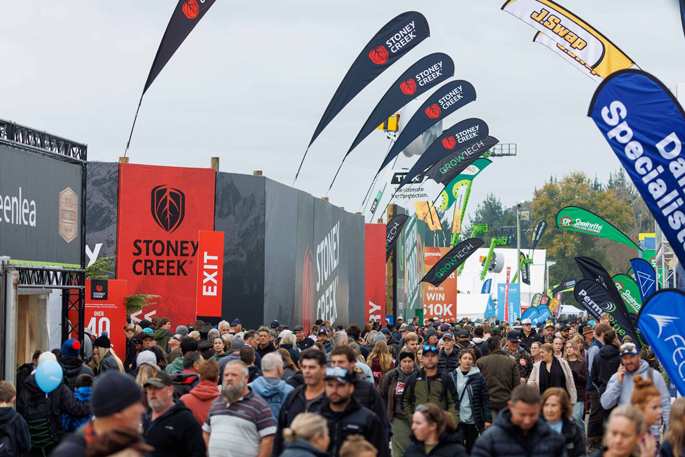
An aerial view of the packed Fieldays’ site during this year’s edition at Mystery Creek.
International interest also continues to grow. This year’s Fieldays hosted 73 overseas exhibitors, up from 66 in 2025, representing markets as varied as Australia, China, Germany, India, the Netherlands, Britain and the United States.
Trade and diplomatic engagement remained strong, with delegations from Brazil and Chile attending after targeted outreach by Fieldays organisers.
Richard says there is already solid interest for the 2027 event from countries including Poland, Spain, Italy, the Netherlands and Brazil, highlighting the event’s increasing global reach.
That international momentum was matched by strong domestic turnout, with this year’s Fieldays benefiting from favourable weather conditions across all four days.
Attendance figures surpassed expectations, with more than 132,000 people through the gates – the first time in five years numbers have exceeded 130,000.
The opening day set the tone, drawing just under 30,000 attendees compared with a more typical Wednesday crowd of about 22,000. Overall attendance was up 20% on the previous year, underscoring the event’s continuing appeal.
While no formal cap limits visitor numbers on any given day, Richard says capacity is instead governed by the ability of infrastructure and operations to safely support large crowds.
“That includes transport and parking capacity, site access, power supply, water supply, wastewater management, emergency services access and overall crowd management,” he says.
Significant investment is being made to ensure the venue can continue to support events of this scale.
Earlier this year, the society secured a $1.35 million loan from the Regional Infrastructure Fund to upgrade the water reticulation system at Mystery Creek, part of a wider $3.2m project completed before Fieldays 2026.
The upgrade strengthens the reliability and resilience of water supply across the site, ensuring it remains fit for purpose not only for Fieldays but for its broader role as a major events venue and critical civil defence hub for the Waikato region.
Attention is now turning to energy resilience, with plans to integrate renewable energy and on-site generation as part of a long-term infrastructure strategy.

Four days of good weather and a buoyant rural sector delivered an outstanding 2026 Fieldays.
The society is working alongside Genesis Energy and Waipā Networks to explore solutions that will support future demand.
A three-year PhD project, launched late last year in partnership with Waipā Networks, Te Herenga Waka – Victoria University of Wellington and Lincoln University, is also examining how rural electricity use, production and distribution can be improved to strengthen resilience.
Richard says Mystery Creek is a unique case study because of its dramatic fluctuations in electricity demand during the annual four-day event, making it an ideal testing ground for innovative approaches.
Transport and roading access remain ongoing challenges, however, with the site primarily serviced by Airport Rd (State Highway 21) and Kaipaki Rd.
While on-site parking capacity is substantial, congestion often occurs on surrounding roads rather than within the venue itself.
A park-and-ride service continues to play an important role in easing pressure, with 18,900 people using the service during Fieldays 2026. Free buses operated from Hamilton, Cambridge and Te Awamutu, although usage rates remained consistent with previous years.
Despite rising fuel costs, Richard says public transport uptake held steady at about 14% of attendees, suggesting behaviour patterns are yet to significantly shift.
With planning now firmly focused on 2027, organisers are balancing strong demand with the need to enhance infrastructure, improve resilience and maintain the visitor experience that has underpinned Fieldays’ success for more than 50 years.

0 comments
Leave a Comment
You must be logged in to make a comment.