


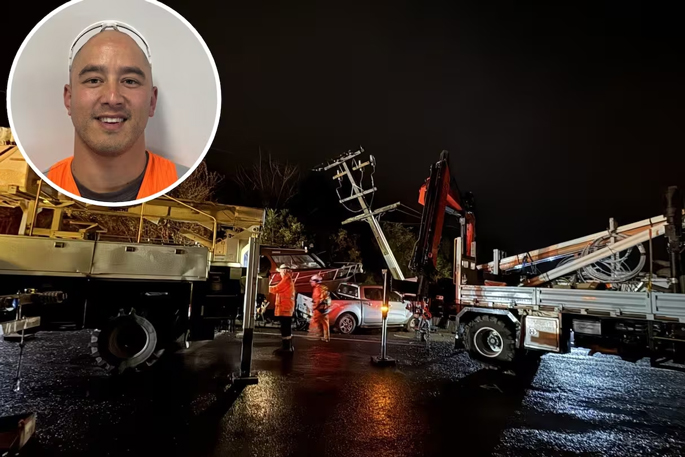
Restoring power lines during a storm is “chaos” and “dangerous” - and Bay of Plenty linesworkers have had more than their fair share of it this year.
This year is the first time the Bay has had two red weather warnings so early, Metservice says, with alerts issued in January, when the fatal Welcome Bay and Mount Maunganui landslides happened, and for Cyclone Vaianu in April.
Northpower fault supervisor Cam Glasgow said conditions during a storm made even basic tasks impossible.
“Just how dangerous it can be up there ... you can’t even get your ladder off the roof to even do any work.”
Northpower maintains the local network for Powerco as a contractor, providing maintenance and fault response services.
Glasgow said crews prioritised public safety and hazard stabilisation during severe weather. Full repairs waited until conditions improved.
“It’s pretty much chaos when the storm’s hitting.
“You repair stuff in one area, and 500 metres up the road it’s going to fall down again.”
He said their strongest asset was local knowledge, built from multiple people who had worked on the network for about two decades.
“Within a group of seven of us, there’s over 120 years of experience.”
During Cyclone Vaianu, Northpower brought in crews from New Plymouth and Matamata to help with the workload.
Glasgow said the extra hands were valuable, but outside crews could not match local efficiency.
He said storms were hitting harder and more frequently.
“It’s like every eight days there’s a weather event now, and they’re all big damaging weather events."
 Northpower crews scale up during major storms, focusing first on public safety before full repairs begin.
Northpower operations manager Mike Stevens said a small team handled outages on a normal night, but that number more than tripled during a storm.
He said the overnight crew of four could quickly turn to eight and by morning routine work was cancelled as 30 to 50 staff moved to storm recovery.
Stevens said during a storm, emergency faults took priority when public safety was at risk.
“If there’s a line that’s fallen on the ground, that will trump a job that’s even got 300 customers off.”
He said severe weather events had risen and lines teams had improved their response accordingly.
Power was restored to 99.9% of customers within two days of Cyclone Vaianu, he said.
Northpower faultsperson Alvin Webby said storm preparation began days ahead of severe weather with reviews of forecasts, wind angles and rainfall.
Access problems because of storm debris often delayed restoration. Fallen trees, slips and blocked roads could turn straightforward jobs into long outages.
Webby said customers were often frustrated when the team could not restore power immediately, but the public did not see the complexity behind the scenes.
Rotorua‑based Unison faultsperson Andy Bowman said Cyclone Gabrielle was the most significant storm he had worked through.
It brought days of continuous faults and difficult decisions about which customers could be restored first.
“We’ve got a good team here. We look out for each other and make sure everyone gets home at the end of the day.”
Bowman said the public may not realise how much co-ordination went into keeping crews safe and the network running.
 A fallen power pole and lines after severe weather.
Whakatāne District Council local duty controller Nicholas Woodley said Cyclone Vaianu delivered a level of disruption that tested every part of their response network.
He said more than 60 roads were hit by fallen trees, debris and downed powerlines.
Water and wastewater systems needed constant monitoring to keep essential services running.
Woodley said the first hours of the cyclone were spent assessing real-time impacts and making safety calls.
Away from public view, teams were co-ordinating resources, planning responses and preparing to move as soon as conditions eased.
“Behind every response are people making careful decisions in difficult conditions ... much of this work happens out of sight.”
He said Cyclone Vaianu underscored how crucial early preparation and public compliance with warnings were.
Resilience would be increasingly important as severe weather became more frequent and intense.
“The focus is always on safety, restoring access and services, and doing what is needed to help people get through severe weather events as safely as possible.”
Red weather warnings
MetService meteorologist Mmathapelo Makgabutlane said Tauranga, Rotorua and Whakatāne have had a much wetter start to the year than usual.
Except for February, every month has recorded rainfall well above the long‑term average.
Many of those totals matched or exceed the extremely wet opening months of 2023, when Cyclone Gabrielle hit.
This year has also been the first time the Bay of Plenty has received two red warnings this early in the year.
Makgabutlane said this showed how active and intense the region’s weather has been.
Zoe Blake is a multimedia journalist at the Bay of Plenty Times and Rotorua Daily Post.

0 comments
Leave a Comment
You must be logged in to make a comment.