


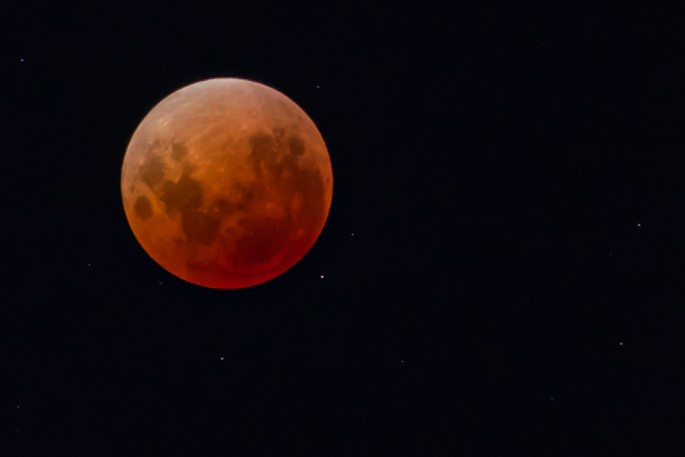
The spectacular sight of a rare lunar eclipse graced southern skies overnight with the moon turning copper-red over the course of several hours.
Called a “blood moon” for the eponymous change in colour, the astronomical event occurs when the moon and Earth shift into alignment.
Last night may have been Kiwis’ only chance to see a lunar eclipse this year, with the next event of its kind occurring in 2028.
Here is what the celestial wonder looked like for those who missed it.
 The eclipse in full, captured in West Auckland and shown in a stacked image sequence. Photo / Hayden Woodward
 The peak of the eclipse, shown in a stacked image sequence. Photo / Hayden Woodward
Stargazers relished the clear skies last night to view the eclipse, as even the most amateur of astronomers could experience the light show – nothing but your eyes was needed to see the eclipse’s effects.
New Zealand was one of the few places in the world able to see the eclipse in its entire duration, Te Whatu Stardome astronomer Josh Aoraki told the Herald.
 The eclipse captured with a telescope. Photo / Ruben Black
 A glowing red moon high in New Zealand's sky last night. Photo / Supplied
Although it lasted almost six hours in total, beginning at 9.45pm, the best time to view the craters glowing in a copper tinge was between midnight and 1am.
 The moon seen during the eclipse's peak. Photo / Supplied
“By about 11pm, you’ll start to notice the kind of visible redness take over the disc of the moon, and then by midnight it’s going to be completely within the Earth’s shadow,” Aoraki said yesterday.
 The best time to view the astrological phenomenon was between midnight and 1am. Photo / Supplied
Thanks to the moon’s height in the sky, the rare astronomical sight was visible just about everywhere across New Zealand.
 The moon seen in Waterview, Auckland. Photo / Sembian
What is a blood moon?
Aoraki said the striking celestial sight is “basically” light being broken up in the atmosphere.
As the Earth, sun, and moon slowly shift into near-perfect alignment, the moon will gradually appear red as the Earth blocks the sun and casts a shadow across its surface.
“If you imagine during a sunrise or a sunset, as sunlight is passing through the atmosphere, it has to go through more of it, so it gets split up into the red wavelengths and those actually get kind of refracted or bent around the Earth into the Earth’s shadow.”

0 comments
Leave a Comment
You must be logged in to make a comment.