


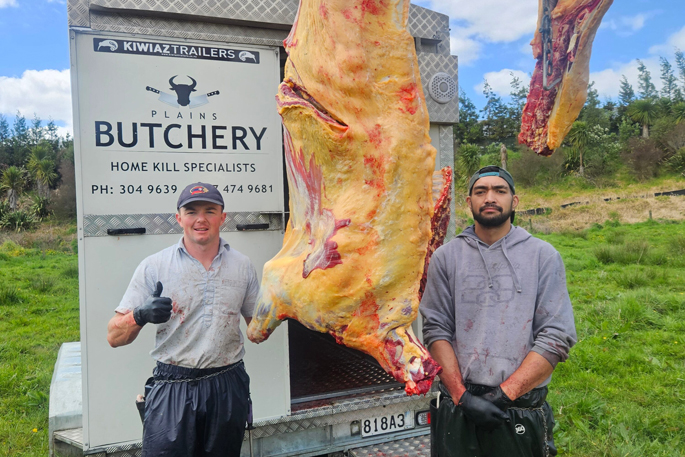
When homekill specialist Toby Barkla posted a clip-on social media showing the inside of a cow’s udder, he didn’t expect much more than the usual interest.
Instead, the video took off, racking up more than 6.2 million views and attracting a wave of curiosity, questions and commentary from right around the world.
“It blew me away,” Barkla says, who owns Plains Butchery in Edgecumbe and is on the Federated Farmers rural butcher leadership team.
“People were genuinely fascinated by how things work behind the scenes.
“Even a lot of farmers commented that they’d never seen the inside of an udder.”
That fascination speaks to something Barkla is seeing more and more of in his day-to-day work.
“People really want to understand where their food comes from and be able to access it more directly,” he says in the latest Federated Farmers Podcast episode.
It’s a big part of what’s driving his next move, establishing a regulated micro abattoir that will open the door for more Kiwis to buy top-quality, locally processed meat.
Homekill has long played an important role in rural New Zealand, but it comes with tight rules.
Because the slaughter happens in an unregulated environment, the meat can only be returned to the animal’s owner, farm staff or immediate family.
It can’t be sold, and it can’t enter the commercial food chain.
“There’s no official inspection process in homekill, so you can’t go out and sell meat to the public,” Barkla explains.
“That’s for good reason too, because we need to protect food safety.”
Those restrictions are what Barkla wants to work around by stepping fully into a regulated system.
His vision is a micro abattoir that operates on a small, local scale, but meets all the food safety and inspection requirements needed for meat to be legally sold.
Barkla, his slaughterman and his partner are nine weeks into a meat inspector course run by AsureQuality.
They’re currently learning the disease, defect and compliance requirements that underpin regulated processing.
“We’re actually already applying what we’re learning on the course when we’re out on the job,” he says.
“It’s been really good.”
Under the definition, a micro abattoir can process up to 20 animals a day, supplying only the domestic market.
“That scale is important,” Barkla says. “We’re not talking about massive numbers, but it’s big enough to make a real difference in the regions.”
Another driver behind the move is waste – something Barkla says has frustrated homekill operators for years.
“At the moment, we can’t utilise a lot of our byproducts at all, not even for pet food,” he says.
Because homekill meat is unregulated, the hearts, livers, kidneys, fat and bones must be buried on farm or sent to rendering.
Even hides, which once had value, are now frequently treated as waste.
“It sucks seeing it go to waste,” Barkla says.
“If you’ve got a 300kg steer carcass, for example, a third of that is fat and bones as waste product.
“There’s a lot of goodness there and that’s a huge part of why we want to set up a micro abattoir.”
With inspection and traceability in place, Barkla will be able to use the byproducts, dramatically reducing waste and opening up new income streams.
For farmers, especially those in remote areas where small abattoirs have closed, Barkla believes the model could be a real win.
“It’d be awesome for places like the East Coast,” he says. “It’d mean a lot less travel time compared to sending meat to the big plants.”
There’s also a strong local angle, as micro abattoirs are designed to feed New Zealanders, not export markets.
“There’s a real feel-good factor,” Barkla says.
“It means New Zealand’s eating its best meat, rather than sending it overseas.
“It would be neat to be able to pick out some of our prime beef – imagine a beautiful line of nice fat Angus heifers – and make that available to the local community.”
While limited in scale, the model is big enough to support rural employment too.
Barkla estimates a fully operational micro abattoir could employ 15 to 20 people, creating skilled jobs in provincial communities.
“That’s definitely a win for farmers and for towns,” he says.
Barkla’s social media videos may have captured overseas attention, but his next chapter is firmly grounded in the regions.
“I’m really excited about finding smarter, more sustainable ways to get quality Kiwi meat onto Kiwi plates.
“Opening a micro abattoir will open up so many avenues for us to do that.”

3 comments
Overit
Posted on 16-02-2026 13:05 | By overit
Yay Toby love the idea, will be using you
I totally agree…
Posted on 16-02-2026 16:26 | By Shadow1
…. with Toby Barkly. My letters to the odd Minister have gone unanswered. A chain of small abbatoirs across NZ would give New Zealanders a fair chance to eat the best meat in the world. By setting the export quality meat using the “market forces “ system( that is overseas prices), it is beyond affordable for the average consumer. Obviously Central Government don’t care as it keeps more GST coming in.
Go for it Toby, I for one will support you.
Shadow1.
Good on you guys!
Posted on 17-02-2026 10:08 | By Cap'n Cray
Good on you guys and best of luck with your endeavour.
Nice to see an opportunity for quality on the home market instead of "seconds", and a dent in the gross pricing (read - profiteering) that we're enduring will be a bonus.
Leave a Comment
You must be logged in to make a comment.