


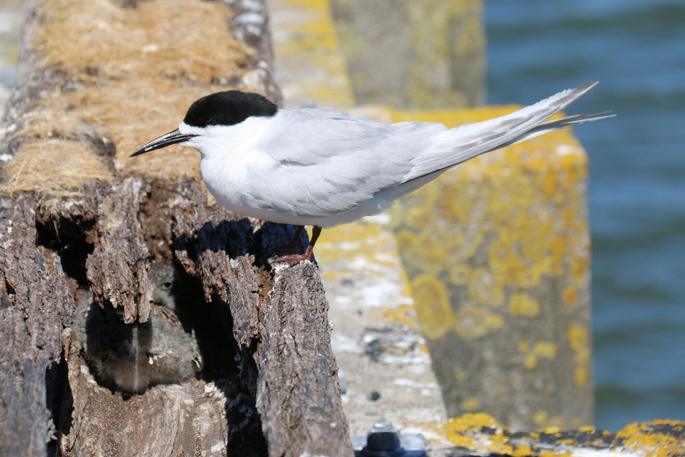
A small colony of white-fronted terns continues to defy convention by nesting beneath Tauranga’s busy Hairini Bridge, even as council contractors carried out investigation work on the structure earlier this month.
For years now, motorists crossing the bridge have grown used to seeing photographers and birdwatchers leaning over the western side, cameras trained on the wooden trestles below where the native seabirds raise their young each summer.
Unique
The colony is considered unique in New Zealand for its accessibility, with most white-fronted tern colonies found in remote coastal locations far from heavy traffic.
Completed in 1882 to connect Tauranga with the southern side of the Bay of Plenty, the Hairini Bridge was once the largest structure of its kind in the country.
Today, it serves not only as a key transport link but also as an unlikely urban nesting site. The terns nest among the original bridge piling and in a specially constructed nesting platform on one of the old abutments.
Between December and February, the colony attracts visitors from around the country keen to observe the birds during breeding season. Eggs are often visible, and fluffy chicks can be seen learning to navigate their precarious surroundings just metres below passing vehicles. Walkers and cyclists regularly stop mid-bridge to check on their progress.
Rebuilt habitat
At its peak, the Hairini Bridge colony has supported up to around 50 white-fronted terns, although numbers fluctuate from year to year and have previously dipped to about 30 birds. A white-faced heron and red-billed gulls are also often spotted there.
The nesting habitat was rebuilt several years ago after storm damage shifted the bridge’s wooden piling framework. The reconstruction was widely seen as a success, with bird numbers increasing in subsequent seasons. During a major storm in January 2018, the bridge itself helped shield the colony from the worst of the waves.
However, the colony’s history has not been without setbacks. In 2017, one chick was killed by a rock deliberately thrown from the bridge, prompting widespread community outrage. Earlier, in 2014, the deaths of three white-fronted terns at the Turret Rd bridge were also believed to be the result of foul play, raising concerns among bird experts that the colony might be abandoned. Despite those incidents, the birds continued to return and breed.
This week, Tauranga City Council has been carrying out water-based investigations on the Hairini Bridge as part of the 15th Ave to Welcome Bay transport project. The work, running until Friday, February 13, was being conducted from a pontoon boat in the Waimapu Estuary, with no activity taking place on the road surface.
During the investigation council urged drivers not to slow down while passing over the bridge, saying reduced speeds could disrupt traffic flow. Contractors were cleaning piles with water blasters to allow close visual inspection, scanning bridge reinforcement with ground-penetrating radar, and undertaking some sample drilling.
Not disturbed
Council said all environmental considerations were followed, including ensuring the protected white-fronted terns were not disturbed.
The investigations will help determine the bridge’s remaining useful life and seismic capacity, informing future plans that include three-laning the bridge, and adding a clip-on shared walking and cycling path.
White-fronted terns are native to New Zealand and are the most common tern species along the country’s coastline, although their overall population is declining. Their name comes from the narrow white band, or frons, separating the black cap from the black bill.
With further transport upgrades planned in the area once the Maungatapu bypass is completed, the long-term future of the terns at Hairini Bridge remains uncertain. For now, though, the birds continue nesting and raising their young in one of the country’s most unexpected wildlife neighbourhoods.

2 comments
Overit
Posted on 16-02-2026 08:18 | By overit
I love those birds, & hope theres always a home for them there.
Agree Overit
Posted on 16-02-2026 21:50 | By Yadick
They're absolutely stunningly beautiful.
Leave a Comment
You must be logged in to make a comment.