


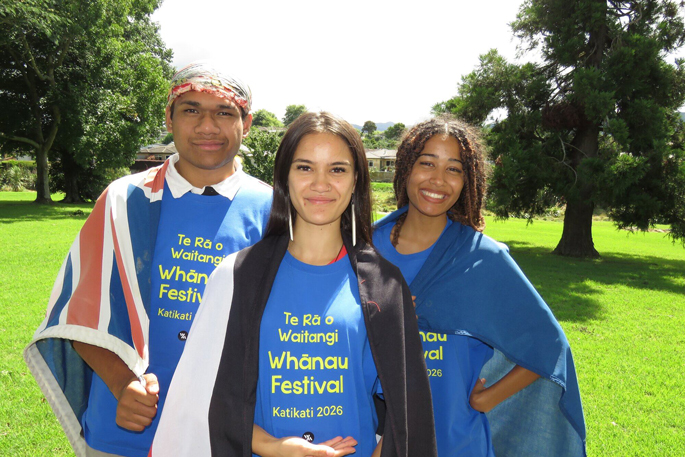
Today, Katikati’s second annual Te Rā o Waitangi Whānau Festival (Waitangi Day Family Festival) will take place at the Haiku Reserve from 11am to 3pm.
The free, family-friendly event is open to everyone – to commemorate the signing of the Treaty of Waitangi (Te Tiriti o Waitangi) and New Zealand’s national day, but also to celebrate Aotearoa and acknowledge the country’s past in a positive, inclusive way.
As such, Katikati News has asked three local teens, who will perform at the festival, what Waitangi Day means to them and why they support the event.
Our responsibility
Tia-Maraea Brown, 18, (Ngai Te Rangi iwi, Ngāi Tamawhariua and Tauwhao hapu, Te Rereatukahia and Otawhiwhi Marae), is part of the band Katikati Trio, with Manase Uilou, 17, who has Pacific Islands heritage, and Inyamoka Toker, 18, originally from Namibia, who moved to Britain and then New Zealand.
“Waitangi Day to me is important because it shows both the beginning and our responsibility,” said Brown.
“It reminds us of where we come from and what we share, as we reflect on our history. It’s also a time to celebrate Te Ao Māori, our culture and the connection that brings us together.”
Important
Brown said she believed Waitangi Day is something all Kiwis should come together and be involved in. “It’s important for everyone living in New Zealand to know our history, isn’t it? I mean, if you’re not going to learn about it, what’s the point? I feel like every NZer should be aware of the multicultural diversity and history that makes up NZ.”
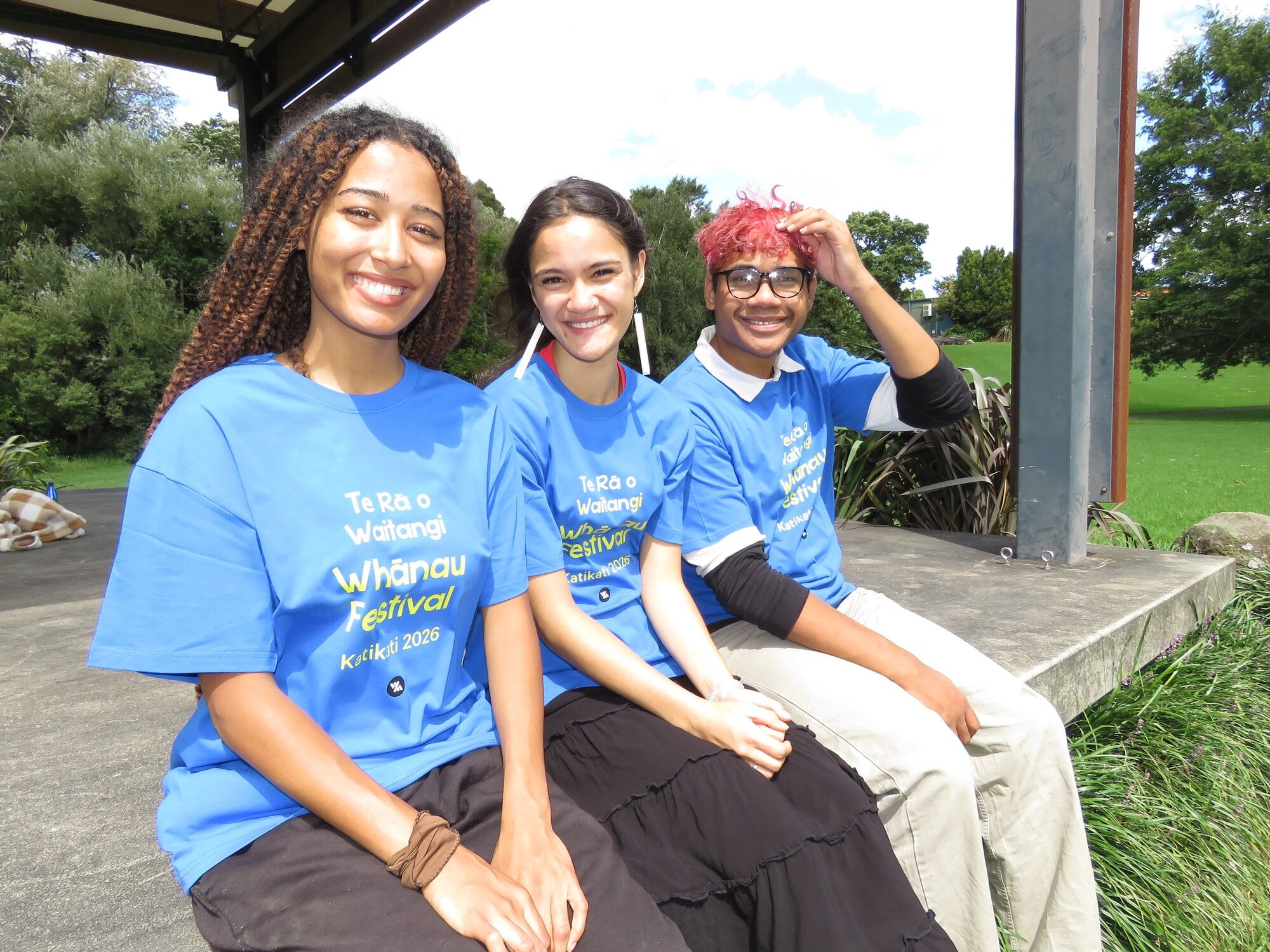
Eighteen-year-olds Inyamoka Toker and Tia-Maraea Brown, and Manase Uilou, 17, are the Katikati Trio that will perform at Te Rā o Waitangi Whānau Festival at the Haiku Reserve on February 6. Photo / Merle Cave
Since 2025, Brown has worked at Western Bay Museum, which hosts Te Rā o Waitangi Whānau Festival in its mahi (work) to raise awareness of Katikati’s early history of both Māori and Europeans.
“I jumped on as, I guess, a wahine toa [strong woman] of our museum, and it’s been really special because I feel like as a young wahine [woman] people can talk to me from both perspectives and share their thoughts and feelings and not feel pressured.”
Toker said Waitangi Day is very special. “I really admire it from my experiences living in a number of different countries. I’ve never seen such a want to broaden and spread that [inclusiveness] among everyone.”
Toker said other countries could be very one-sided in the way they marked their history, “or it’s done without much care or interest … so I really like how in NZ you all seem so open to let everyone know about the country’s history”.
Beautiful experience
“Waitangi Day is a beautiful experience, in my opinion,” said Uilou. “It’s nice to learn more about the history, even for those who come to the event to learn more about who the Māori people are and what they’ve been through, and everything that everyone’s gone through over the years, to bring us to this [present] day.”
Small, local, grassroots events across the nation on Waitangi Day – such as Katikati’s – massively supports the revitalisation of Te Ao Māori, said Brown.
“With them we can bring back the uprising of Te Ao Māori, the recognition of it and the fact that there was a wrongdoing that lots of people aren’t learning about, or choose not to learn about, but that is important to know about.”
More accessible
Western Bay Museum manager Paula Gaelic said 2025 was the first time her organisation had held a festival on Waitangi Day, and there was reasoning behind it.
She wanted more local residents to attend the event by making it more accessible, appealing and comfortable. “We wanted something rather than a formal dawn service, which was a bit restrictive because some people don’t like dawn things or formal things.
“We decided to give our event a more festival approach, and I always think kai [food] and waiata [song] bring people together, and it kind of levels everyone out – especially music.”
Surprisingly, Gaelic said many Kiwis had never seen a live Māori cultural performance. Her kaupapa (vision) was to change that.
“Our younger generations, because cultural performances take place at school these days, they see it regularly. But for a lot of older people, even middle-aged, unless they’ve gone to Rotorua or grown up with a link to a Māori community, they’ve never had the opportunity.
“Some have never worked with Māori or got to know a Māori family, so when you host a grassroots-level festival like this – everybody that comes is there for the right reason for a start.
“Then, once the cultural performances start, you just can’t help but let the wairua [the spirit] take over. Last year was just this beautiful event where everybody was so happy.”
The inclusive-positive vibes mix was a successful recipe to reach people who wouldn’t otherwise gather on Waitangi Day, Gaelic said.
“With our communities, we make the vibe for the day,” said Gaelic. “It’s just a day of being,” said Brown. “It’s not too heavy,” said Toker.
Local support
“It’s in the moment,” said Gaelic. “And the other side is that we do everything on a shoestring. We do get funding from the Kaupapa Māori event team, but still it’s a tight budget, yet our community jump in to help.
“Our local fire brigade offers on-site first aid. An early childhood education centre has offered to run a sunblock station. Our stage manager, sound technician and main act have reduced their fees.”
Brown said overall the day was about ensuring everyone – of all ages and walks of life – felt comfortable to come along “and to make a start on their journey to embracing Waitangi Day and learning more about our country’s history”.
“I’m so excited to see the turnout. I know Paula [Gaelic] has worked so hard on it, trying to exceed expectations, and I’m excited to see who embraces the day.”
Come along!
This year’s festival begins 11am at Haiku Park with a mihi (official opening) from kuia and kaumatua of Ngāi Tamawhariua Te Rereatukahia Marae.
From here a diverse line-up of cultural acts will perform – including Katikati College’s kapa haka group Te Kapa o Uretara ki Wharei, Tauranga’s high-energy Cook Islands group, and Katikati’s Indian cultural group, plus headliner King Cool, a dynamic powerhouse trio covers band from the Waikato.
Cultural interactive workshops and craft activities will run throughout the day, including poi making, harakeke weaving, and Pasifika lei and crown crafting. “Last year’s craft tent got slammed, so we’ve doubled the space for 2026,” Gaelic said.
She advises people to bring water, sun umbrellas, hats, chairs and sunblock. “We will take care of the rest. Food is always what brings people together, so there will be a variety of vendors to purchase delicious food choices.” For updates, check ‘Western Bay Museum’ on Facebook.

0 comments
Leave a Comment
You must be logged in to make a comment.