


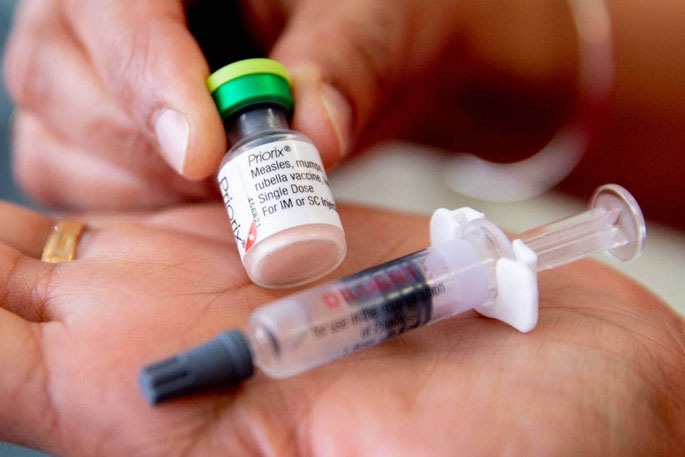
Child vaccination rates in some areas remain in a state of crisis as healthcare providers are stuck in a post-Covid-19 catch-up phase, according to an expert.
Figures from the Ministry of Health, covering the period between July 1 and September 30 last year, show just 65 per cent of children in Counties Manukau were fully vaccinated at six months old.
Dr Nikki Turner is the medical director of the University of Auckland's Immunisation Advisory Centre. She said while vaccination numbers could often improve as providers 'catch-up”, the situation was dire.
She says during the pandemic health systems around the world had been dealing with one crisis after another and as a result, preventative health measures like child immunisation have suffered.
'But we can't let our child vaccination programme decline,” says Turner.
'There is an awareness that this is a real crisis, but we're still stuck in a catch-up phase.”
The World Health Organisation recently raised concerns about an international outbreak of polio cases in New York, Israel, Indonesia and London.
Turner says while there is a growing awareness about it, it's important not to lose sight of the fact that all childhood vaccinations were important.
'I think that's the key message. We don't want to just focus on polio in isolation.
'Currently measles remains our biggest concern.”
The 2019 measles outbreak saw more than 2000 cases recorded nationwide and Turner says many of those who contracted it hadn't been vaccinated as children.
Childhood immunisation includes the MMR vaccine for measles, mumps and rubella, as well as vaccinations for pertussis (whooping cough), polio, diphtheria, tetanus, rotavirus, influenza and Covid-19, for those who are eligible.
Turner says a lot of children in lower socio-economic communities like south Auckland aren't enrolled with a GP and access to primary healthcare remains a barrier. And far too often such factors impact on whether a child get immunised.
'But we want to act before we see these diseases again.”
A paper to the Counties Manukau DHB in March last year said immunisation rates fell considerably between March 2020 and March 2021 and had continued to drop.
According to the DHB report 85 per cent of children in Counties Manukau were fully vaccinated at eight months of age in February 2022, but only 67 per cent of Māori babies were fully immunised. That compared to 83 per cent for Pasifika infants, 89 per cent of Europeans and 98 per cent of Asian children in the same age group.
In a statement, Te Whatu Ora outbreak response director Matt Hannant says over the past few years, childhood immunisation rates have been falling globally – in part due to the impact of Covid-19.
'New Zealand is part of this global trend, with some regions and specific population groups (such as Māori and Pacific children), with lower than average immunisation rates giving us cause for concern.
'Significant work is underway at both national and regional level, as well as on the ground with healthcare providers in communities to encourage and support childhood vaccinations as a priority.”
-Public Interest Journalism funded through NZ On Air.

0 comments
Leave a Comment
You must be logged in to make a comment.