


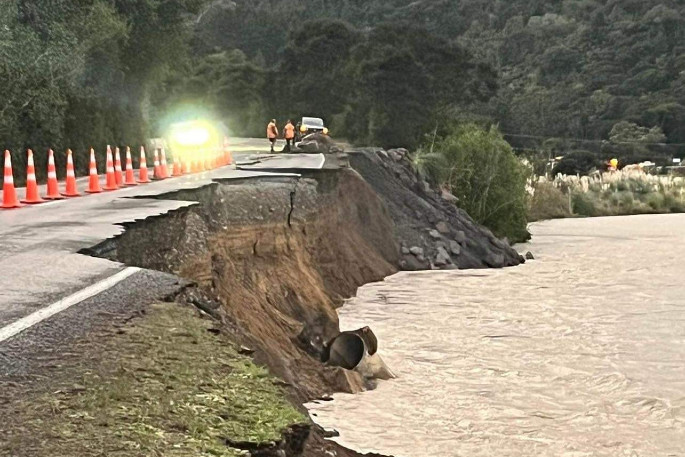
The resilience of state highways, making alternative routes fit for purpose and the reason there are so many potholes are just some of the topics being talked about at the moment.
'This is annus horribilis in terms of resilience challenges,” Waka Kotahi Waikato-Bay of Plenty relationships regional director David Speirs told Ōpōtiki District Council at its first meeting since the elections.
'You'll know this from your own personal experiences. Everywhere in the network has struggled with weather events.
'What those weather events have highlighted is, where we have a closure of a major network, we have very limited alternative route provision and often those alternative routes are not suitable for the vehicles travelling on them. Very large trucks, for example, or even in some cases emergency vehicles.”
He says alongside Ōpōtiki, Gisborne, Coromandel, Taranaki, and some parts of the South Island have been identified by the transport agency as 'hotspots” both in the context of where the weak points were, but also as critical lifelines to communities.
'State Highway 2 and State Highway 35, in your case, have already been identified as having significant issues from a geotechnical point of view, but also from a lifelines point of view, so they are critical; there is only one way in, there's only one way out.”
He says Waka Kotahi is assessing alternative routes.
'We are looking at, whether we can be confident that, if the state highway is closed for any reason - be it a crash, be it a washout - that the alternative routes that we are relying on are fit for purpose.
'It's going to be an enormous job, but that will identify the one-lane bridge that's not capable of carrying a milk tanker, the gravel road that will fall apart if you put 1000 cars a day instead of 50 on it for three days.”
David says he will be working with councils to help identify these areas over the next few months, but it will be a lengthy process.
He also addressed the issue of potholes on state highways, saying it's due to less funding provided for maintenance.
'It's no secret we've got some pothole issues at the moment. Much of that is driven by decisions made some years ago to take a minimalist approach to the maintenance of the network in favour of funding some large infrastructure projects.
'We are now starting to see the impact of that minimalist approach.”
He says that as a result, Waka Kotahi is now having to invest quite heavily in renewals and in maintenance of the network to get it back up to speed.
David talked the council through Waka Kotahi's investment process to help them understand where their biggest influence as a council could be in expressing their community's needs.
Talking about the issue of road safety, David says the Bay of Plenty-Waikato region has one of the highest death and serious injury rates in the country, partly due to how much the roading network was in use because of how spread out our communities were.
'Unfortunately, those networks were built back in the 1940s and 50s.
'They weren't built with 58 tonne trucks in mind. They weren't built with speeds of 100kmh-plus in mind.
'They weren't built with the number of vehicles that we've got now in mind.
'As a consequence of that, we tend to score way above anyone else in terms of deaths and serious injuries. Reducing that is quite a high priority for us.”
-Local Democracy Reporting is Public Interest Journalism funded through NZ On Air


0 comments
Leave a Comment
You must be logged in to make a comment.