


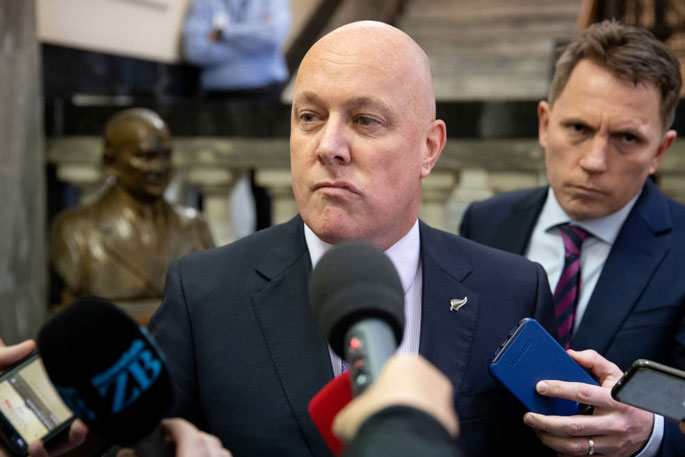
Industry and opposition voices have decried the latest fuel sector shake-up as "a leap back to the 1970s" and warn the measures could drive prices up, not down.
Minister of Energy Megan Woods announced a suite of measures on Wednesday morning aimed at making the country's fuel system more secure and affordable.
Under the plan, the Commerce Commission would be given the power to step in and set fairer fuel prices if it identified anti-competitive behaviour.
National leader Christopher Luxon says the model is a band-aid solution and a "leap back to 1970s".
"Global fuel is a global commodity and it's very difficult to impose 1970s price controls ... didn't work then and it's not going to work now."
'Today it's fuel companies, who's next?'
Industry group Energy Resources Aotearoa chief executive John Carnegie says the proposal is rife with fishhooks.
"Price controls do not work. They did not work in the 1970s and they will not work now. They will create barriers for competitors and leave consumers worse off.
"The risk of price controls will be a red flag for any international firm weighing up whether to enter New Zealand. Today it's fuel companies, who's next?"
The response from individual fuel companies has been muted.
Gull's chief executive Dave Bodger says he's not overly concerned by the "wee bit more red tape" but it would have flow-on effects.
"It is a greater compliance cost which unfortunately ends up with the consumer in the end."
In a statement, a spokesperson for Mobil also warns of "the potential for unintended impacts" such as discouraging new market participants.
Z Energy chief executive Mike Bennetts says the government's announcement has been well flagged and did not come as a particular surprise or concern.
"Our performance is transparent. We report on it regularly and publicly disclose it. We have nothing to fear from this."
Other aspects of the government's announcement have caused disquiet in the fuel sector, notably the new fuel stock levels required on-shore in case of disruption.
Carnegie says "minimum fuel stockpiling" would inevitably add unnecessary costs to the price motorists pay at the pump. Bodger describes it as a "significant inconvenience and significant additional cost".
'It's about making sure we're planning for our future'
Speaking on Wednesday, Woods told reporters the full suite of measures was necessary to increase fuel supply resilience.
"This is about making sure that we've got that balance of resilience, sustainability, and competitiveness in our fuel markets right.
"It's about making sure we're planning for our future and that we're protecting New Zealanders' hip pockets as we go through."
Officials are developing a "backstop regime" - expected to be in place by mid-next year - to allow the Commerce Commission to intervene if it sees anti-competitive behaviour or market power being exerted.
If excessive terminal gate prices were being offered, the Commission could regulate prices for one or more wholesale suppliers.
"If they found that there was anti-competitive behaviour occurring, then they would have the ability to regulate what what would be a fair price," says Woods.
The Commission could investigate of its own accord or at the request of the Minister. Such investigations could take six to 12 months.
The "backstop regime" was one of the recommendations made by the Commission in its fuel market study in 2019.
'It's vital that we have good resilience'
The policies announced this week follow the closure of the Marsden Point oil refinery.
Woods told media she's confident the new measures will ensure the country has either the same or a higher level of fuel resilience than when Marsden Point was operating.
New rules will ensure New Zealand has enough petrol on-shore to last 28 days, enough jet fuel to last 24 days, and enough diesel to last 21 days.
The government will also buy 70 million litres of diesel stock, roughly an average of seven days' supply for the country.
"Transport fuels currently underpin the day-to-day running of our economy and it's vital that we have good resilience in this fuel."
These levels are similar to what the country held before Marsden Point cut back its operations, Woods says, and will help protect against disruptions like economic shocks, natural disasters, and infrastructure failures.
'This is not putting climate change on the back-burner'
The fuel industry has also been given another year before having to comply with the Sustainable Biofuels Obligation which requires wholesalers to add biofuels to their supply. The deadline has been delayed to April 1, 2024.
"If we had pushed on with the April 2023 implementation date, that could have added six-to-10-cents-a-litre to diesel," says Woods.
"That was something, as a government, we were not prepared to do."
Woods says the initial deadline would have been inappropriate given many households are struggling with the increased cost-of-living.
The government has also slashed fuel tax by 25c a litre and halved public transport fees until at least January to assist. That deadline has already been pushed back twice.
But Woods rejects suggestions the government is prioritising the cost-of-living crisis over the climate.
"I just want to be very clear: This is not putting climate change on the back burner."
Woods says the biofuels change would have resulted in a "relatively small" emissions reduction over just one year and Cabinet is confident savings could be found elsewhere to ensure it still met its emissions reduction budgets.
"Many of the fuel companies were looking at simply paying the fines for not fulfilling their obligations... so we wouldn't have seen the emissions reductions anyway."
Fuel prices have been volatile this year due to Russia's war on Ukraine and the subsequent global economic shock.
Petrol surged past $3 a litre in March, but is currently sitting around $2.56, according to price tracker Gaspy. Diesel is priced at $2.63.

2 comments
Always
Posted on 10-11-2022 09:47 | By Merlin
Always criticism how about solutions for a change from the opposition.
Govt never helps
Posted on 10-11-2022 12:23 | By an_alias
More regulation and govt has never helped a single thing. The floating tax and double tax for gst are your problems. This govt doesnt actually want you driving your car, so no surprise
Leave a Comment
You must be logged in to make a comment.