


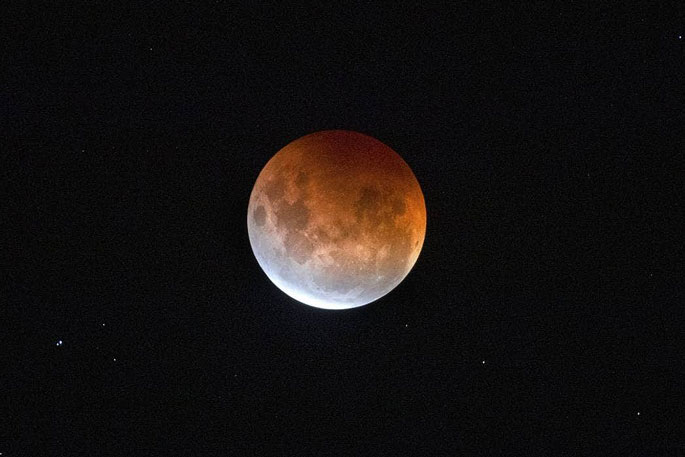
A total lunar eclipse is set to turn the Moon red on Tuesday night for the last time until 2025.
Total lunar eclipses occur when the Moon, Earth and Sun line up during a full moon.
The Earth blocks any sunlight from reaching the Moon, and instead light is bent through the Earth's atmosphere, casting a reddish hue over the Moon.
A partial eclipse will begin just after 10pm, according to timeanddate.com. The full eclipse will be visible for almost an hour and a half, between 11:16pm and 12:41am.
Stargazers won't need to look very far to see the blood moon, says Josh Aoraki, an astronomer at Auckland's Stardome Observatory and Planetarium.
'The good thing about lunar eclipses is you don't need any equipment to view them, you just need to head outside. The only thing you do need is a clear sky.
'The eclipse will start just after 10pm, but the reddest peak will be just before midnight, so that's going to be the best time to view the eclipse.”
Most of the country is set to see clear skies on Tuesday night with a few exceptions, says MetService meteorologist Lewis Ferris.
'A lot of the country looks like it's going to have pretty clear skies, but it is looking cloudy over the likes of Auckland, Coromandel and Northland.”
'The South Island is looking very good, it's really just Fiordland and Stewart Island that won't get very good viewing conditions.”
If you can't see the eclipse in the sky on Tuesday night, the eclipse is being livestreamed by various sites, including Lowell Observatory in Arizona, and astronomical science and education service the Virtual Telescope Project.
The total lunar eclipse will be visible in New Zealand, Australia, northern and eastern Europe, Asia, North America, most of South America, the Pacific, Atlantic and Indian Oceans, and Antarctica.
According to timeanddate.com, another lunar eclipse isn't due to happen until March 2025.

0 comments
Leave a Comment
You must be logged in to make a comment.