


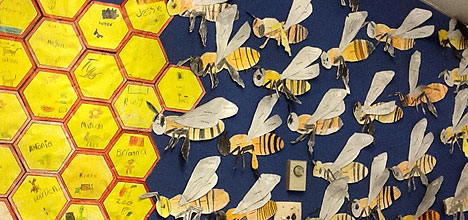
Classrooms at rural Pahoia School near Katikati were full of bees for weeks last term, but no one got stung and the only beekeeper called in was a dad who turned up in full protective gear to explain to students the art of extracting honey and caring for bees.
A wall display made by pupils at Room Five at Pahoia School to recognise Bee Week.
Teachers Karen Radley, Gemma Grinder, Corrine Devitt and Billy Edwards choose bees as the theme for a term-long study because bees were a subject of national significance and also of importance to the school's own community, with many farming and orcharding families relying on pollination.
'Bees also gave us the chance to learn that it is not just humans who live in communities but that bees have communities too and need to work together to survive,” says Gemma.
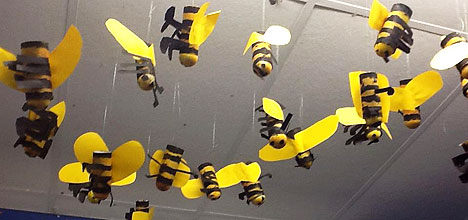
Artwork featuring bees, flowers and hives decorated the walls and ceilings of the classrooms and Karen was so proud of the children's efforts and what they had learned, she sent photos to John Hartnell, Federated Farmers Bees chairperson. In turn John congratulated the school.
'Federated Farmers Bees would like to single out the work of Room five at Pahoia School.
'Under teacher Karen Radley, these primary school children have worked hard to understand how important bees are in feeding New Zealand and the world. The children studied all aspects of a honeybee's life by building displays and even, a replica hive.
'Having seen the photographs of their work, they deserve to be proud of their efforts. Karen Radley commented to us that her students have learned a terrific amount about bees and the bee industry.
'By working with schools and by turning on the imagination of children to the world of bees, it can only be of benefit to this fascinating creature beekeepers are proud to work with,” John says.
The children, aged six to eight from four classrooms at the school, also visited Mossop's Honey to learn about honey extraction and honey based products.
The project was obviously a hit with the students who can happily recall a number of facts about bees, including the meaning of their ‘waggle dance” used to tell other bees where to find a new nectar source.
The students also understood the role of bees in pollinating much of the food they eat and how important it is to help create a bee-friendly environment with plants to provide nectar for bees and one in which sprays are used carefully to avoid harming bees.
'Without the incredible honeybee, two-thirds of the food we take for granted would almost vanish, making life as we know it impossible,” says John Hartnell
'The reality is that no bees mean no food and no people. That's no joke because bees make civilisation possible.
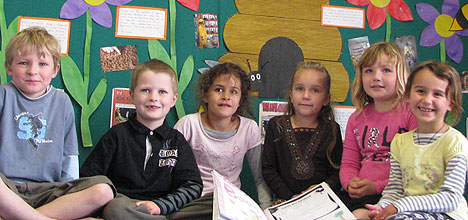
Pahoia School pupils Theo Turnwald, Conrad Hodgson, Matisse Clark, Renee Evans, Mikaela Banks and Maia Armstrong were among the students who spent a term studying the life of bees.
'If we don't look after all natural pollinators and the honeybee especially, we could see economic and social collapse. We are truly tiptoeing around the edge of a global chasm.”
John says one-third of the food all humans eat is directly pollinated by honeybees.
'Nothing comes close to matching nature's super pollinator. It is why the honeybee is most indispensable animal to modern society. When you eat your main meal tonight, just examine what's on your plate. Anything of colour, from avocados to zucchinis, are only there because of honeybee pollination.”
Another third of the food we eat from agriculture is indirectly supported by honeybees pollinating pasture and crops.
Fruit is New Zealand's sixth largest export worth over $1.6billion each year. Whether it is kiwifruit, apple, blueberry, cherry or pear, all are directly pollinated by the honeybee.
'Without the honeybee, we'd be pretty much dependent on an austere diet of fish, starch, grains and seaweed. In China, much of its pear industry relies on pollination by human hand because the overuse of agricultural chemicals has made the land hostile to the honeybee.
'That is why bees are an industry group within Federated Farmers and share policy resources with our arable sector. This recognises just how vital bees are to farming and farmers know that.”
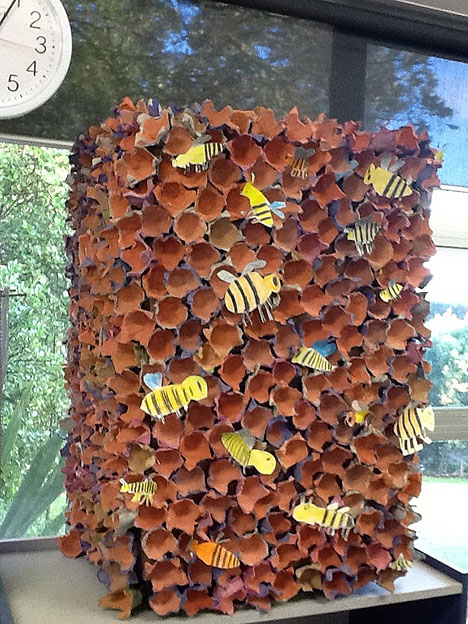
A beehive made by Pahoia School pupils.

0 comments
Leave a Comment
You must be logged in to make a comment.