


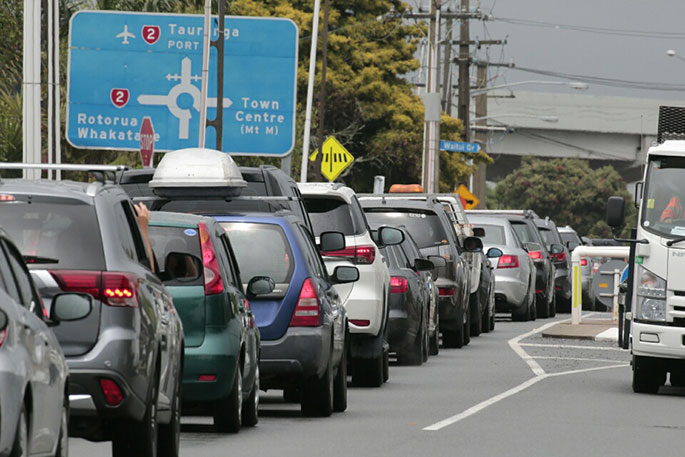
Car pollution is killing thousands of New Zealanders each year, according to new research. And it's costing the country billions of dollars.
The study is the first of its kind and measured the health impacts of nitrogen dioxide, a toxic gas that's emitted when petrol and diesel are burned.
New statistics show Invercargill is the deadliest place in New Zealand when it comes to air pollution - more dangerous than larger cities.
The study also shows that Tauranga and Rotorua are among the cities with high death rates associated with car pollution. See more here.
It shows air pollution kills about 3300 people each year - with vehicle emissions responsible for two thirds of those, nearly 10 times the road death toll.
The study shows air pollution is sending more than 13,000 people to hospital each year - and costing the country more than $15 billion.
Shock in Southland
Invercargill topped the death-rate rankings for air pollution from vehicle exhaust and domestic fires and industry combined.
It was followed by Christchurch city, then Waitaki, Timaru and Masterton districts.
Invercargill's position shocked Environment Southland chair Nicol Horrell.
He says it may need to rethink its air pollution strategy, and get more help from the government and health officials.
"It is quite stunning, quite staggering actually and we need a coalition to try and get some interventions which can actually improve that."
Dunedin city has the second highest traffic pollution death rate, behind Christchurch, and has the sixth deadliest overall rate.
Older people were among the most vulnerable to sickness from toxic gas.
Otago Grey Power president Jo Millar says Dunedin is choked with cars, leaving people choking on exhaust fumes.
"I quite frankly don't go anywhere now without a mask on and that purely and simply is because I'm quite convinced then I'm not going to pick anything up from fumes from cars, traffic, whatever it is.
"And the trucks that go backwards and forwards are incredible."
She says the city's bus network is far too slow meaning most people used their cars to get around.
"Nobody uses the buses down here, they all travel back and forth in cars."
Invercargill City recorded 219 premature deaths per 100,000 people aged 30 and over from air pollution in 2016, while Christchurch had 206 deaths per 100,000 people.
Impact on hospitalisation rates
For the first time the study was able to measure the health impacts of nitrogen dioxide, a toxic gas from petrol and diesel engines.
Scientists are startled to discover its massive impact - tripling Aotearoa's air pollution hospitalisation statistics.
Not surprisingly cities had the worst death rates from traffic exhaust.
Christchurch topped the figures, then Dunedin, Napier, Nelson and Invercargill.
Christchurch residents are almost three times more likely to die prematurely from air pollution than those living in Wellington city - which is way down the list.
Tauranga, Hastings, Hamilton, Auckland, Whanganui and Horowhenua also have high vehicle pollution death rates.
NIWA air quality scientist Dr Ian Longley says those living near busy roads are the worst affected.
"If [you] live in a quiet residential street, there is some traffic pollution around, but if you live next to a major road the level will be double.
"Particularly if you live near roads which have a lot of congested traffic or those where there are a lot of clusters of tall buildings."
Greater urgency for cleaner vehicle fleet
Associate Environment Minister Phil Twyford says the government has brought in policies like the clean car standard and discounts to electrify the vehicle fleet, and the study's findings gave that even more urgency.
But it also raises some thorny questions about how to manage other plans to cut emissions - such as moves to build up along transport corridors in cities to reduce the carbon footprints of residents.
"Access to clean air I think also has to be part of that thinking.
"And I think that will be part of the mix of things that we're looking at when we're setting good urban design standards for the new system."
Project lead Dr Gerda Kuschel says small reductions in pollution can make a big difference.
"Every little bit that you can do to improve it, like even improving concentrations by five per cent can make a massive difference to the health burden from air pollution so there is hope."
The study used data from 2016 and car ownership rates have gone up since.

7 comments
Trash!
Posted on 07-07-2022 09:18 | By The Professor
What a load of trash!!! This research was clearly carried out by environmentalists and those who are against cars/don't have cars. If it was that serious, cars would be banned!! Can you imagine these findings being applied to China, USA etc....it would lead to a ban. Complete trash!!
Paid research
Posted on 07-07-2022 10:19 | By an_alias
Wow, just really lucky the govt found some paid for study to promote there agenda. Should be a good Tui advert....
Correlation
Posted on 07-07-2022 14:54 | By Bob Landy
Another eco-study claiming correlation is causation. It is not. Life expectancy has risen in New Zealand every year for decades. It is amongst the highest in the world.
Well....
Posted on 07-07-2022 15:54 | By groutby
...this hardly warms the 'cockles of your heart' on a cold wintery day...geez...hopefully articles of positivity will come to light at some stage...I am sure all of us are trying to make a 'go' of it and do the right thing...but...when you do.....BAMM !! the activists are at it again.....
Air Pollution
Posted on 08-07-2022 07:24 | By Thats Nice
"air pollution kills about 3300 people each year" I've never heard of people dying from air pollution in this country. For over ten years the Rotorua community has been swapping their old, smoky fires for cleaner technology. The air is now cleaner and safer and yet 28 people have died from domestic fires??? How is this data collected and analyzed to show these figures?
Not surprising.
Posted on 08-07-2022 13:52 | By peanuts9
The results do not surprise me. The pollution, in Tauranga, is very visible to the naked eye and the smell is obvious.
Nothing More
Posted on 08-07-2022 16:19 | By Yadick
Than a scare-mongering to push sales of EV's.
Leave a Comment
You must be logged in to make a comment.