


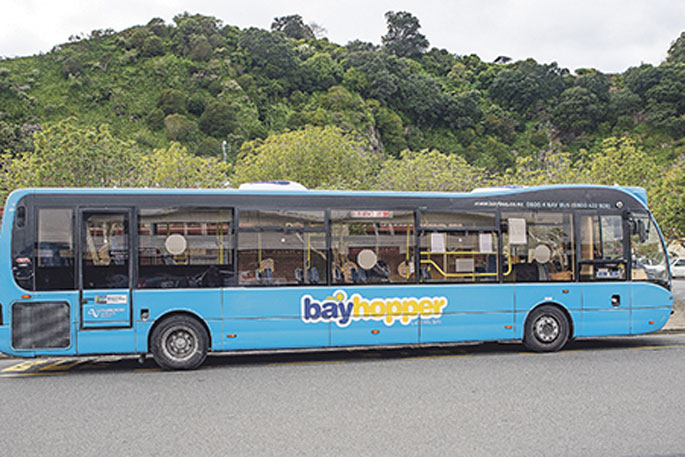
While bus passengers will enjoy half-price bus fares on Bay of Plenty Regional Council buses over the next three months, a push by some regional councillors to make them free has been found not feasible.
At a full council meeting last Thursday, transport and urban planning manager James Llewellyn presented a report and recommendations that the council not investigate any further providing a free bus service.
The matter had been put forward by councillors Lyall Thurston and Norm Bruning at a meeting of the Bay of Plenty Public Transport Committee on March 14.
The councillors suggested taking advantage of central Government's funding of half-price fares to test whether making them free would improve patronage of the underused bus network.
Llewellyn gave several reasons for not implementing the free fares.
These included there not being enough time to implement the ticket machine charges, the inability to collect data from B Cards if people were allowed on for free, the amount of staff time required to implement the changes and pressure on some peak services.
What scuppered the idea, however, was concern expressed from Waka Kotahi about the council giving away fare revenue.
The transport agency had indicated to council staff that they potentially would not receive funding for the half price fares unless they were receiving fare revenue.
'We need to collect revenue to receive the Waka Kotahi funding,” he said.
Llewellyn also raised the potential of anti-social behaviour on the buses as occurred when free fares were offered during the Covid-19 outbreak in 2020.
'People were getting on them just to get warm and travelling without any particular purpose. If people don't have to pay for a service, they don't value it.”
Mr Llewellyn also showed the findings of a paper the regional council commissioned from consultants MR Cagney in 2018 that showed free fares were not an effective means of increasing patronage on public transport.
The paper referenced experiments conducted in European cities, including Estonia and Amsterdam.
The studies showed that providing a service that was more frequent, quicker, and convenient for passengers were more effective 'mode shift initiatives”.
'A holistic approach is needed to achieve a mode shift rather than pulling one lever on its own.”
-Local Democracy Reporting is Public Interest Journalism funded through NZ On Air

1 comment
SORRY
Posted on 08-04-2022 22:39 | By The Caveman
BUT NOTHING IS FREE !!!! Somebody has/is paying for a FREE service. And why should RATEPAYERS who NEVER use the buses pay for FREE buses??
Leave a Comment
You must be logged in to make a comment.