


Ministry of Education Statistics released this week reveal more young people are staying in school rather than being excluded for misbehaviour or anti-social antics.
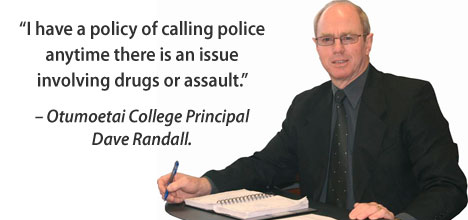
Otumoetai School Principal Dave Rendell says a lot of the reduction can be attributed to a school's internal policy of handling delinquents and disturbing conduct.
'I have a policy of calling police anytime there is an issue involving drugs or assault,” says Dave.
'We don't want to stand any student down, but sometimes you have to if teachers or fellow students feel threatened, intimidated or in danger at all.
'We have a variety of resources we can use, and sometimes call in CYPs, but CYPs are often frustrated by these children too. We know if we stand down a 14-year-old he is just going to hang around the school making a nuisance of himself.”
Dave says the school tries to enforce restorative justice as much as possible.
'We had one boy doing work around the school over the holidays as. Under the Education Act, every child under the age of 16-years old has an absolute right to an education. If you have a student with behavioural problems you can only do so much.
'We have three alternative education providers in Tauranga and we work with them to keep kids in school. No one want's to see youths loitering around the street causing problems.”
Otumoetai College has 2000 students and has only excluded one child this year through lack of alternative options.
Mount Maunganui Intermediate School Principal Lisa Morrisay says each child is an individual and every act of disobedience requiring intervention must be judged on its own merit.
'It is quite a complex process to exclude a child from school. We are a values based school and go to great rouble to teach our students appropriate behaviour. But adolescents will do some really dumb things.
'When a disruptive child threatens the wellbeing of students or teachers then action has to be taken. Before you can stand down a child there is quite strict criteria to follow. There are a sequence of events you must follow before standing down a child.
'The principal makes a decision whether or not to stand down or suspend a child. You have to ask yourself whether the child's behaviour constitutes gross misconduct or does the objectionable behaviour risk serious harm to themselves or others.
Lisa says if the matter is serious enough to consider standing the student down or suspending them, the principal presents the facts to the School Board who are the only people who can make a final decision.
'It is always an option of last resort and we work with number agencies to keep kids in school. A lot of disciplinary action is restorative and we have had some great results involving whanau to turn kids around.”
Mount Maunganui Intermediate has a roll of 380 students and has not had to exclude any student recently.
Although national statistics report fewer student exclusions, it would be dangerous to compare school by school as there are too many variables between colleges.
Figures released by the Ministry of Education on the numbers of learners who were stood down, suspended, excluded and expelled from New Zealand state and state-integrated schools during 2011 show exclusion rates are down.
The figures show stand-down rates have fallen for the fifth consecutive year, and rates for stand-downs, suspensions and exclusions are now at their lowest in 12 years of recorded data.
Group manager Leo Trompetter says any decision to stand-down, suspend, exclude or expel learners is made by school boards, and must be reported to the ministry.
'Stand-downs may be ordered for up to five days, and can offer a positive opportunity to reduce tensions and reflect on behaviour.”
He says when matters are not resolved, schools may opt to suspend a learner, with potential to escalate to exclusion (learners aged under 16) or expulsion (learners aged 16 or over).
'In the longer term though, it is widely recognised that punitive and exclusionary approaches to discipline do not bring about sustainable changes in behaviour. We know that pro-active partnerships with parents and keeping the focus on both achievement and behaviour are key,” says Leo.
The Ministry of Education's $60 million Positive Behaviour for Learning Plan, published in 2009, supports schools and parents in managing challenging behaviour.
It includes parenting skills training for 15,000 parents, focused positive behaviour training for 7240 early childhood and primary school teachers, the implementation of a school-wide approach to behaviour in 400 schools, a nationwide behaviour crisis response service, and a targeted intensive behaviour service for up to 100 of the most challenging learners.

1 comment
PARENTING SKILLS
Posted on 21-07-2012 17:00 | By PLONKER
This is not the job of schools, train the parents to be better parents and set some boundaries.
Leave a Comment
You must be logged in to make a comment.