


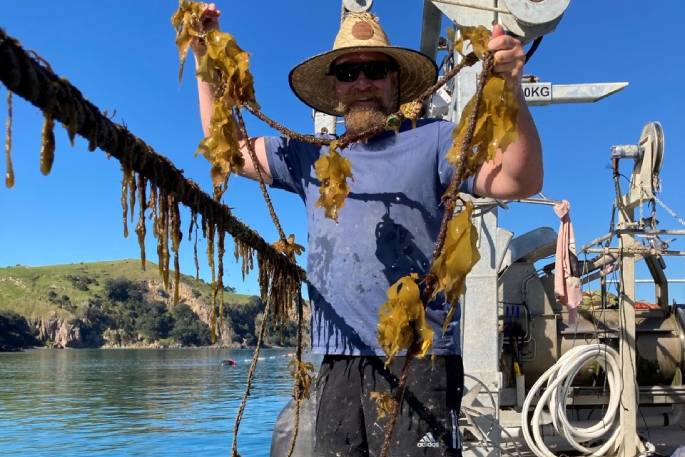
A $5 million commercial regenerative seaweed farming pilot is set to get underway in the Bay of Plenty and Hauraki Golf.
The scheme is backed by the Government and could mark the beginning of a new industry for New Zealand.
'Through our Sustainable Food and Fibre Futures fund we're investing nearly $2 million in a pilot programme that aims to help seaweed farmers throughout New Zealand to establish their own farms, using a regenerative ocean farming model,” says the Ministry for Primary Industries' director of investment programme Steve Penno.
'The model was developed by GreenWave in the United States, and the pilot will take place in the Hauraki Gulf and Bay of Plenty.
'It will include hatchery production, on-water farming, seaweed processing, and training programmes for seaweed farmers.”
Auckland Council is also investing $1.2 million in the three-year project, with EnviroStrat and additional investors making up the balance.
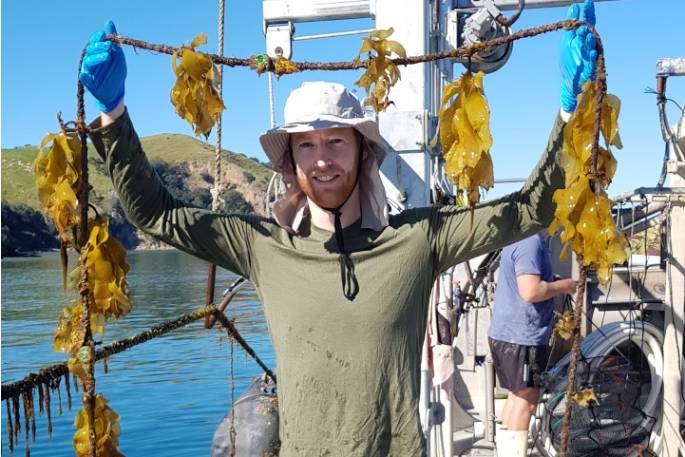
University of Waikato technical officer Peter Randrup holding up farmed Ecklonia for inspection. Photo credit: University of Waikato.
The project has been supported by grants from Ākina, BayTrust, Foundation North, Ports of Auckland and The Tindall Foundation during its establishment phase.
The University of Waikato will lead the research and trial designs, and Premium Seas Limited and AgriSea will contribute their production, market and processing expertise.
'There's limited research and development available for ocean-grown seaweed in Aotearoa currently, which is a significant barrier to establishing a seaweed sector,” says executive chair of GreenWave NZ Mawae Morton.
'This project will provide the proof-of-concept for farming New Zealand seaweed at a commercial scale. Positive findings will provide confidence to new entrants and co-investors, reducing the risk associated with the creation of a new sector.
'The intellectual property developed through the project will be accessible to the sector.”
The project is developing hatchery facilities able to produce enough seaweed to support commercialisation. It will develop on-water farm infrastructure and growing techniques, and test production to prove the commercial viability of seaweed farming.
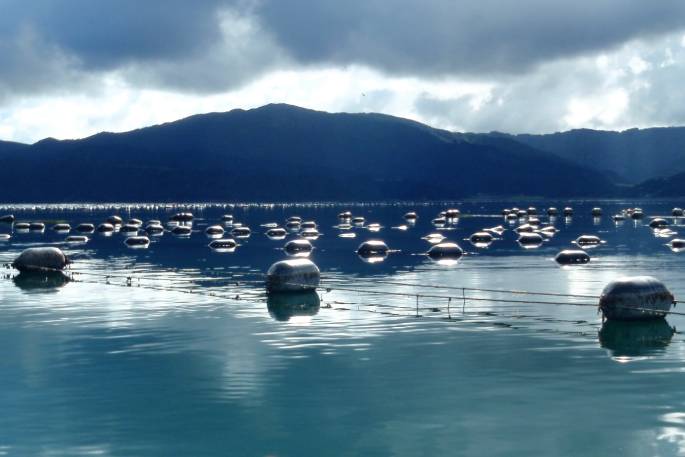
Mussel lines Photo credit: Envirostrat
'Markets exist for locally produced seaweed-based products, and there is potential to develop future markets for blue carbon and nutrient credits,” says Steve.
'This project will measure the potential environmental benefits, which include increasing marine biodiversity, improving water quality through the uptake of nitrogen and phosphorous, carbon sequestration, and potential erosion protection for coastlines.
'Establishing commercial seaweed farming across the country will also provide new jobs in coastal communities where employment opportunities are more limited.
'This project complements our Fit for a Better World roadmap to increase exports, lower emissions, improve the environment and employ more people in the food and fibre sector.
'It will deliver economic growth and jobs for the regions, which will also contribute to the Government's goal of sustainably growing the value of the aquaculture industry four-fold to $3 billion by 2035, and help to boost our economic recovery from the Covid-19 pandemic.”

1 comment
Great idea ?
Posted on 10-12-2021 17:17 | By an_alias
Sounds a great idea just hope the commercial aspect is sound and its not money for nothing
Leave a Comment
You must be logged in to make a comment.