


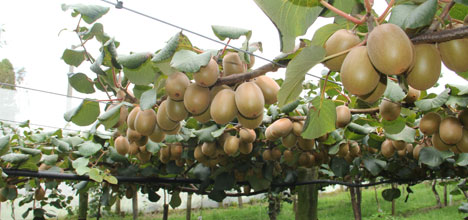
The kiwifruit industry is bracing for a massive operation which could see hundreds of hectares of new varieties grafted in orchards this winter.
With the first round of tenders to graft to the new varieties closing on Wednesday afternoon Zespri is today preparing thousands of bundles of bud wood ready for release to growers.
Zespri's general manager for global supply Simon Limmer says up to 1500ha could be grafted, making it the largest transition to new varieties ever undertaken by the New Zealand industry.
'Then it will be over to growers and grafters to graft the bud wood, followed by the technology transfer teams who will help growers with the management of the vines over the next six months.”
Up for tender are the new gold variety called G3, which has so far shown more resistance to Psa-V than Hort16A, and a green variety called G14.
Growers have been warned to consider the risks of grafting very carefully, says Simon.
'Psa is the driver here. We would not be doing this on such a scale if Hort16 (gold kiwifruit) was not so fundamentally flawed when exposed to the disease.
'In the past the release of new varieties has been staged and more conservative and we are well aware this move is not without risks. When it comes to Psa we only know what we know today.”
The bacterial disease Psa-V has devastated Hort 16A gold orchards, hitting Te Puke growers particularly hard.
'Between 500 and 600 ha of Hort16A vines have already been removed and we could see the same numbers again as growers conclude this is their last season so we expect there could be 1200 to 1500ha eventually.”
Supply of bud wood won't be a problem as Zespri has enough for 2000ha.
'It would not be possible to carry out such a large operation if this was not a united industry.”
While the best window of opportunity for grafting is July, not all growers will have to decide to take up new varieties this winter.
'There is another opportunity in spring, while not as good as winter when the vines are dormant. However, spring is the time when Psa will show us what it will do and some growers may want to wait until them.”
The tenders, which closed on Wednesday, are fixed bid and commercial tenders. However, transitional licences for those who already hold Hort16A licences will remain open over time, giving growers the opportunity to make decision when they are ready.
The transitional price per hectare for G3 has been set at $8000 and growers don't have to pay it all up front. G3 is a high yielding variety which should see growers have reasonable volumes to harvest in two seasons but G14 takes a little longer reach production.
'We know that the worst hit growers (by Psa) are now strapped for cash flow as either this is their last season of a Hort16A crop or they have no crop this year.”
The rationale behind offering growers time to pay is not only about assisting them in hard times, but also hopefully retaining their knowledge and skill within the industry.
'The fastest pathway to recovery for the industry is retaining the best and most experienced growers and many of them are in Te Puke.”

2 comments
HORT RORT INFLICTED
Posted on 01-06-2012 03:26 | By YOGI
The growers paid for Hort16A now that disaster has come a full circle they are now asked to front with more coin for the next "super-duper" strain, what guarantees are there for this next round?
Sounds like revival
Posted on 08-06-2012 16:59 | By blokebear
Well done to all the NZ scientists and the combined effort to bring this about... leading the world as usual in coming up with the solutions to save NZ's own industry not to mention the wealth generated for the district once we are past this brief moment in upheaval... Anyone who truely understands the whole situation and industry would be proud not to mention discusted in T&G for trying to derail what is the bays and take all the profits overseas instead giving it back to the orchards!
Leave a Comment
You must be logged in to make a comment.