


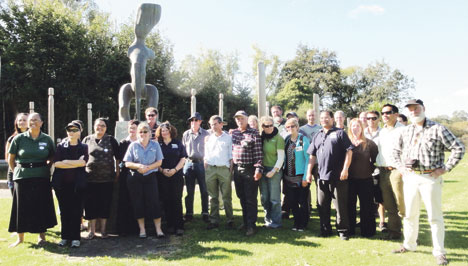
Many people don't realise just how much volunteer Landcare groups contribute to ‘greening' and protecting the environment in this country.
A recent networking day, held at Te Ohaaki Marae near Huntly, allowed some of the movers and shakers from these groups to get together to share progress and learn new stuff.
A lot of knowledge and experience in this group!
With the new funding and arrangements for co-management of the Waikato River, holding such an event on a riverside marae gave real impact to the day, with a formal welcome and generous hospitality by marae members.
The talkfest began with a presentation by Dawn Metcalfe, one of the founding members of Waikato RiverCare. This group began life in 1999, and were incorporated in 2001. Since then huge efforts have gone into selecting sites along the 240km of riverbanks which stretch from north of Hamilton to the Waikato River mouth. Consultation with locals on what they want, and preparation of detailed project plans are first steps. Later in the day the group travelled to Huntly College, where selective clearing and planting of 1.5km of riverbank was the group's first big project 10 years ago.
That project taught them many lessons, including careful research of what might have grown there originally, and a need to eco-source native plants to get the best results. Not to mention how to be sure your volunteers will turn up on the planting day, whatever the weather!
Waikato Regional Councillor Stu Kneebone, gave a background on the complexities of making a regional plan change, particularly in relation to water use and regulation. The success of this long running project is yet to be seen, but progress has recently been made with the publication of the ‘final' version of Variation 6.
Norman Hill, who was wearing three hats on the day - head of the marae, Chair of Waikato RiverCare and biodiversity ranger for DoC - gave an enlightening picture of Maori views on what the river means in terms of a cultural perspective of environmental management (Kaitiakitanga). In the past it represented food, recreation, transport, communication as a minimum, and there is a keen desire to retrieve some of these factors.
Bruno David, a scientist at WRC, presented a lively session on the problems and some possible solutions to the koi carp infestations on the lakes, streams and the river itself. Push traps may manage to catch huge tonns of fish, but what do you do with them then? The discovery of a local firm running a thermophilic bacterial digester, housed in shipping containers, may just hold the answer. What is produced looks like coffee grains, and some quiet research has been done on adding it to potting mix in different percentages to help grow native seedlings, because the grains are high in phosphorus and not suitable for pasture spreading.
He also talked about the difficulties native fish, such as the giant kokupu, have in moving upstream to spawn when man inserts blockages such as perched culverts along the way. While these fish can, with difficulty, climb falling water, their route is much eased by the installation of ropes (such as used mussel spat ropes) laid in the culverts and down the fall.
The morning session closed with a number of local representatives of involved groups updating on their findings and progress with their projects. It demonstrated just how much learning can be done when such a variety of organizations get together.

0 comments
Leave a Comment
You must be logged in to make a comment.