


The `forest fairy' skipping along the narrow bush path stopped beside a slender tree.
'That's a pittosporum turneri and it's very rare,” said Jemma Shaw with authority few six-year-olds could match. A little further on she pointed out white coral lichen and then ran off to catch up with the family dog Tui. Later, back at the cottage home she shares with parents Peter and Julie, Jemma coloured in a princess picture and played with Barbie dolls, a counterpoint to the environment she was born into and one few modern youngsters experience.
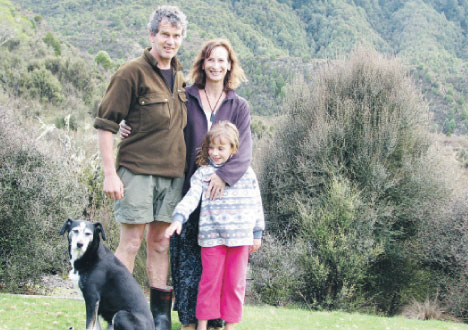
Julie, Pete and Jemma with dog Tui love their isolated lifestyle at Pohokura.
Jemma, Julie and Peter live on the remote 11,348ha property called Pohokura on the Central Plateau north of the Napier-Taupo Highway.
Owned by Auckland businessman Simon Hall, executive chairman of Tasti Products Ltd, Pohokura is predominately covered in red beech forest and managed as a private conservation block under the Forest Lifeforce Restoration Trust (FLRT) of which Simon is chairman. Peter, also a trustee, is manager of the trust and of Simon's forest properties.
It's nine years since Peter left a senior position with the Department of Conservation and he and Julie moved to Pohokura – about one and a half hours drive from Taupo along a maze of forestry and private roads.
For Pete it is a dream job and he's full of admiration for the investment and commitment Simon has made into four properties, three in the North Island and one north of Milford Sound, all with the intention of the restoration of threatened native fauna and flora.
'Since 1999, Simon has established, at his own expense, good backcountry infrastructure which is necessary for the project work and recreation at Pohokura.”
This includes 120 kilometres of walking tracks, eight huts and other accommodation, vehicles, equipment and communications.
Jemma has grown up at Pohokura, in a wild environment close to the way New Zealand used to be and she loves it.
'I love everything about living here. The walks in the bush, swimming in the river in summer – just everything. Do you know you can eat this plant if you get lost and hungry?” she said as she guided us along the tack known as the Nature Trail.
Julie and Pete have fostered Jemma's love and understanding of the environment at every opportunity and her first five years were spent immersed in the outdoors. Now she and Julie spend four days a week at Ohope with Pete's father so Jemma can go to school in Whakatane, but she's always happy to return home on Thursday nights, despite the long drive.
Fortunately for Pete, Julie also loves the isolated lifestyle and the wildlife and worked alongside Pete in track construction and other tasks.
Pete has little desire to leave the land he administers. The young man who grew up in Whakatane and wanted to become a deer culler had his plans thwarted by a knee injury when out hunting.
'I couldn't go deer culling so I went to uni as a second choice.”
Pete later joined the Department of Conservation where his knowledge of the bush, developed from teenage years spent hunting deer and trapping possums in the Te Urewera National Park, and his academic abilities, were quickly recognised.
However, the opportunity to manage a privately owned conservation estate, and Simon Hall's commitment to realising Pohokura's ecological potential, were too good an opportunity to miss, so Pete and Julie moved onto the property and into a newly built cottage late in 2002.
In 2005 Simon bought the 6120ha property called Maungataniwha some seven kilometres east of Pohokura and Pete took over its management too.
Maungataniwha is bordered to the north by Te Urewera National Park and the west by the Whirinaki Conservation Forest. The area has three main types of forest, kanuka/kamahi, tawa/podocarp and red beech with emergent rimu.
It is of national importance geologically as the site where palaeontologist Joan Wiffen first discovered evidence of land-based dinosaur fossils in New Zealand.
'Before Joan made that discovery, it was thought New Zealand didn't have any land dinosaurs and her find caused quite a stir among scientists.”
Pete has also found a section of rock containing large vertebrae, believed to be from a plesiosaur, in the Mangahouanga Stream.
A keen hunter since teenage days, Pete now admits to getting just as much thrill from finding a rare plant as having a deer in his sights. Among those plants he's enthusiastic about are Pittosporum turneri, kakabeak (Clianthus maximus), mistletoe (peraxilla tetrapetala) and the native wood parasite commonly known as the wood rose (dactylanthus taylorii).
It was Pete's botanist brother Willie (of Wildland Consultants) who first discovered a kakabeak plant in 1983; at the time the only confirmed record of the plant, believed to number around 100 in the wild, in the Waiau catchment of Te Urewera National Park.
Subsequently in 2008 Willie and Pete found three other plants and the FLRT approved the establishment of a kakabeak restoration project, using plants located in the Te Urewera National Park as a source of seeds and cutting. Pete now oversees a nursery set up to propagate the plants as a seed source to re-populate the wild.
Pittosporum turneri has tiny flowers and non-descript foliage, but Pete (and Jemma and Julie) have become experts at finding plants which are ranked by DOC as ‘nationally critical'. This is the most threatened ranking and Pete says the plant is at serious risk of extinction, largely due to predation by possum.
'Possums feed on and kill the adult form of the plant, supressing the emergence of the adult foliage and only adult foliage can produce flowers and seed. Since on-going periodic aerial 1080 poisoning of possums began in 2005, we have seen the emergence of the adult foliage and seed.”
Pohokura and Maungataniwha are also home to many endangered birds, including little black shag, fernbird, yellow crowned kakariki, long tailed cuckoo, kereru, bush flacon, grey duck, North Island kaka, and whio (Blue duck). Native bats and gecko are also to be found.
In 2005 trust members discovered a remnant population of kiwi at Maungataniwha, a find which was unexpected because the area had no history of pest control and more than 95 per cent of wild kiwi chicks die mainly because of predation by stoats.
Pete consulted Dr John McLennan, an expert in kiwi, and the result was the establishment of the Maungataniwha Kiwi Project. In March international fashion model and actress Rachel Hunter took part in the return to the wild of the 100th kiwi chick to be hatched and released by the project.
This is the sixth season the trust has worked alongside BNZ Operation Nest Egg and Kiwi Encounter in Rotorua to take kiwi eggs from the wild, incubate them and release the birds once they are big enough to defend themselves.
Fifty of the trust's 100 kiwi chicks have been released back into the Maungataniwha Native Forest, where the eggs came from, and 50 have been relocated to the Cape Kidnappers and Ocean Beach Preserve. Another 30 are due for release at Maungataniwha from this season's eggs.
Pete's role as manager for FLRT is varied, from cutting and maintaining walking tracks, to identifying and protecting endangered flora and fauna, pest control, writing funding applications and annual reports, and working with scientists, to helping Simon host guests to his unique properties.
It's a life he loves, despite the long cold winters, and never leaving home without a chainsaw in the ute to cut trees off the forestry roads just to get to town.

0 comments
Leave a Comment
You must be logged in to make a comment.