


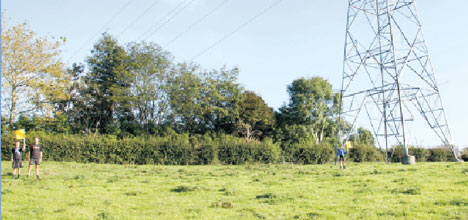
Tony Parkes has tolerated the impacts on his business and property values of three power pylons on his Ohauiti farm but now Transpower wants legal restrictions placed on what he can do around the lines, he's had enough.
'What they are asking amounts to land theft,” says Tony.
Twins Kyle and Regan Parkes (13) and their father Tony illustrate how much land a proposed buffer zone beneath a power pylon on their Ohauiti farm may be affected by proposed new district council rules. Regan is standing at the 12 metre mark and Tony at 32 metres.
'I understand we have to have power and that these lines serve Tauranga City but what is proposed would affect how I can work and develop the farm,” says Tony, who could potentially lose control of up to six hectares of his 40 hectare dry stock farm.
That's because Transpower has asked the Western Bay of Plenty District Council to include transmission line buffer zones in its District Plan which could see restrictions placed on buildings, trees and any development in an area of between 24 metres to 32 metres either side of the pylons and the lines they carry.
Western Bay is the first council in the country to consider Transpower's request to protect the transmission corridor under the Resource Management Act and Steve Bailey of Bay of Plenty Federated Farmers says this is a test case landowners throughout the country are watching with interest.
'From Federated Farmers' point of view, buffer zones should not be part of the district plan and Transpower should negotiate with land owners individually.”
Steve says nationally at least 48,000 hectares of privately owned land could be affected if a precedent is set by the proposed changes to Western Bay council's plans.
'If council incorporates buffer zones into its District Plan it will amount to a significant land grab and seriously affect what owners can do on their land, as well as the value of their properties,” says Steve.
The three pylons on Tony's farm were installed around 40 years ago and while his parents May and Norm received some compensation for their construction, Tony says that in no way made up for the issues the transmission lines have caused in the decades since.
'My parents weren't happy about them going over their land but they had no choice. The construction process left our farm tracks in a mess and all of the pylons are in hay paddocks which affects how we can mow them.”
While Tony receives notice when staff go on to the property to maintain or upgrade the pylons and lines, exactly when they will arrive is never clear.
'They are good about closing gates but sometimes come in very wet weather – I've even had to pull one of their vehicles out by tractor after it got away on them.”
However, that's a minor inconvenience compared with what might happen if Plan Change 5 is adopted into the District Plan. That could mean restrictions would be imposed on how the land affected by the buffer zones would be used and there would be new rules for earthworks, buildings and subdivisions.
Tony says the pylons have already affected a subdivision he made on part of the farm, which enjoys extensive views of Tauranga.
'Two of the pylons are right in the view which put some people off buying the land. This farm is so close to the city its long term future is probably urban but if Transpower has its way it could be difficult to subdivide.”
Steve believes if buffer zones become law it will open the way for other energy providers to seek similar protection without compensating land owners.
'People tend to think farmers have plenty of land so why should it be a problem but just like someone in the city, every meter of land is important to those who have bought and paid for it. It is wrong if anyone, especially a large company, is able to profit from the free use of someone else's land.”
The width of the buffer zones originally proposed could mean owners of smaller lifestyle blocks or orchards through which the lines pass may have restrictions imposed over their entire property.

0 comments
Leave a Comment
You must be logged in to make a comment.