


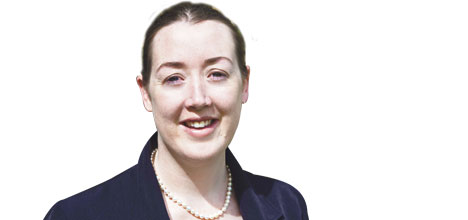
One woman is stepping in to the bull ring – working in an industry that is still male top-heavy.
Erica van Reenen is the new Beef and Lamb NZ extension manager for the Mid Northern North Island.
Her role entails arranging activities and events, projects and programmes tailored to the needs of farmers in the region.
She works with the director and the farmer-elected Farmer Council to identify needs of the region and is involved in some industry-wide projects to represent sheep and beef farmers.
'I'm your go-to girl.”
She does believe there are more women on their way to leadership roles within the agriculture fields, but she has seen there is a long way to go.
'At university, it was 50:50, and there are a lot more women coming through.”
She got a shock though when she invited a number of industry leaders to the launch of the Hamilton Young Farmers Club.
'Out of 100 industry leaders, 97 were males. I was astounded.
'It's still a male dominated industry, but I like a good challenge.”
The 27-year-old takes up the role after working for the Ministry of Agriculture and Forestry as a policy analyst.
'Policy was an interesting way to start my career. I had some advice early on that getting government experience early on and then going private is a good way to go.
'I learnt an incredible amount in my three years at MAF and got some great experience.”
After growing up in Wanaka and spending most of her school holidays on her friend's high country farm, Erica soon fell in love with farming.
The time when ‘townies' all knew someone on a farm has long gone though, along with a lot of the understanding of what agriculture does for the country.
'I have noticed there is a shift in urbanised communities – they have much less of an understanding of agriculture than when I was growing up,” says Erica.
'People always used to have someone in the family that had a farm, so all kids, even if they were townies, would have some understanding of how a farm operates.
'But that's not really the case anymore, which is a real shame I think.
'I think it's a real challenge that the industry faces, to try and educate the public on what the agriculture sector does and vice-versa for farmers to understand some of the challenges and pressures that townies face.”
Some of the other big challenges she sees facing the sheep and beef industry are working towards farming more sustainably and the changing face of farm succession.
'There has been a big shift towards more sustainable and environmentally-friendly practices on farms.
'Intensive beef is one area that might come under pressure soon.”
There are good examples of steep hill country that's been managed well, says Erica, and how farmers can make retired land profitable.
'There are opportunities out there, it's just being willing to take the first step and get robust advice.
'It's a change of thinking for a lot of farmers.”
Erica says a lot of the groups she is managing want to look at optimising land use classes.
'So I think there'll be a bit of a focus on that for this region over the next year, across the board, both in the Bay of Plenty and the Waikato and down Taumarunui way.”
Farm succession is a concern, says Erica, as more children leave the farm for jobs elsewhere and the current generation of farmers is aging with nobody to take over the reigns.
'I think succession is a really big issue – what succession looks like now compared to five, 10 years ago, is quite different.
'I think partly because farming has become much more of a business than it used to be, so a farmer has to have an understanding of the accounts and the whole situation.”
Erica says there are many kids leaving to go to university with the intention of returning to the farm, but just not coming back.
'I know a lot of people with the view that they would go back to the farm, but they haven't because other opportunities have come their way.
'With the aging population of farmers, it's certainly something that's pretty critical.
'And it's not easy for someone else (without the succession path) to get into land ownership – it's really difficult.”
One area Erica wants to harvest is to encourage farmers to ‘get the basics right'.
'It's my philosophy really – getting the basics right can make a really big impact.
'We've got all this amazing technology with EID and that sort of thing – that we need to make sure we get the most out of that information.
'Having that hard data to support what you're doing, that can be as simple as creating an excel graph to set benchmarks, that could make a huge difference to a business.”
Erica is focused on seeing the Beef and Lamb ‘Farming for Profit' (F4P) programmes for the Bay of Plenty, Taumarunui and Waitomo set up this year.
'We've got the Waikato/Franklin one set up and that's so far going really well, we've had really positive feedback about the new programme.
'So I'm keen to get the other three going and getting some good speakers and options on the table and working with those communities.”
The objective of a F4P programme is to address the issues faced by the community from a farm systems perspective.
A F4P programme will identify the critical farming issues within a farming community and develop activities to address these, and deliver through a range of mechanisms.
F4P will use on-farm field days, seminars and workshops to deliver the components identified as being of highest importance for the community.
These will always be linked to a section of the sheep and beef sector value chain and may not always be on-farm specific.
F4P will deliver knowledge transfer outcomes and monitor the progress of a community, as a whole, rather than that of an individual farm.
The Waitomo ‘Farming for Profit' programme is planning a day for March 28. Check out the March Coast & Country for more information.

0 comments
Leave a Comment
You must be logged in to make a comment.