


Comvita, a combination of comfrey and vitamins, was always about a vision of making natural products that could really help people.
Comvita's history is a New Zealand story of passion, breaking conventionalism, taking risks and dreaming big.
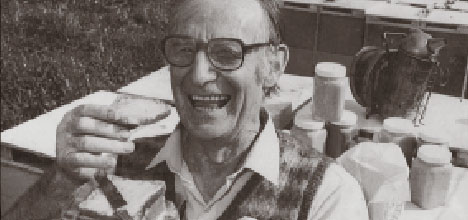
Comvita cofounder Claude Stratford with some of his early honey.
It epitomises the Kiwi entrepreneur characteristic, all starting in 1976 when a young 26-year-old Alan Bougen ventured to the Bay of Plenty to meet 66-year-old beekeeper Claude Stratford.
After spending several years abroad, Alan had returned to New Zealand with a philosophy on natural products and came across one of Claude's skin care ointments.
He visited Claude, who was managing a few hives and making honey and medicinal bee products out of his basement in Paengaroa as a ‘retirement project'. The pair sat down over a cup of Claude's favourite Godfrey tea – with a little bit of added honey of course – and talked about their shared philosophies and the vision of what Comvita could become.
The second time they met, Claude invited Alan to buy a 50 per cent share of the 'fledgling business”.
The financial risks and doubts of going into business together were all outweighed by a sense of destiny, says Alan.
'It was a crazy opportunity – he was a controversial guy with very leftfield ideas. I felt he was 40 years ahead of his time.
'Claude was a self taught ‘nature doctor'. He had ideas about health and nutrition that were really advanced and his approach was prevention rather than cure.
'It meant putting in money – and it was quite a lot of money for me and my wife at the time, 'but we both felt a sense of destiny; it seemed like the opportunity we had been looking for.”
The business partnership went ahead and the early days were spent in Claude's basement blending honey in vats and creating skin care products in the mornings, then Claude and Alan would go beekeeping in the afternoons.
'Claude Stratford is a very good beekeeper,” says Alan.
'I've never seen anyone handle bees quite like Claude.
'He has a unique and gentle management style. When he was working with bees, there was a peaceful aura around the experience.”
The pair's beekeeping skills were put to good use as their hive numbers increased to 2500 during the next few years – helped by the demand for pollination services in the growing kiwifruit industry.
Meanwhile, the pair opened a small shop and started distributing through small health stores which Alan says were run mostly by ‘hippy types'.
'They were the people that supported Comvita in the early days.
'The more conservative thought we were on some weird trip and were seen as being ‘alternative lifestylers'.
'We certainly weren't mainstream in that many of our ideas on nutrition – we definitely challenged the status quo at the time. These days we would probably seem ordinary and boring.”
Alan says from day one the Comvita brand had growth written all over it and a major milestone for the company was when Woolworths started a small ‘taste of nature' section in some of its supermarkets.
Comvita was one of the few product ranges put on the shelves. At the same time, Comvita started selling into selected pharmacies, however, international markets were always where the future lay.
'Export was on our radar right from the start,” says Alan.
'We were dreaming big dreams – always thinking outside of New Zealand.
'Claude was always slightly outrageous in his thinking. He would say things like ‘we'll be a $10 million company in Australia in five years'.
'Well I knew there was no way that was going to happen, but I didn't discourage that because I always felt it was good to dream big dreams.
'You might not be a $10 million company, but if you're a $1 million company it's still pretty damn good.”
The first ‘export' business was a few small mail orders into Japan and Australia, with the first real opportunity coming in 1989 through a New Zealand couple living in London. While visiting the Bay of Plenty they called into the shop and asked to take some products back to sell in their London based health food store.
Several months later Comvita had a letter for another order.
Alan laughs about the time spent waiting for letters back and forth and what a revolution a fax machine meant for the business.
At that time New Zealand beekeepers were mainly sending honey overseas in 44 gallon drums for a miniscule profit while all the value was added offshore.
Comvita took a risk by designing a PET poly jar; a unique looking plastic pot with square sides to package their exported product in.
The feedback from their UK distributors was that nobody was selling honey in plastic jars and it wouldn't sell – they soon had to eat humble pie because the product sold really well, says Alan.
'I spoke at the beekeepers national conference and talked about the new export business Comvita was pioneering in the UK.
'Industry colleagues at the time said it couldn't be done because the duty rates would mean an unrealistic selling price; and besides, Europeans only eat honey out of glass jars. Claude and I took great pleasure in proving them wrong by our success in the UK market during the next few years.
'By 1993 we were shipping pallets lots to the UK.”
By the early 1990s sales were in the range of $3 million and the business had reached a crossroads, says Alan.
Annual revenue growth of 25 per cent was the norm and Comvita had a constant requirement for capital, skilled people and better business structures.
'The business was evolving from a ‘cottage industry' through the ‘80s to a far more professional, commercial business in the ‘90s, albeit still quite small.”
Alan took the opportunity to buy back shares from two silent partners and took a majority shareholding position.
By that time, Comvita was producing an extensive range of natural health products and Alan decided to go back to the basics and concentrate on what they knew well – bees.
Comvita had been working with others in the industry on the development of the science around manuka honey and decided to evolve a range of products which recognised the antibacterial properties of such a unique New Zealand honey.
At the same time, the range of propolis products underwent major expansion based on a number of ideas picked up by Alan on his many overseas business trips.
Comvita continued on its strong growth path with a far smaller range of products and the company become more profitable year by year.
They were continually running out of space in the factory and warehouse and so in 1997 Alan purchased an old pub on three acres of land at Paengaroa, where the company's headquarters remains today.
He set about designing a GMP standard processing plant which opened for business at the end of 1998. This set the scene for significant growth in exports including the Australian market. Alan then set in place a robust structure for the company including a governance board and in 2002 the company floated on the NZAX.
Comvita went onto the main NZX board in 2005.
The decision to go from a private to a public company was based on the need for increased capital so the company could continue to realistically address its ever growing export opportunities.
Comvita has also made nine acquisitions in the last decade, acquiring businesses to complement and help build the brand.
It hasn't all been an easy ride, however, says Alan.
'When the global financial crisis hit, our share price went through the floor and it's been a hard road back.”
Shares went from $2.80 to an all time low of 70 cents.
Alan says the company is ready to realise its full potential.
'Comvita will almost reach its target of $100 million in sales this year.
'We are still a minnow in the global sense, but we've got a big future.”
For Claude, now 101 and Alan, 60, the hope is for the vision and the ethos of Comvita to continue – which was always around creating a business that wasn't just about making money, but about helping people and making a difference in the community.
'Comvita today has a staff of 330 people located in many parts of the world who have signed onto the mission of the company and work hard each day to see the vision realised.
'It's really humbling when I think back to our beginnings in the basement.”

0 comments
Leave a Comment
You must be logged in to make a comment.