


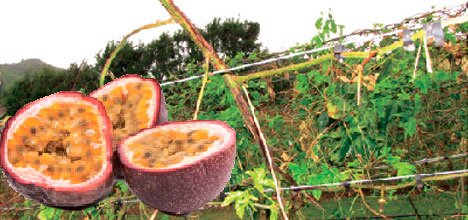
The passionfruit industry has been struggling with black leg for years, but just never made the headlines, says industry committee member David Bateman.
Now growers are steadying themselves for another hit as kiwifruit growers plant passionfruit as an alternative income and are likely going to swamp the market.
'When I first heard about Psa, I thought ‘welcome to our world',” says David.
'Nobody really cares about or worries when a passionfruit grower loses his crop – which you can understand, we are such a small industry – but it's headline news when it's kiwifruit growers – which is totally understandable as it is a major industry in the Bay.”
He has heard nurseries have sold out of passionfruit plants as kiwifruit growers look to it as an option – with some rumours of growers planting up to 14 and 17ha blocks.
'That's a very large area considering the whole industry is probably only about 20ha altogether.
'So they're all of a sudden going to double it and try and find markets out there, which are there, but at very, very low prices, which won't be economical to growers.
'The old growers that have stuck it out realise that the industry will be more likely to be stuffed for about two years. That no-one is going to make any money.
'The (passionfruit) growers are very nervous, but I can understand for the kiwifruit growers panicking and trying to put in something to try and make some quick money.
'But it's going to stuff a lot of small industries.”
David says the industry has between 40 and 50 passionfruit growers at any one time and even with those numbers they still find it hard to sell their fruit in the middle of the season.
'So these kiwifruit growers might get a bit of a shock.”
Small export market
Growers produce about 100 tonne a year, with about 40 tonne sent to the US and a small amount sent to Australia. The rest is sold to the domestic market.
'We're pretty lucky in New Zealand that Kiwis like passionfruit and they're willing to pay reasonably good prices for them,” says David.
'We're very limited in our markets overseas. We're very lucky we go into the United States. If the States allow another country in there we'll be stuffed. It will only be domestic market.
'As a whole industry, we only export about 25,000-30,000 trays to the States – so it's just a drop in the ocean.
'Yet in the middle of the season, when Florida is coming on with their passionfruit and we've got a lot going in, they actually stop it for a couple of weeks – they actually say we've had enough.”
There is a small window into Australia between the different varieties of passionfruit, 'but the Australian growers don't like us sending it there”.
'We can send fruit for about two or three weeks. It's average money. That will never be good money.” The industry has tried to set up a market in Asia; Singapore and Hong Kong, but they would only pay $5 a tray – about $2.50kg.
David says the industry also can't compete with the price that passionfruit pulp is imported at.
New Zealand imports about 300 tonnes of frozen or fresh pulp from Asia and South America for products such as yoghurts, drinks and icecreams.
'They buy it in as little as $2.50kg and you wouldn't even produce it at that cost.”
At the start of the season, early fruit can reach a peak of $34-$40 a tray, 'which everybody pins their hopes on”.
'We get about five per cent of our crop away at the early prices and then it drops sharply every week.”
Domestic prices can drop from $15kg down to $5kg in the middle of the season.
'We average, on a bad year about $7kg and on a good year up to $10kg for the whole crop,” says David.
Growers give up
'An average grower will last four or five years and then give up because it's bloody hard to grow with blackleg, frosts, fungal problems.”
David has grown up with kiwifruit and owned a kiwifruit orchard in the past. 'A lot of kiwifruit growers won't realise how labour intensive passionfruit is and how you have to be there all the time with a crop.”
He says kiwifruit growers need to be prepared to be out in the orchard more.
'You're seven days a week tied to it.
'You have to get all your fruit off the ground before 10.30-11am otherwise it gets sunburnt and your fruit's stuffed. And that's every single day.
'For the average grower the season starts late January and goes all the way to early April and then you slowly drip feed after that. So it's a long season”.
Growers have tried growing big passionfruit crops.
'There was a guy who put in about 11ha in Whangarei. The first year was great. And then all of a sudden he had major problems; staff; fungal problems coming in because getting around that 11ha isn't like a kiwifruit orchard, it's more intense; and then he had black leg. He only lasted about four years.”
No cure for black leg
David says black leg wipes out orchards.
'We have it and are living with it and thought of giving up several times as it is very demoralising, but are now experimenting with different growing techniques.
'There is no cure for black leg.
'We have gone to HortResearch and done some trails, but they can't come up with any answers.”
Growers need to be aware passionfruit plants are also very susceptible to frosts.
'I don't know how they're going to go in Te Puke; they've got their sprinkler systems – but that's adding more water, which is a problem.
'It's like Psa in that it comes out when it's wet and cold over winter and it slows down in the summer.”
The one thing going for passionfruit is its quick turnaround.
'Within 15 months you've got a small crop of it.
'Passionfruit guys have persevered with it, but a couple of growers this year – who have grown it for longer than I can remember – have just given up because of black leg.
'They keep planting every year and they keep getting black leg.
'You don't know you have it until about August and then plants, that look really healthy, all of a sudden just get this black, gooey trunk and then everything above it wilts and the whole plant dies.
'Like the psyllid, like the black leg, like the Psa, we've all got our problems, but we can understand why kiwifruit growers are planting passionfruit.
'In summary, I think Psa will be the worst thing to hit the Bay that I know of as it will affect everyone directly and indirectly and a flow on effect will be felt for years unless they come up with an answer – we do feel for the kiwifruit growers.”

0 comments
Leave a Comment
You must be logged in to make a comment.