


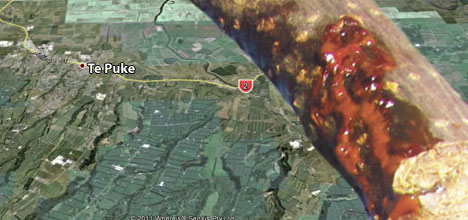
The Western Bay of Plenty's rating revaluation shows the kiwifruit disease Psa-V has knocked half the land value off Gold kiwifruit orchards in Te Puke.
The triennial revaluation of the district under the Rating Act is measured at July 1, 2011 – before the full extent of the infection was known.
Gold orchard values in Te Puke are down as much as 50 per cent from their 2008 valuations, with most of the reduction in the value of the vines and support structures. Although Psa has meant vines have had to be removed, and at the time of the revaluation there was no cure in sight, an infected orchard still has an alternative use, says the council's rating report.
The land has been valued to reflect this with the result that land values for orchards have typically dropped by 25 per cent over the district.
The capital values of Green orchards over the whole district are typically down by 35 per cent with Gold orchards in the Katikati area declining by a similar amount.
Orchard sales in the district have been scarce and inconsistent since the discovery of Psa-V on some Te Puke orchards in November 2010.
The revaluation was undertaken by the independent firm Landmass Technology Limited and audited by the Office of the Valuer-General.
All councils are legally required to do revaluations every three years under the Rating Act 1998 as part of the process to gather the best information on which to set rates.
Land values across the district are 22 per cent lower than three years ago, according to the district's revaluation.
Horticultural valuations have reduced overall by 37.8 per cent, dairy properties 35.2 per cent.
Pastoral farming values are down 32.7 per cent across the district, forestry 13.9 per cent and rural lifestyle properties 12.6 per cent.
Poultry and deer farming have also dropped, falling in value by an average of 27.8 per cent since 2008.
Urban, commercial and industrial property values have also declined, but to a lesser extent, averaging a 6.1 per cent reduction for commercial properties, 8.6 per cent for urban residential and 9.3 per cent for industrial properties.
Western Bay of Plenty District Council chief executive Glenn Snelgrove says the fall is in line with a nationwide trend he attributes mainly to the global financial crisis.
'When you reflect back to when the last valuation was done in 2008 we were at the peak of market values for property and land values – many of which were over-inflated,” says Glenn.
'Since then, no-one has been immune from the effects of the economic downturn, the drop in growth, the slowed property market, fluctuating commodity prices, a reluctance to take on more debt and the devaluing of land in all sectors.
'All these factors have maintained the downward pressure on property prices.
'In the Western Bay we are mirroring these trends, but unfortunately our rural land values are being more severely hit due to the impact of Psa on kiwifruit orchards.
'In some cases this has reduced individual property values significantly more than the average for the horticultural sector.”
The drop in property value does not automatically lead to a reduction in rates, says Glenn.
'As a general rule of thumb, if your valuation decreases more than the average you will have a reduction in rates.
'If your valuation decreases less than the average, your rates are likely to increase.”
The council calculates rates on a mix of capital value and land value, making up about 70 per cent of rates income.
Targeted rates or Uniform Annual Charges, make up about 30 per cent of rates income.
Targeted rates will not be affected by the valuation changes, but land value and capital value rates will be.
The new valuations are being sent to all ratepayers this week advising them of the reasons behind the change in values and how the new values impact on each property.
Urban ratepayers will pay slightly more due to the fact that they have had a smaller drop in values than the rural and industrial sectors.
A significant drop in the volume of property sales has resulted in different movements for the various locations in the district.
Beach front properties are the type of discretionary purchase that has been hit by the market downturn.
While good quality Waihi Beach property values have moved only slightly, in Pukehina values are down by more than 25 per cent.
In both Katikati and Te Puke, house values have typically dropped by between five per cent and 15 per cent, which is in line with urban locations nationwide.
The market for smaller lifestyle properties tends to follow the trends of the residential market as people trade in and out of each sector.
The result is a drop of about 10 per cent, with large properties down by as much as 20 per cent in some locations.
Dairy property prices were rising rapidly until mid-2008 at which point the global financial crisis combined with changing fortunes within the dairy industry, and a significant tightening in bank lending brought about a sharp decline in farm values.
Farm gate returns have improved since, but this is not being transferred into increasing values as farmers pay off debt in preference to increasing their total borrowings.
Sales volumes substantially decreased with only five dairy farm sales in the district for this revaluation, although sales outside the district were useful for comparison.
The overall result is that the 30 per cent to 40 per cent decline in farm values that occurred after the 2008 economic downturn has carried through to the 2011 revaluation.
Pastoral farm values in the Western Bay of Plenty tend to be linked to the dairy industry as demand for land used as dairy support is stronger than can be sustained by the commodity prices of lamb, beef and wool production.
The ongoing economic uncertainty, tightened bank lending and the trend to reduce debt also contributed to minimal sales and falling values; with capital value reductions typically in the range of 30 to 35 per cent.
The 38 exotic forestry blocks in the Western Bay are recognised as producing both high yields and superior quality timber as well as having good access to the port.
The past two years have seen increased confidence within this sector resulting from improved returns and the ability to trade carbon credits.
The result is that forestry values have dropped the least of all the rural sectors with an overall decrease of around 11 per cent.
A tightening in bank lending as a consequence of the global financial crisis is given as the reason for the significant drop in commercial and industrial categories across the district.
It has had an impact on the ability to invest capital in existing enterprises to improve productivity and raise funds to purchase new businesses.

1 comment
Oh Goody.
Posted on 06-12-2011 20:34 | By Zara
Iguess my rates will go down by a similar amount ??????? Or should i not hold my breath ? Maybe its only a one way street.....
Leave a Comment
You must be logged in to make a comment.