


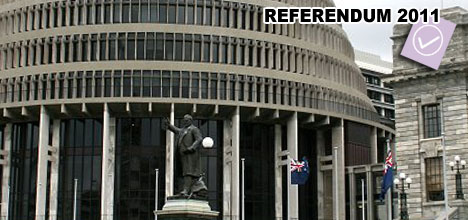
Saturday is election day, when voters have their say on who should govern New Zealand, but also being questioned is what electoral system the country should use.
The referendum being held in conjunction with the general election features two questions.
The referendum is about determining how New Zealanders vote in representatives to office at Parliament in Wellington.
The first asks if the voter wants to keep using Mixed Member Proportional (MMP) and the second asks if a new system was wanted which would be best?
There are four electoral systems presented to the voter as choices to answer the second question: First Past the Post (FPP), Preferential Voting (PV) Single Transferable Vote (STV) and Supplementary Member (SM).
Prior to 1996 New Zealand had a FPP electoral system, but in that year, the first MMP election was held.
Waikato University Political Science lecturer Alan Simpson says MMP is the most proportional of the voting systems at play in this referendum.
'In most cases you will end up with a coalition government. Most people like the thought of a coalition as it means parties are kept in check.
'FPP is the only system that is a non-proportional system. Around the world some form of proportional representation is favoured.”
The United States uses the FPP voting system and Alan says it can provide strong or weak governments.
The following are Electoral Commission definitions of each of the electoral systems.
MMP – Mixed Member Proportional
This is the system we currently use to elect our Parliament.
There are 120 Members of Parliament (MPs). There are 70 electorates, including the Maori electorates. Each elects one MP, called an Electorate MP. The other 50 MPs are elected from political party lists and are called List MPs.
Each voter gets two votes.
The first vote is for the political party the voter chooses.
This is called the party vote and largely decides the total number of seats each political party gets in Parliament.
The second vote is to choose the MP the voter wants to represent the electorate they live in. This is called the electorate vote.
The candidate who gets the most votes wins. They do not have to get more than half the votes.
Under current MMP rules, a political party that wins at least one electorate seat or five per cent of the party vote gets a share of the seats in Parliament that is about the same as its share of the party vote.
For example, if a party gets 30 per cent of the party vote it will get roughly 36 MPs in Parliament (being 30 per cent of 120 seats). So if that party wins 20 electorate seats it will have 16 List MPs in addition to its 20 Electorate MPs.
Coalitions or agreements between political parties are usually needed before Governments can be formed.
FPP – First Past the Post
There are 120 Members of Parliament. Each of the 120 electorates, including the Maori electorates, elects one MP.
Each voter has one vote to choose the MP they want to represent the electorate they live in. The candidate who gets the most votes wins. They do not have to get more than half the votes.
The winning party usually wins a share of the seats in Parliament larger than its share of all the votes across the country. Smaller parties usually receive a smaller share of seats than their share of all the votes.
A government can usually be formed without the need for coalitions or agreements between parties.
PV – Preferential Voting
There are 120 Members of Parliament. Each of the 120 electorates, including the Maori electorates, elects one MP.
Each voter ranks the candidates – 1, 2, 3, etc – in the order they prefer them.
A candidate who gets more than half of all the first preference votes (that is votes marked ‘1') wins.
If no candidate gets more than half the first preference votes, the candidate with the fewest number ‘1' votes is eliminated and their votes go to the candidates each voter ranked next.
This process is repeated until one candidate has more than half the votes.
The winning party usually wins a share of the seats in Parliament larger than its share of all the votes across the country.
It is hard for smaller parties to win seats in Parliament, but votes for smaller party candidates may influence who wins the seat because of second, third, etc preferences.
A government can usually be formed without the need for coalitions or agreements between parties.
STV – Single Transferable Vote
There are 120 Members of Parliament. Each electorate has more than one MP. This includes the Maori electorates. It is likely the 120 MPs would be divided between 24 and 30 electorates, each with 3-7 MPs.
Each voter has a single vote that is transferable. Voters either rank the individual candidates – 1, 2, 3, etc – in the order they prefer from all the candidates, or they may vote for the order of preference published in advance by the political party of their choice.
MPs are elected by receiving a minimum number of votes. This is known as the quota and is based on the number of votes in each electorate and the number of MPs to be elected.
Candidates who reach the quota from first preference votes are elected.
If there are still electorate seats to fill, a two-step process follows.
First, votes the elected candidates received beyond the quota are transferred to the candidates ranked next on those votes. Candidates who then reach the quota are elected.
Second, if there are still electorate seats to fill, the lowest polling candidate is eliminated and their votes are transferred to the candidates ranked next on those votes.
This two-step process is repeated until all the seats are filled.
The number of MPs elected from each political party usually mirrors the party's share of all the votes across the country.
Coalitions or agreements between political parties are usually needed before governments can be formed.
SM – Supplementary Member
There are 120 Members of Parliament. There are 90 electorates, including the Maori electorates. Each elects one MP, called an Electorate MP.
The other 30 seats are called supplementary seats. MPs are elected to these seats from political party lists and are likely to be called List MPs.
Each voter gets two votes.
The first vote is to choose the MP the voter wants to represent the electorate they live in.
This is called the electorate vote. The candidate who gets the most votes wins. They do not have to get more than half the votes.
The second vote is for the political party the voter chooses. This is called the party vote. The share of the 30 supplementary seats each party gets reflects its share of the party vote.
For example, if a party gets 30 per cent of the party vote, it will get about nine List MPs in Parliament (being 30 per cent of the 30 supplementary seats) no matter how many electorate seats it wins.
This makes SM different from MMP where a party's share of all 120 seats mirrors its share of the party vote.
One or other of the major parties would usually have enough seats to govern alone, but coalitions or agreements between parties may sometimes be needed.

5 comments
how many mps to change a lightbulb?
Posted on 25-11-2011 11:34 | By Openknee8ted
Compared to other countries we are over represented by MPs, yet we do not enjoy a higher level governance. To have the same ratio as other countires we should have about 60 to 65 MPs. One MP spent 3 years looking after the grandchildren.
Get rid of the chaff.
Posted on 25-11-2011 12:24 | By Investigator
Only 80 MPs max , no maori seats,and no MMP. Choice has to be STV or preferential voting otherwise you get people from lists you don't know never voted for and who are usually unelectable in their own right.
HOW MANY MATE!
Posted on 25-11-2011 13:35 | By SCOTT NUFFIN4U
25-30 is more than enough. This is no diffeent to having 10 or 200 TV channels, the good stuff just gets a bit thinner on the ground that is all, there is no improvemetn becasue there is "more" of them. In fact one could argue that the affect is "converse".
NO BRAINER
Posted on 25-11-2011 13:55 | By KAMIKAZE
MMP is a dog of a thing put it down and move on.
ELECTORAL SYSTEM
Posted on 25-11-2011 14:14 | By BUSH WACKER
How great it is ... but sadly it is not a guarantee that those voted in are of any use to anything other than self interest, just look at the recent history here where "Bob the Builder" collected all the perks but did absolutely nothing for Taurnaga.
Leave a Comment
You must be logged in to make a comment.