


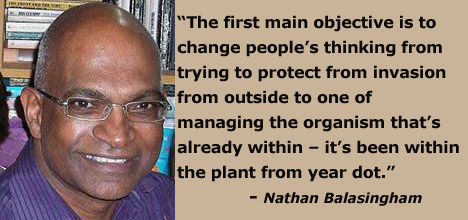
An environmental scientist is using his independence from the mainstream to give kiwifruit orchardists a different view of the Psa-V vine infection.
'I'm sticking my head right out because a lot of scientists don't speak out these days because they are dependent on funding and a lot of the funding organisations are infiltrated by scientists from the Crown Research Institute,” says Nathan Balasingham.
'If they start sticking their heads out they never get any funding, but in my case I'm not dependent on government funding at all, so I can stick my head out and I'm going to do that.”
Nathan has a Masters of Horticultural Science with first class honours in biochemistry from Massey University.
He has won food industry awards including the New Zealand Premier Food Award in 1992.
He has also won the New Zealand Institute of Agricultural Science Award for Development of Export Crop and was a finalist in the Pricewaterhouse Coopers New Zealand Hitech Awards in 2007.
Nathan's an entrepreneurial scientist with 40 years product and market development success.
He has been involved in the kiwifruit industry for decades.
In the mid 1980s Nathan was involved in research on Bacterial Bud Rot.
He researched and registered several pesticides.
He is the inventor of Kiwi Crush, the award winning kiwifruit drink, and the inventor of Agrizest.
His view of current research into ways of combating Psa-V is that the approach is inappropriate.
'The first main objective is to change people's thinking from trying to protect from invasion from outside to one of managing the organism that's already within – it's been within the plant from year dot,” says Nathan.
Psa-V is an endophyte, says Nathan.
Endophytes are bacteria or fungi that live within a plant.
They are found in all plant species and some are beneficial and others like Psa-V are pathogenic.
Nathan says control of an endophyte cannot be done in isolation.
'It's really good that it's contained within the plant because it's an organism that's in the air, on the surface, in the soil, in the roots, inside the plant – how are you going to round them up?
'Because if you did have an amazing way of rounding them up and kill 99 per cent, that one per cent, overnight they would breed into a huge colony again.
'It's not like trying to stop a disease like sclertinia or botrytis where you have got spores and the spores don't divide.
'If you kill 99 per cent and you are left with one per cent, and even 50 per cent of them germinate, you are not going to cause mass destruction.
'Bacteria is different – if you leave even one per cent behind, overnight you are back to the biggest colony you have ever known.
'By using copper and streptomycin you are getting rid of all the beneficial organisms so they have got an open door, and that's what we are doing, we are breeding superbugs.”
Nathan is speaking at a meeting in Te Puke tonight with the aim of putting the science before the orchardists.
'We have got to change the whole thinking, and I'm not going to leave them high and dry.
'I'm going to give them the tools they need to start with and they can improve the tools.”
The management approach for Psa-V is integrated pest management, says Nathan. Several tools are needed
The meeting is at the Orchard Church Te Puke from 7.30pm to 9.30pm.

2 comments
Finally!
Posted on 24-11-2011 14:21 | By sojourner
Finally, someone is making sense, a LOT of sense, and here's hoping the insane knee-jerk spraying of every killer chemical and antibiotic will stop. Then, perhaps, human beings in the area can breathe clean air again and stop worrying about the long and short term ill effects we are being bullied with.
Don't get hopes up
Posted on 24-11-2011 21:55 | By Justintime
IPM is a process, but you still need the right tools to follow the process. Easy to say it, harder to do it. I'll believe it when I see it.
Leave a Comment
You must be logged in to make a comment.