


What's very unattractive, but very valuable?
The answer is sea cucumbers – or sea slugs as they're sometimes called – and they're in huge demand by Chinese gourmets who know them as hoi sam.
The Japanese and Koreans also eat them, but they stick mostly to their home grown species, whereas the Chinese eat a variety of species and have been doing so for more than 2000 years. For much of that time they imported most of their needs from South East Asia.
Demand during the last 500 years or so was so high it caused sea cucumber populations in Asia to plummet as fishermen ventured further and further afield to satisfy the market. Today, the demand is even higher because more Chinese than ever before can afford luxuries such as hoi sam, are determined to enjoy them and will pay big money to do so. While much of their needs are met by aquaculture within China, there is a big shortfall that importers are looking to fill and New Zealand, which has sea cucumbers very similar to the Chinese species, is high on their list.
 It's not just for their culinary value, however, that the Chinese want sea cucumbers –they're not even particularly tasty, a bit like boiled mushrooms – it's their medicinal and reputed aphrodisiacal qualities that are in big demand.
Traditionally, they are used to cure many diseases including cancers, claims that are being looked at closely by western researchers. As for being an aphrodisiac – well, there are many, many stories.
In South East Asia people began farming sea cucumbers several centuries ago by collecting baby sea cucumbers from sea grass beds, stocking them into enclosures and fattening them for the market. They are easily fed; they are detritovores, which means they eat decaying material for the bacteria and other small organisms it contains. Villagers feed them on a 60:40 mix of chicken manure and rice bran.
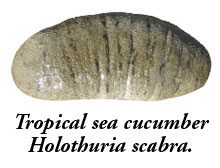
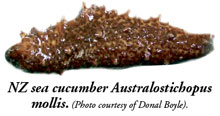
This method of cultivation relies on the collection of the babies from the wild, which is, for various reasons, not always possible. In recent years a great deal of work has been done on producing sea cucumbers for hatcheries and then either seeding them into a fishing ground or growing them in ponds. Outside China most of this work has been on the tropical species Holothuria scabra, but more recently there has also been work on cold water species such as the New Zealand's Australostichopus mollis.
Quotas
There is a small ‘exploratory fishery' for A. mollis, but each fishing quota carries specific conditions, such as they can only be taken by free-diving, which rules out deep water harvesting. Donal Boyle, director of Echinoderm Diving at Mount Maunganui, has been active in the sea cucumber fishery for several years. He says that in the 2010-11 year only two quota holders were active and between them they took only 12.9 of the allowable 35 tonne.
Although they can be sent live to China, Donal prefers to process their catch here. The process involves gutting, cooking and drying to exacting standards and produces an end product variously called beche de mer, trepang or hoi sam – depending where in the world you are.
It also reduces the sea cucumber's weight by between 90 and 95 per cent, meaning that from the 12.9 tonne caught in 2010-11, the real export quantity was only about 0.9 tonne. This is not enough to establish a reliable long-term market and even if the quotas were fully utilised, they would only produce about 2.5 tonne of dried product. With a median price of NZ $350kg it would still not be a significant fishery.
It has been more than adequately demonstrated overseas, however, that sea cucumbers of any species can not naturally sustain heavy fishing, so the only way to increase production is by hatchery technology and some form of aquaculture.
In China there are currently 2000 sea cucumber hatcheries producing more than 20 billion juveniles each year.
The feeding habits of sea cucumbers present the possibility that they could be stocked beneath mussel farms where they would feed on the mussel's waste, opening the possibility of polyculture farms – growing two or more species together. This would be hugely beneficial, not just to mussel farmers, but also the environment.
Environmentally valuable
'Environmentally they're valuable because they clean up the mussel farm's waste. Potentially they could do the same under salmon farms, but that needs to be tested because there the waste is more concentrated and the composition of the faeces is different from that of mussels,” says Dr Phil Heath from NIWA.
'And financially it's a win – at present, dried A. mollis returns between NZ $250 and $500kg to the producer, not a bad return at all for something that can potentially be fed entirely on the wastes from another farmed species and therefore cost the farmer nothing. 'A farm returning $30,000 annually from mussels could produce an estimated additional $100,000 from sea cucumbers.”
Those prices make sea cucumbers an attractive species to cultivate, however, at present hatchery technology for many species of sea cucumbers, including A. mollis, is still in the research stage.
Recently NIWA researchers, in collaboration with colleagues from China, have successfully reared A. mollis. Although there is more work to be done to commercialise the hatchery process, developing the full package is only a matter of time and funding. The returns will more than repay the research costs, but as in most research in the current climate, funding is not easy to come by.
Phil has great faith though in this ‘black gold' and predicts the day when mussels could be grown just to feed the sea cucumber crop.

0 comments
Leave a Comment
You must be logged in to make a comment.