


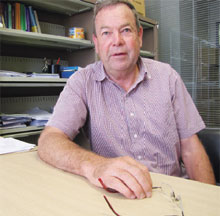
Valuer John Middleton says Psa-V has had a significant impact on the value of both Gold and Green variety kiwifruit orchards in the Bay of Plenty since it was first found in November.
'The importance of finding a solution to this disease is not only paramount to the survival of the industry and the rebuilding of the growers' asset and equity situation, but also to the local communities who rely on the industry.
'While the media is pre-occupied with the Pike River mine enquiry, the Canterbury earthquake and more lately the Rena grounding, there is a slowly developing disaster taking place on our doorstep, the severity of which doesn't seem to have registered with the media nor a majority of the public.”
John, a valuer for TelferYoung Group in Tauranga, says the 2011 Rating Valuations are due to be issued soon, which 'will no doubt have to reflect the market and therefore will be significantly different from the 2008 valuations”.
Prior to the outbreak of Psa-V, Gold (Hort 16A) orchards which were achieving an Orchard Gate Return (OGR) of about $100,000 per canopy hectare were selling for between $400,000 and $450,000 per canopy hectare.
'In fact, returns were so good that Gold orchard owners didn't want to sell,” says John, 'so there were very few sales”.
Green orchards on the other hand, generating an OGR of about $40,000 per canopy hectare, were selling for $200,000 to $250,000 per canopy hectare.
'The situation is now substantially different.
'Gold orchards now have limited saleability and those within the priority zones would probably have a value near land value of $60,000 to $80,000 per hectare.
'And outside of the priority zones, they could be $100,000 to $200,000 per canopy hectare,” although, John says, there is no recent sales evidence (of which he is aware) to support these values.
He says although the incidence of Psa-V is not so prevalent in Green orchards, their values have also been significantly affected due to a combination of the Psa-V threat and lower returns forecast for the 2011 crop.
'The most recent sales outside of the priority zones indicate prices of between $100,000 and $130,000 per canopy hectare, but if the disease becomes more widespread, these prices could drop further, and like Gold orchards, they could trend towards land value.”
After Psa-V was discovered in a Gold orchard in the Te Puke district in November 2010, Kiwifruit Vine Health Incorporated was set up to administer and manage the disease and measures were put in place in an attempt to control its spread.
These included introduction of priority zones, vine removal and pruning vines back with compensation being payable to the earlier affected orchards.
'However, regardless of the vine removal, the disease continued to spread and compensation payments were withdrawn,” says John.
The disease has now spread to Tauranga, Katikati, Waihi and Whakatane.
Research of products to stem the spread of the disease is being undertaken with urgency in New Zealand and other countries. In addition to copper sprays there are some promising products and technology which are being developed which will hopefully be released in the near future,” says John.
'The impact of Psa-V has therefore created an enormous amount of uncertainty within the industry and this in turn has had a severe impact on orchard sales and values.
'Sales of orchards are virtually at a standstill with no recorded sales in Te Puke since early 2011, one sale in Tauranga, one in Te Puna and two orchards were sold in Katikati in June 2011.”
Like any investment, risk is usually reflected in returns. High risk, high returns relative to the investment and vice versa, says John.
'Clearly investment in kiwifruit orchards is now high risk and therefore this will translate into lower values – at least until a remedy to the disease is found or a resistant variety is bred (which could be several years away).”
The key to the future of the industry is in identifying a resistant rootstock and new resistant varieties to graft on to the rootstock as soon as possible.
Banks are also concerned says John, 'the degree of which is dependent on their respective exposures to the industry”.
'No banks are lending for orchard purchase unless an alternative form of security is also provided. Growers have their income for this season from the 2011 crop proceeds or from compensation, so the full impact of the disease will not be realised until next season when some orchardists will not be able to grow a crop and thereby generate an income.”
In anticipation of the financial difficulties likely to arise next season as a result of Psa-V, a financial advocates group has been set up by NZ Kiwifruit Growers and KVH.
This group will assist those affected growers by liaising with banks and making arrangements for financial assistance so they can continue their business.
'The anticipation is that a remedy will be found before 2013 from when re-grafting can take place and orchard values should start improving.”
The uncertainty of the industry's future is also generating talk of alternative crops.
'There are a selection of fruit tree varieties which could be planted such as avocados, figs and the like, however, if a remedy to Psa-V is found within the next two years, there is no point in planting varieties that take three to five years before they crop.
'Cash flow needs to be generated quickly, which could mean grazing stock, cash cropping or planting of short term crops. I am aware of some growers who are looking at these short term measures with a view that a solution will be found.”

0 comments
Leave a Comment
You must be logged in to make a comment.